REVIEW | GIGABYTE X870E AORUS MASTER X3D ICE | CLEAN, STABLE & HEAVY
A white motherboard only works when the hardware under the color is strong enough to deserve the attention. Gigabyte X870E AORUS Master X3D Ice is not trying to disappear inside a case. It is built to be seen, especially in a clean white AM5 gaming build, but the more important part is that the specification sheet does not feel like decoration. This is an X870E board for modern Ryzen systems, with strong power delivery, PCIe 5.0 support, heavy storage options, Wi-Fi 7, rich rear connectivity and Gigabyte’s X3D-focused tuning system aimed directly at Ryzen X3D gaming CPUs. This is not the motherboard for a cheap AM5 build. It is too large in ambition, too loaded in features and too specific in visual identity for that. The X870E AORUS Master X3D Ice makes sense when the rest of the PC is already serious: a strong Ryzen 7 or Ryzen 9, preferably an X3D model, a premium GPU, fast DDR5 memory, multiple SSDs and a case where the Ice design can actually be seen. In that kind of system, the motherboard stops being only a platform and becomes part of the build’s personality.

The risk with a board like this is obvious. Premium motherboards can easily become expensive objects that look impressive but do not change enough for most users. A cheaper AM5 board can still run a Ryzen CPU, a GPU and one or two SSDs without trouble. That means the AORUS Master X3D Ice has to justify itself through the full package, not only through one marketing feature or one white heatsink. The good news is that Gigabyte has not built a weak board behind a strong look. This is a serious high-end AM5 option, even if it is not the smartest buy for every Ryzen user.
a high-end am5 board with a very clear target
Gigabyte X870E AORUS Master X3D Ice is built for AMD’s AM5 platform and modern Ryzen processors. The X870E chipset places it in the higher AM5 class, and the board’s feature list immediately makes the target clear. Gigabyte lists an 18+2+2 Twin Digital VRM design, an 8-layer PCB, AM5 Ryzen support, 8+8 pin CPU power with UD Solid Pin connectors, 4 DDR5 DIMM slots, 5 M.2 slots and 10 PWM/DC fan headers. That is not mainstream minimalism. That is a board prepared for high-end gaming and serious desktop builds. The X3D part of the name is also important. This is not just a standard AORUS Master with a white coat. Gigabyte is clearly aiming at Ryzen X3D users, especially buyers who care about gaming performance more than synthetic bragging. Ryzen X3D processors have become some of the most interesting gaming CPUs on AM5 because their 3D V-Cache can deliver excellent frame-rate behavior in many games. A motherboard built around that identity has a clean purpose: give those chips a strong platform, modern connectivity and a tuning layer that speaks directly to gamers. Tom’s Hardware describes the X870E AORUS Master X3D Ice as an upgrade over the non-X3D version, with more robust power delivery, a larger BIOS, connectivity improvements and X3D Turbo 2.0 functionality for X3D chips. That is exactly what this board needs to be. If it were only a white version of an existing product, the value would be harder to defend. But as a more focused premium board, it has a better argument. The board still has to be judged carefully. X3D branding does not automatically make a motherboard faster in every game. A motherboard is still a foundation, not a graphics card. But the foundation here is strong enough that the X3D label does not feel empty. It gives the product direction, while the actual hardware gives it weight.
the ice design looks purposeful, not just repainted
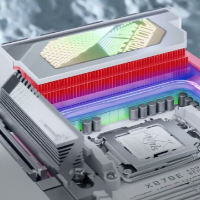
The visual design is one of the main reasons this board exists. The Ice version is clearly aimed at white PC builds, and that matters more than some people admit. A modern gaming PC is often seen through glass, photographed for articles, posted online and built around color consistency. A motherboard that does not match the rest of the system can make an expensive build look unfinished. Gigabyte gets the basic idea right here. The X870E AORUS Master X3D Ice looks clean, heavy and premium. The white and silver armor gives the board a strong visual identity, while the darker PCB areas and metallic details stop it from becoming too flat. It has the kind of look that works with white GPUs, white RAM, white AIO coolers and clean cable routing. In a black case or a mixed-color build, it may look too specific, but in a planned white setup it makes sense immediately. The design also does not feel like a thin cosmetic layer. The heatsinks and covers have presence. This matters because high-end boards need real cooling around VRM, chipset and M.2 areas. A board with multiple fast SSD slots and PCIe 5.0 support cannot rely on looks alone. The Ice styling works because it is attached to parts that already need to be there. There is still a limit. If someone does not care about appearance, a big part of this board’s appeal disappears. A cheaper dark motherboard can deliver strong performance for less money. But for users who want a white Ryzen X3D system, this board gives the build a center. It looks like the motherboard the rest of the system is supposed to follow.

power delivery and pcb quality are built for strong ryzen systems
The power section is one of the reasons the board feels serious. An 18+2+2 Twin Digital VRM design gives the X870E AORUS Master X3D Ice the kind of power delivery expected from a high-end AM5 motherboard. Most Ryzen X3D users are not going to do wild manual overclocking in the old sense, because X3D chips have their own limits and behavior, but stable power still matters. A strong VRM helps the board stay calm under long gaming sessions, heavy CPU loads, BIOS tuning and future CPU upgrades. The 8-layer PCB is also important. It is not a glamorous feature, but it matters for signal integrity, memory behavior and PCIe 5.0 reliability. Gigabyte highlights the board’s PCB design, and that is the kind of detail that fits this class. With DDR5, PCIe 5.0 GPU lanes, PCIe 5.0 SSDs, USB4 and fast networking, the board is carrying a lot of high-speed signals. Premium boards should be engineered for that instead of simply adding ports to a weaker foundation. This is also where the board’s price starts making more sense. You are not only paying for a white heatsink. You are paying for stronger power hardware, a better PCB, more cooling surface, more expansion and more long-term room. That does not mean every user needs it, but at least the money is visible in the platform. For a Ryzen 7 7800X3D, Ryzen 7 9800X3D or future AM5 X3D build, this motherboard is more than enough. The board gives the CPU a clean home, gives the GPU proper PCIe support and gives the builder enough headers and storage options to build something more serious than a basic gaming tower.
x3d turbo mode 2.0 is useful, but should be read carefully
Gigabyte’s X3D Turbo Mode 2.0 is one of the headline features. The idea is simple enough: a tuning system focused on Ryzen X3D performance, using board-level control and optimization to improve gaming and multitasking behavior. Gigabyte promotes it as a way to unlock better X3D performance through AI-assisted tuning, and reports around the feature mention claimed gaming gains that can sound very large. This is interesting, but it needs a realistic reading. Motherboard tuning can help. It can improve boost behavior, memory interaction, power behavior and how the CPU behaves under different gaming loads. For players who do not want to manually tune BIOS settings, a one-click or guided optimization feature can be useful. It makes the board feel more approachable, especially for users who buy expensive hardware but do not want to spend hours testing every setting. But no tuning mode should be treated like magic. Performance improvement will depend on the CPU, memory kit, BIOS version, cooling, game engine and baseline configuration. Some games may show a visible gain. Others may show very little. Some users may prefer to leave the CPU closer to default behavior, especially if stability and thermals matter more than chasing a few extra frames. For this review, X3D Turbo Mode 2.0 is best seen as a bonus, not the only reason to buy the board. The motherboard already has a strong platform underneath it. The tuning feature gives it a sharper identity for Ryzen X3D users, but it should not be the entire purchase argument. If the board were weak, X3D Turbo Mode would not save it. Since the board is strong, the feature becomes an extra tool rather than a desperate trick.
memory, storage and pcie 5.0 support make the board feel modern
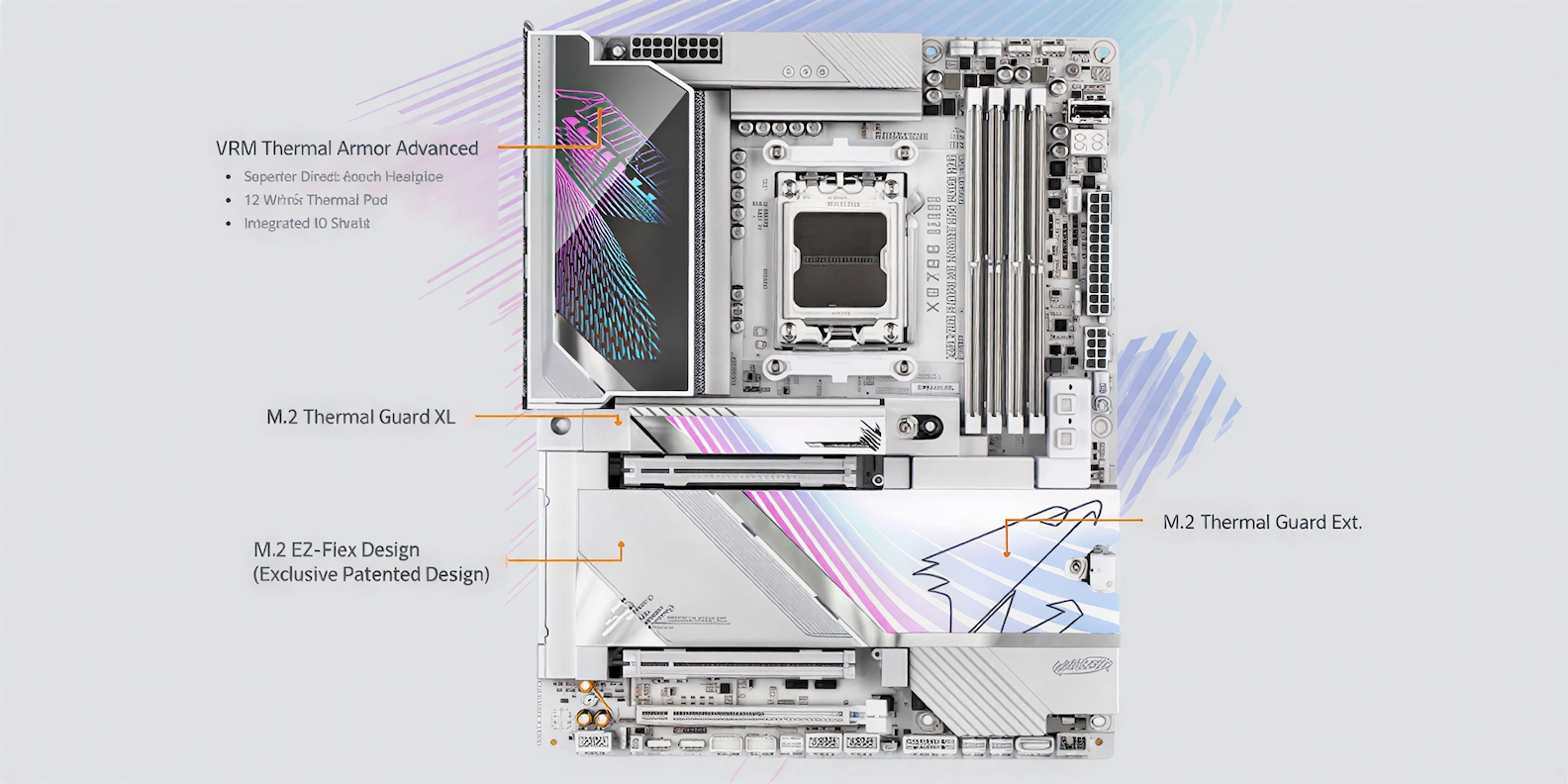
A premium AM5 board in this class has to be ready for fast storage and modern expansion. The X870E AORUS Master X3D Ice gives the user 5 M.2 slots, with 2 PCIe 5.0 M.2 slots and 3 PCIe 4.0 M.2 slots. That is a strong storage layout for a gaming and creator PC. A user can run a fast primary NVMe drive, a second high-speed drive for games or active projects, and still have extra slots for more storage later. The PCIe slot configuration also fits the high-end position. Gigabyte lists 2 full-length PCIe 5.0 x16 slots that can operate as x16 or x8/x8, plus one PCIe 4.0 x4 slot. Most gamers will only use one GPU, but the available lane configuration still shows that the board is not built as a minimal platform. It gives room for expansion cards, capture devices or other specialized hardware. Storage cooling is another part of the premium motherboard experience. Fast NVMe drives can get hot, especially PCIe 5.0 models. The board’s large covered design and heatsink structure make sense in that context. A motherboard like this should make a multi-SSD build feel clean instead of messy, and the AORUS Master line generally leans into that kind of tool-friendly, covered design. For gaming only, PCIe 5.0 storage may not change everyday life today. Many games still do not demand that kind of speed. But this board is not only about today. It is built for a system that should stay relevant through several GPU, CPU and SSD cycles. In that sense, the storage and PCIe layout are exactly what a high-end AM5 buyer should expect.
connectivity is one of the board’s strongest arguments
Connectivity is where premium motherboards often make everyday life easier. The X870E AORUS Master X3D Ice is loaded enough that a serious desk setup should not feel cramped. Gigabyte’s AORUS listing highlights AM5 Ryzen support, UD power connectors and 10 PWM/DC fan headers, which already helps for cooling-heavy systems. Other specification listings and Gigabyte pages point to the board’s modern I/O direction, including USB4, HDMI output, Wi-Fi 7 and Bluetooth support. The fan header count matters more than it looks on paper. A high-end white build may include multiple intake fans, exhaust fans, an AIO cooler, pump control and possibly extra RGB or controller hardware. Ten PWM/DC headers give the builder more flexibility and reduce the need for awkward splitter chains. That makes the build cleaner and easier to manage. Networking is another strength. Wi-Fi 7 gives the board a modern wireless identity, while strong wired networking makes sense for users with fast home networks, NAS devices or high-speed file transfers. Even if a gamer mostly uses standard Ethernet, the board’s network options make it feel less like a short-term purchase. Rear USB capacity is also important in real use. A modern PC desk can quickly fill ports with mouse, keyboard, headset, controller adapter, microphone, webcam, DAC, external SSD, phone cable, stream deck and capture gear. A premium motherboard should not force the user into immediate hub dependence. The X870E AORUS Master X3D Ice feels built for that kind of full setup.

the board is overkill for many users, and that is okay
The biggest weakness of this motherboard is not a technical disaster. It is the simple fact that many users do not need it. A cheaper AM5 board can still run a Ryzen 7 X3D CPU and a strong graphics card very well. If the budget is limited, the extra money may be better spent on the GPU, monitor, SSD or cooling. That is the honest line for this review. The X870E AORUS Master X3D Ice is not the value king. It is a premium board for a premium build. It makes sense when the user wants the white Ice design, the stronger hardware, the rich connectivity, the storage flexibility and the X3D-focused features together. If someone only wants to play games at high FPS, this board alone will not transform the experience more than a better GPU would. But that does not make the board pointless. Premium PC building has always had a layer beyond pure necessity. Better boards can offer cleaner building, stronger power delivery, easier upgrades, more ports, better storage options, nicer debug features and a more complete visual result. These things matter to the right buyer. The key is not to pretend this is a motherboard for everyone. It is not. It is for a user who already knows the build direction and wants the motherboard to match it.
who should buy it
Gigabyte X870E AORUS Master X3D Ice is best for someone building a high-end white Ryzen gaming PC around an X3D processor. It fits a system with a strong GPU, fast DDR5, multiple NVMe drives, quality cooling and a case with enough visual space to show the board properly. It also fits users who want AM5 long-term upgrade room and do not want to feel limited by storage, fan headers or rear I/O. It can also work for creator-style users who game seriously but also move files, use fast external devices, run several drives and care about network speed. The board is not gaming-only in practice. Its connectivity and storage layout make it useful for broader high-end desktop work too. The wrong buyer is someone building a tight-budget AM5 machine. If the motherboard price forces a weaker GPU or a worse monitor, the build is probably unbalanced. A board like this belongs after the core performance parts are already strong.