
REVIEW | ASSASSIN’S CREED: BLACK FLAG RESYNCED | THE SEA STILL WINS
I have never been an ultra fan of Assassin’s Creed as a series, and the reason is not that the games lack money, style or historical beauty. They usually have all of that. My problem was always somewhere else. The worlds often looked impressive from a distance, but too much of the life inside them felt decorative once the player came closer. Crowds moved, guards patrolled, side activities filled the map, but the sense of deeper consequence was not always there. NPCs often felt like part of the scenery rather than people with real weight, and the historical setting sometimes became a luxurious background for climbing, fighting and clearing icons. That does not make Assassin’s Creed bad. It just means the formula needs a stronger fantasy to fully work. Black Flag was always one of the rare entries that had that fantasy. It did not need to be the deepest Assassin’s Creed game, because it had the sea, the ship, the pirate mood and Edward Kenway’s rougher personal journey. Resynced succeeds because it understands that this was the real treasure. It modernizes the experience without pretending that Black Flag was something it never was. This is still an accessible open-world action adventure, still built around familiar Ubisoft structure, but the pirate identity is strong enough to make the old formula feel alive again.

the pirate fantasy gives the game its own blood
Edward Kenway remains one of the better leads in the series because he does not begin as a clean ideological figure. He is not immediately interesting because he understands the Assassin cause or because he carries some noble historical burden from the first scene. He works because he begins with selfish energy, hunger, pride and the simple need to survive in a violent world. That gives Black Flag Resynced a more natural dramatic shape than many entries that push the Assassin and Templar conflict too directly. Edward enters that conflict almost from the side, and the game is better because of it. His story feels like a collision between pirate ambition and a larger war he does not fully respect at first. The Caribbean setting supports that perfectly. Islands, ports, storms, taverns, plantations, ruins and open water give the campaign a constant sense of movement, and that movement matters more than pure narrative depth. This is not a world where every person feels meaningful, and it is not a simulation where every choice changes the political structure of the map. Still, the illusion of adventure is strong. The setting has rhythm, color and danger, and the remake treatment gives it enough modern polish to remind players why Black Flag stood apart in the first place.
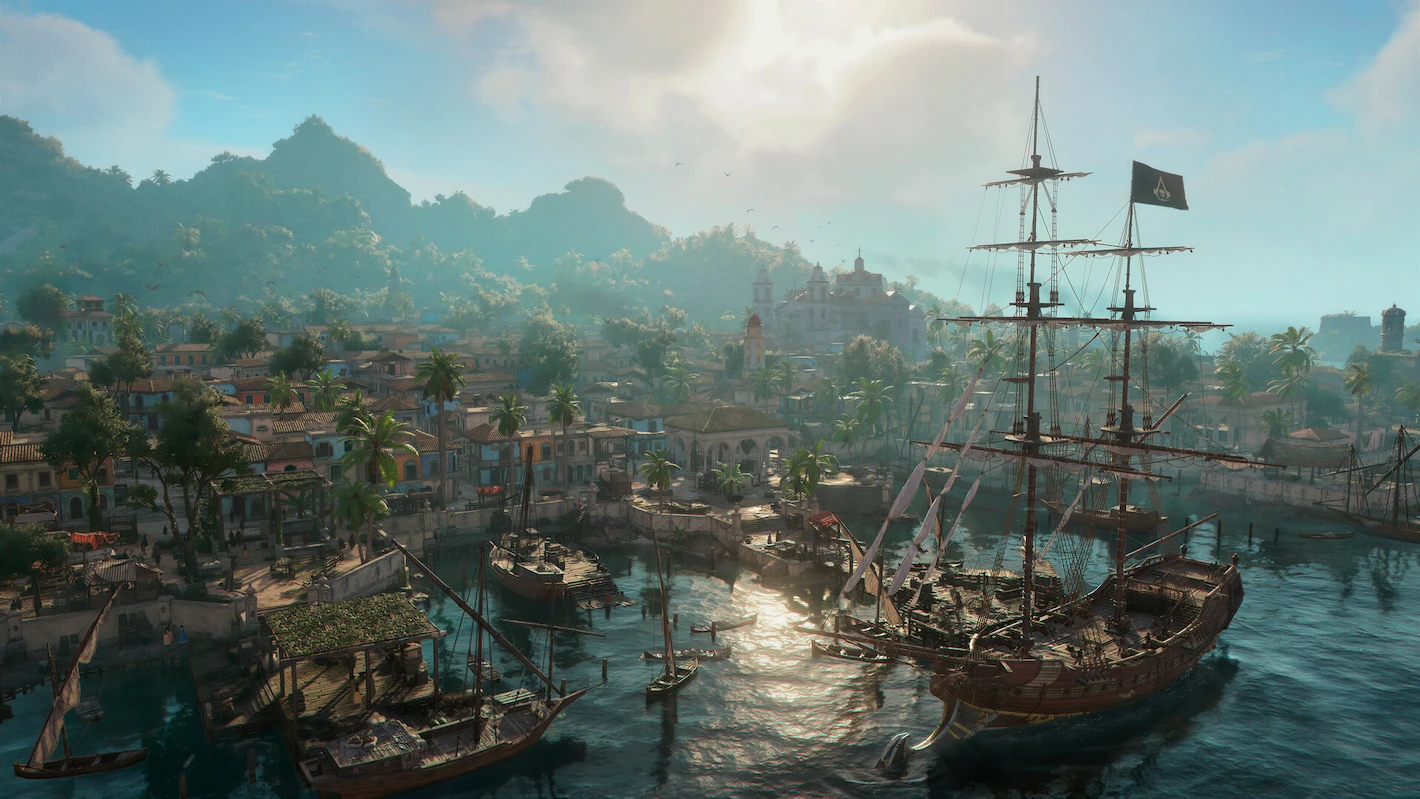
the jackdaw is still the real progression system
The Jackdaw remains the heart of the game, and that is the biggest reason Black Flag Resynced still deserves attention. In many open-world games, travel is just dead space between objectives. Here, travel is the game. Sailing is not only movement from one marker to another. It is risk, reward, atmosphere and progression tied into one clean loop. The ship begins as something that must be protected, improved and respected, then slowly becomes an extension of the player’s power. Better cannons, stronger hull upgrades, improved firepower and more confidence at sea all create a satisfying sense of growth that never feels completely separated from the world. Naval combat still has that excellent balance between spectacle and control. Cannon fire, maneuvering, boarding actions and storms give encounters a physical weight that many land fights in the series never had. Resynced benefits most when the ocean looks stronger, the weather feels more dramatic and the ship has a cleaner sense of presence on screen. The sea is not just pretty background here. It is the stage, the enemy, the road and the reward. When Black Flag Resynced is at its best, the player is not thinking about the usual Assassin’s Creed checklist. The player is watching the horizon, judging the next target and feeling that dangerous pull of open water.
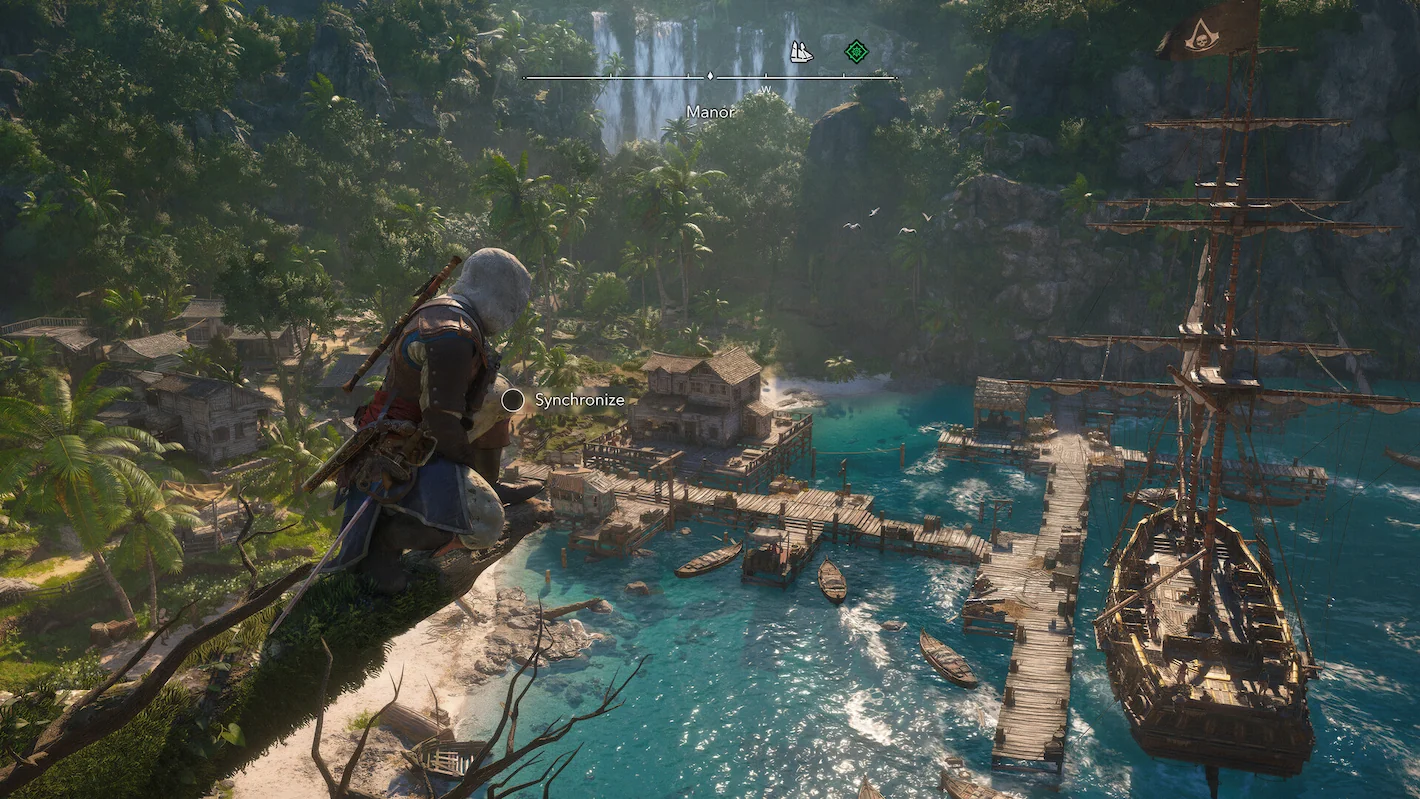
land gameplay is cleaner, but the old structure still shows
The land side is improved, but it is also where the older Assassin’s Creed bones remain easiest to notice. Parkour feels smoother, stealth has more control, and combat is easier to accept in a modern review context, but Resynced does not magically turn every old mission into a new design philosophy. Some of the familiar structure is still present. The player still follows targets, enters restricted zones, clears objectives and moves through sequences that belong very clearly to the classic Assassin’s Creed blueprint. The important thing is that the irritating edges seem reduced. Better stealth control helps because the player feels less trapped by old animation behavior. Cleaner movement helps because traversal no longer feels as stiff. Changes to tailing and eavesdropping flow matter because older instant-failure design could turn tension into annoyance very quickly. These improvements do not make Black Flag Resynced revolutionary, but they make it easier to enjoy the parts that already worked. The game is still at its weakest when it behaves like a standard Assassin’s Creed entry and at its strongest when it lets the player breathe inside the pirate fantasy. That is the line this review keeps returning to. Resynced is not elite because every system is deep. It is strong because its best systems support the identity of the game.

a better-looking caribbean gives the adventure more force
Visually, Resynced is most valuable because Black Flag depends heavily on place. This is not a game that can survive on mechanics alone. It needs the water to look alive, the sky to feel dangerous, the ports to feel warm and dirty, and the islands to make the player want to leave the main road. A modernized presentation helps that more than it would help a colder or more mechanical game. The Caribbean benefits from stronger lighting, richer water, denser environmental detail and a cleaner overall image. The remake does not need to be the most technically advanced open world on PC to justify itself. It needs to make the player want to sail again, and that is exactly where it works. The difference is not only cosmetic, even if some parts of the world still function in a cosmetic way. Better atmosphere changes the emotional rhythm of exploration. A storm at sea feels heavier when the water and sky carry more texture. A port feels more inviting when the lighting gives it more character. The ship feels more powerful when the ocean around it has more depth. Black Flag was always a game of mood as much as mechanics, and Resynced makes that mood easier to return to without the rougher presentation of the original version standing in the way.

where the score stops climbing
The reason this lands at 85/100 instead of pushing higher is simple: Resynced improves Black Flag, but it does not transform the Assassin’s Creed formula into something deeper than it is. The world is still more attractive than reactive. NPCs still create atmosphere more than consequence. Side content can be fun, but not every activity feels important. Some missions still carry that familiar open-world design where the player understands the structure before the scene has fully started. For players who want a dense RPG-like world, social depth, meaningful faction systems or stronger long-term consequences, this will not suddenly become that kind of game. The game’s strength is adventure, not simulation. Its strength is movement, naval combat, atmosphere, ship progression and a protagonist who fits the pirate fantasy well. That is enough for a strong score, but not enough for a masterpiece score. Black Flag Resynced is not trying to become Kingdom Come at sea, and it is not trying to turn every NPC into a living story. It is still Assassin’s Creed, only this time the central fantasy is strong enough to carry the familiar structure much better than usual.



![ASSASSIN'S CREED BLACK FLAG [2013]](https://pcdoorz.com/wp-content/uploads/2026/07/Assassins_Creed_IV_-_Black_Flag_cover.webp)