RECENZIJA | LOGITECH Z207 2.0 | STILL MAKES SENSE
Sometimes a review begins with weeks of planning, product comparisons and the expectation that a new piece of hardware might meaningfully change a setup. This one started much more simply: we needed a pair of computer speakers, we needed them quickly, and we were not looking for anything remotely audiophile-grade. The price range was modest, the requirements were basic and logitech’s z207 ended up being the practical choice. That would normally be the end of the story, except the Z207 is an unusually old product to be buying new in 2026. It has been around since 2017, yet it remains on store shelves and Logitech itself still sells it directly today. That combination made it worth reviewing. Nine years after arriving on the market, the question is no longer whether the Z207 was competitive when it launched, but whether an inexpensive pair of desktop speakers this old can still make sense now. Logitech’s current product page says yes strongly enough to keep selling it; after living with the speakers, our answer is more measured, but ultimately still positive.
a design that aged surprisingly well
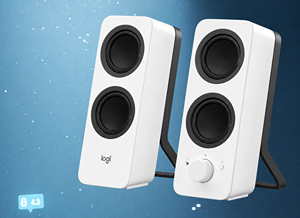
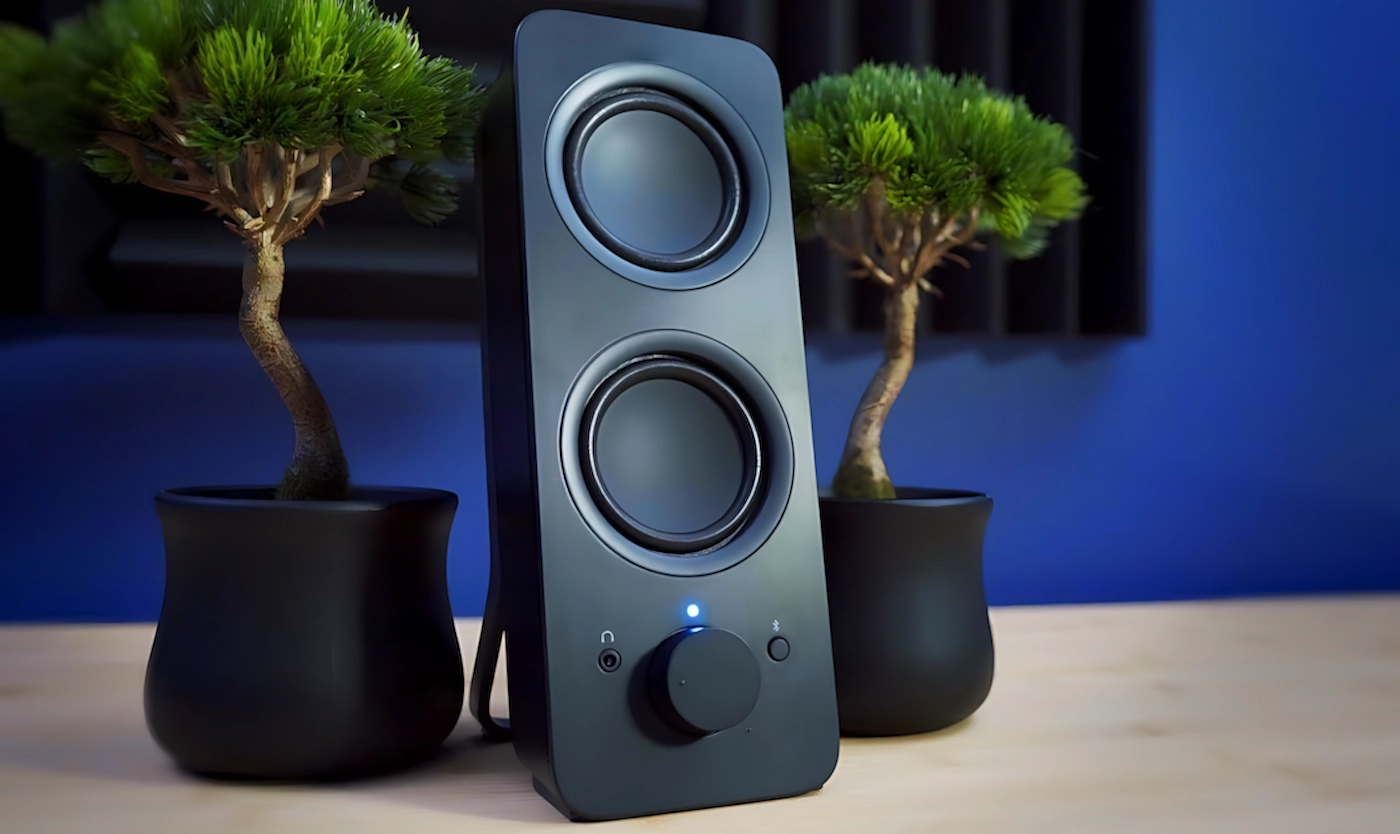
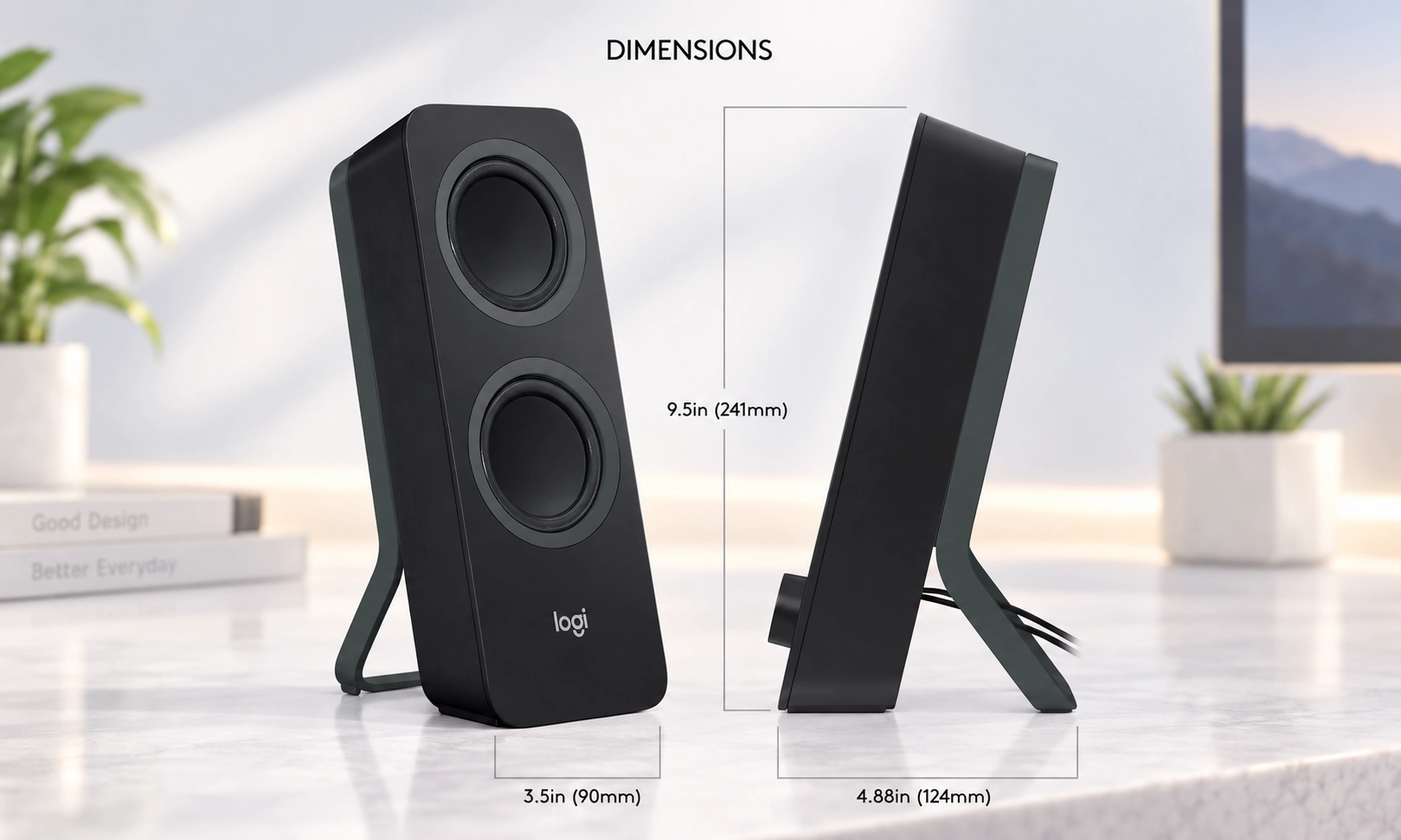
Age shows very little in the physical design. The Z207 avoids gaming flourishes, RGB lighting, oversized branding and almost everything else that could have dated it badly over the past decade. The tall rectangular cabinets are softened by rounded corners, while the rear support structure gives both speakers a noticeable backward tilt. That support is more important visually than it initially appears: viewed from the side, it creates a leaner, almost floating stance rather than leaving the speakers looking like two upright plastic boxes. On a desk they are elegant, restrained and easy to place beside a monitor without becoming the visual focus of the setup. At roughly 241 mm tall, 90 mm wide and 124 mm deep per speaker, they are not miniature speakers, but their narrow footprint keeps them manageable. The same basic shape is still used today without looking particularly old, which may be one reason Logitech has had little reason to replace it purely for cosmetic purposes. Both cabinets are made almost entirely from plastic, including the rear supports, but this is one of those cases where the material itself matters less than how it is used. The plastic is relatively hard and rigid, the surfaces do not immediately communicate budget hardware, and the construction feels substantially better than the hollow, lightweight shells sometimes found in inexpensive desktop speakers. There is no attempt to disguise the Z207 as something premium with fake metal trim or decorative material, and that restraint works in its favor. More importantly, we never felt that the enclosure material was damaging the listening experience to an unusual degree for the category. At this price level a wooden cabinet would be unrealistic, and Logitech has instead produced something that feels properly assembled and durable enough for daily desktop use. The combined system weighs around one kilogram, which is enough to keep the speakers planted without turning them into awkward objects to move around.
simple hardware with a useful trick
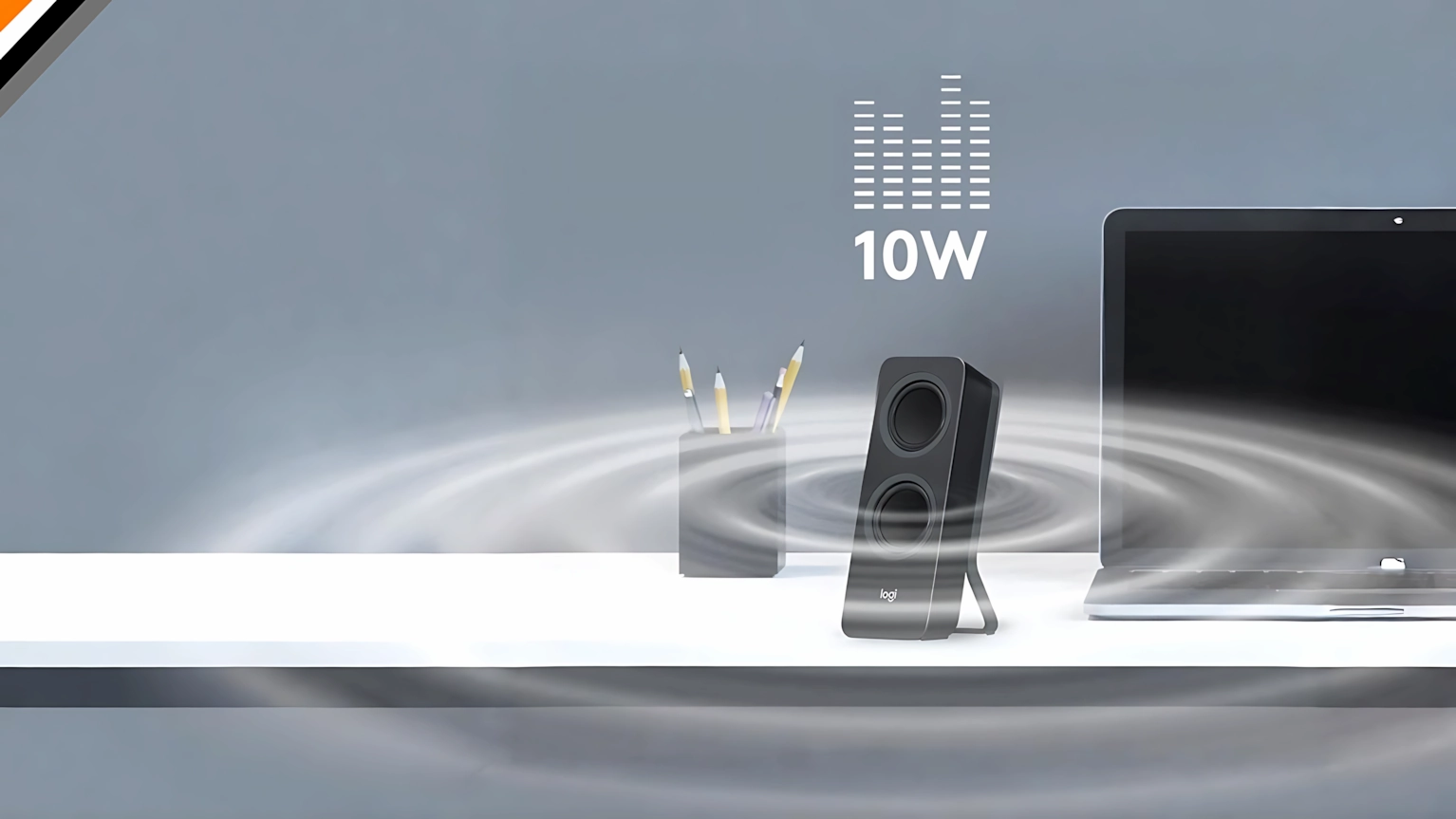
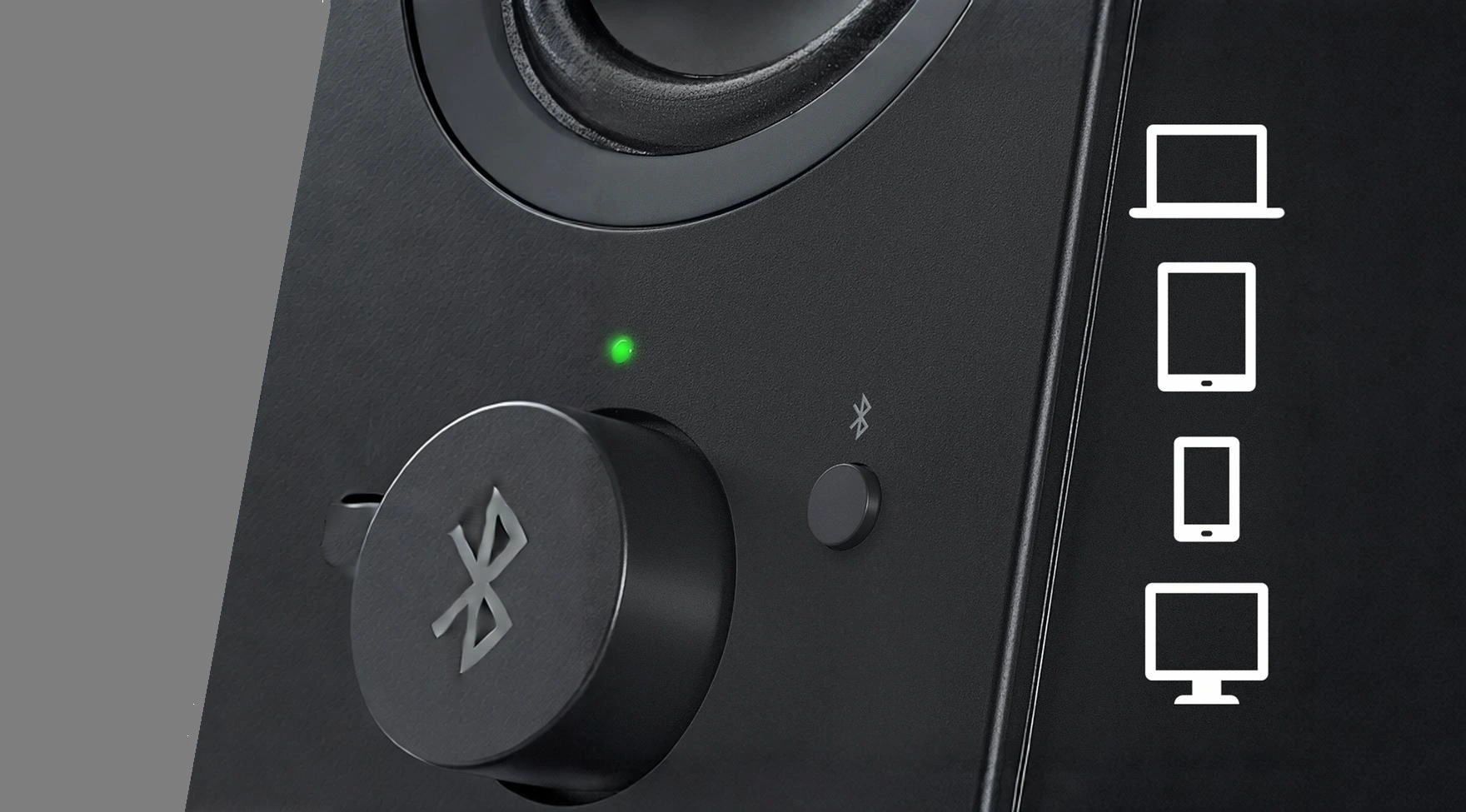
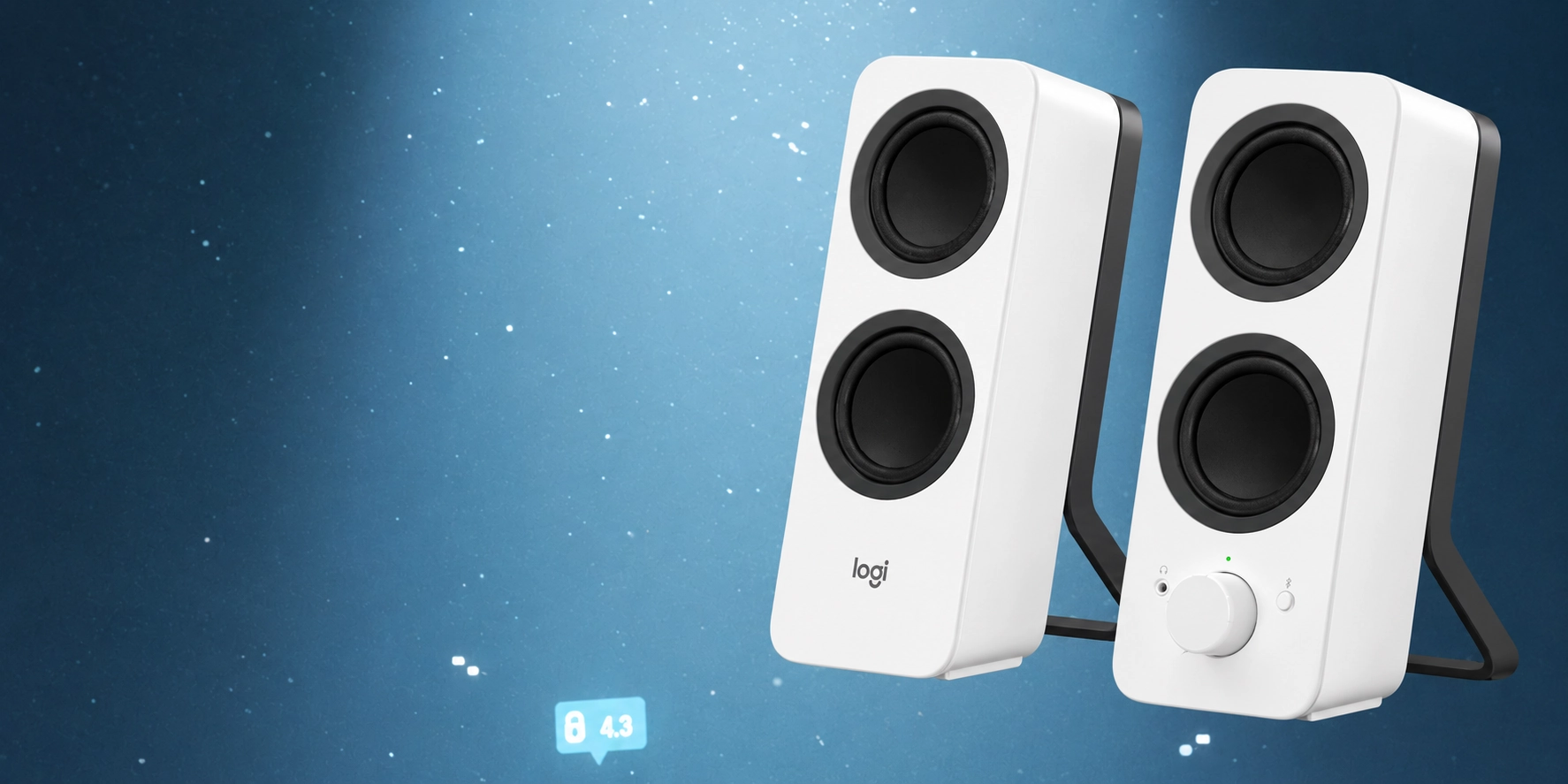
Internally, the Z207 is a straightforward 2.0 system. Each cabinet contains one powered full-range driver and one passive radiator, with the complete pair rated at 5 W RMS and 10 W peak. Logitech describes the passive radiators as a way of extending bass response, but this is still a compact speaker system without a dedicated subwoofer, and expectations need to remain realistic. More interesting in everyday use is the connectivity. The Z207 can maintain connections to as many as two Bluetooth devices while also accepting a third source through the 3.5 mm analogue input. Logitech’s Easy-Switch implementation lets you pause playback on one Bluetooth device and continue from the other without repeatedly going through the pairing process. That feature was useful in 2017 and arguably makes even more sense today, when a desktop setup can easily involve a PC, phone and tablet at the same time. There is very little to learn. The right speaker carries the combined power and volume knob, Bluetooth pairing button, status LED and a front-facing 3.5 mm headphone output. The wired 3.5 mm source connection and power connection sit at the rear. Pairing is performed by holding the Bluetooth button for three seconds until the indicator begins flashing and then selecting the Z207 from the source device. This is not sophisticated hardware, but there is something pleasant about a product that requires virtually no setup and no software layer. There is no companion application, no firmware interface and no EQ built into the speakers themselves. That last point does limit sound adjustment, but it also means the Z207 behaves like an ordinary peripheral: connect it, turn the knob and it works. Logitech’s own setup guide still reflects exactly this stripped-down approach.
sound that matches the price rather than the marketing
The actual sound quality is where the Z207 settles firmly into its price category. It is average rather than impressive, but average does not mean unpleasant. For normal desktop listening, videos, background music and general PC use, the pair is entirely satisfactory. Voices remain understandable, stereo presentation is clearly preferable to relying on built-in monitor audio, and there is enough presence to make ordinary content feel properly separated from the screen. What the Z207 does not deliver is the kind of clarity, extension or tonal balance that would make it worth buying primarily for critical music listening. Logitech describes the system as providing rich, room-filling stereo sound; in practice we would call it competent near-field desktop audio first and foremost. The 5 W RMS rating already tells much of that story. These speakers were designed to improve the everyday PC experience without demanding much space or money, not to become the center of a serious audio setup.
bass is the clearest limitation
The biggest weakness is bass quality. The passive radiators help the speakers avoid sounding completely thin, but they cannot replace the authority and extension of a dedicated low-frequency driver. Bass is present, yet it lacks weight and depth, particularly on tracks or game scenes where low frequencies are supposed to provide impact rather than simply be audible. Kick drums have less body than we would like, electronic bass lines lose some of their lower texture, and cinematic effects understandably lack physical punch. This does not make the Z207 unusable for music or games; it simply defines the ceiling of what this type of inexpensive 2.0 system can do. A current 2026 test from Computer Bild reached a similarly restrained conclusion, describing the presentation as warm but somewhat dull and lacking power, which broadly aligns with our own impression that the low end never develops enough authority to anchor the rest of the spectrum.
the middle moves forward
Our more noticeable tonal issue is actually above the bass region. Mid frequencies are pushed slightly further forward than they should be, while the upper end is comparatively restrained. The result can make voices, guitars and other mid-heavy material sound prominent while some finer high-frequency detail sits further in the background. It is not an aggressively unpleasant tuning, and for spoken content it can even work in the Z207’s favor, but music exposes the imbalance more readily. Fortunately, this is also the part of the sound signature that responds reasonably well to software equalization. Pulling the mids back slightly and adding a modest amount of upper-frequency energy produces a more balanced result. EQ cannot manufacture the deeper bass that the hardware physically lacks, but it can make the overall presentation cleaner and less mid-dominant. That distinction matters: the Z207 can be customized into a more enjoyable version of itself, but it cannot be transformed into a fundamentally higher-class speaker system. That leaves the Z207 in a fairly obvious role. For YouTube, streaming video, general desktop work, casual music and ordinary gaming, there is little reason to complain heavily. Stereo separation gives games and video a proper sense of width, and having independent speakers positioned on either side of the display is still a meaningful step above most integrated monitor solutions. For competitive gaming, critical music listening or anything that depends heavily on positional detail, dynamic range or deep low-frequency information, these are not the speakers we would choose. But judging inexpensive hardware by standards it was never designed to meet is not useful. We bought the Z207 precisely because we needed simple PC speakers without turning the purchase into an audio project, and within that context they perform the required job. Their shortcomings become obvious when you listen for them, but they do not constantly interfere with ordinary use.
bluetooth gives an old product a longer life
One reason the Z207 has aged better than a completely basic wired speaker pair is Bluetooth. A nine-year-old PC peripheral built around a proprietary connector or platform-specific software could feel obsolete by now; a speaker that accepts Bluetooth and a standard analogue input does not have that problem. Even better, the multi-device implementation remains genuinely practical. A PC can stay attached through the 3.5 mm connection while a phone and another Bluetooth source remain paired, giving the system more flexibility than its simple appearance suggests. There is also a headphone jack directly on the right speaker, which is a small feature until your computer’s own audio jack is awkwardly positioned under a desk. None of this is technologically exciting in 2026, but useful connectivity does not stop being useful because it is old. Logitech has largely avoided building anything into the Z207 that could become unsupported, which has probably contributed to its unusually long commercial life.
nine years later, the context matters
There is no getting around the strange part of this review: we are discussing a speaker system designed in 2017 as if it were a current purchase because, commercially, it still is one. Logitech continues to list the black Z207 as available directly, and European retailers continue to carry the model. That does not automatically make it good, but it does make a contemporary review relevant. Hardware does not always need a yearly refresh when its job is simple enough. The Z207 has no battery waiting to degrade, no software platform waiting to lose support and no wireless ecosystem that locks it to a particular generation of computer. Its fundamentals remain compatible with current PCs, phones and tablets. The more important question is whether its sound quality has enough margin left to compete with today’s inexpensive alternatives. Our answer is yes, but narrowly: the connectivity, build quality and design have aged better than the actual audio performance. Taken on its own, the Z207 is not an especially exciting speaker system. Taken as an inexpensive, easy-to-buy desktop solution that still looks good, feels properly built and works with several devices, it becomes much easier to recommend. The sound is the limiting factor and should be understood before purchase: bass extension is modest, mids are slightly too dominant and highs could use more presence. Those characteristics keep the score well below the territory of genuinely strong audio hardware. Yet none of them made us regret buying the speakers for the purpose we had in mind. We needed computer speakers quickly, did not expect anything exceptional from this price segment, and ended up with a pair that does the basics competently while offering a little more convenience than expected. Sometimes that is enough.