NVIDIA VS RADEON | THE CHOICE NOBODY WANTS TO ADMIT IS PERSONAL
For many PC gamers, graphics cards are not just components you install and forget. They become part of your identity as a player, part of your memory of when games finally started running smoothly, when you first saw a world rendered with detail that felt almost unreal. People do not argue about NVIDIA and Radeon only because of performance numbers. They argue because these brands are tied to personal experiences, to the first PC that truly felt powerful, to the moment when upgrading a GPU changed how games felt to play. Over time, the green and red camps became more than just hardware choices. They became symbols of different approaches to PC gaming, different philosophies of how power, value, and technology should be delivered to players.
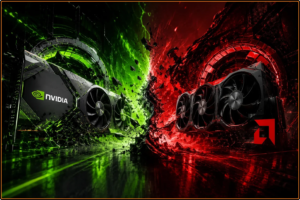
For years, the same debate has repeated itself in forums, comment sections, and late-night Discord calls. Which one is better. Which one has more stable drivers. Which one is more honest with pricing. Which one pushes the industry forward with new features, and which one relies on brute-force performance. The answers always depend on who you ask. Some players swear they cannot imagine modern gaming without DLSS. Others argue that FSR is good enough and prefer that it works across different hardware. Some people trust NVIDIA’s software ecosystem more, while others point out how AMD cards have historically improved over time through driver updates. The truth sits somewhere in between, uncomfortable for fanboys on both sides. The rivalry is not about one company being universally superior. It is about different priorities colliding in a market that keeps shifting under our feet. To understand today’s situation, it helps to look back beyond the RTX era and modern buzzwords. Long before ray tracing became a selling point, ATI and NVIDIA were already shaping how PC gaming felt. ATI was often associated with strong raw performance at more accessible prices, sometimes paired with drivers that needed time to mature. NVIDIA built a reputation around stability, aggressive partnerships with developers, and a premium image that justified higher prices in the eyes of many users. Even then, the split was visible. Some players were willing to pay more for perceived reliability and tighter software integration, while others preferred maximum performance per dollar and accepted the occasional rough edge as part of the deal. When ATI became part of AMD, the transition was not instantly transformative. AMD needed years to stabilize its GPU strategy, align it with its CPU roadmap, and rebuild trust among users who had seen inconsistent generations of graphics cards. NVIDIA, meanwhile, doubled down on building an ecosystem rather than just selling hardware. Their GPUs were increasingly presented as gateways into a broader platform of software tools, developer support, and proprietary technologies. This changed the battlefield. Performance alone was no longer the only metric that mattered. The surrounding experience, the tools you used, and the way games were optimized began to shape buying decisions just as much as raw frame rates.
The Ray Tracing Shift and the Technology Divide
The arrival of hardware-accelerated ray tracing marked a turning point that still defines much of the NVIDIA versus Radeon discussion today. NVIDIA took the first major step by introducing ray tracing hardware at a time when very few games could truly take advantage of it. Many users criticized this move as premature and overpriced, arguing that they were paying for a future promise rather than a present benefit. At that moment, Radeon focused on traditional rasterization performance and competitive pricing, offering strong results in conventional gaming scenarios without the extra cost of early ray tracing support. It was a pragmatic approach that appealed to players who valued immediate gains over experimental features. As ray tracing became more widely adopted, NVIDIA’s early investment began to pay off. Their hardware matured, performance improved across generations, and DLSS emerged as a crucial companion technology that made ray tracing practical in real-world gaming scenarios. AMD eventually introduced its own ray tracing hardware, but often found itself trailing NVIDIA in terms of performance efficiency in ray-traced workloads. This gap is not always dramatic in everyday gaming, but in titles that heavily rely on advanced lighting and reflections, the difference can become noticeable. At the same time, AMD’s commitment to more open technologies like FSR offered a different kind of value. While DLSS often delivers superior image quality and stability, it remains tied to NVIDIA hardware. FSR’s broader compatibility reflects a philosophy that prioritizes flexibility over exclusivity, even if that flexibility sometimes comes with compromises.

Performance in the Real World, Not Just in Charts
On paper, performance comparisons can look decisive. In practice, they are often far less dramatic. In traditional rasterized gaming, many Radeon cards compete closely with their NVIDIA counterparts, especially in the mid-range segment where value matters most to average players. In real gameplay, the difference between two competing GPUs may come down to a few frames per second, a gap that disappears the moment you stop watching performance overlays and start playing the game. NVIDIA’s advantage becomes more pronounced in ray-traced scenarios and in workloads that benefit from their proprietary features, but this does not automatically translate into a universally better experience for every user. What often gets lost in benchmark discussions is how games are actually played. Competitive titles prioritize high frame rates and low latency, often with graphics settings turned down to maximize performance. In these scenarios, the differences between NVIDIA and Radeon cards can be minimal. Story-driven, visually rich games tell a different story, where ray tracing and advanced upscaling can enhance immersion in ways that raw frame rates alone cannot capture. The “better” choice depends not on which company wins more charts, but on what kind of experience you value most when you sit down to play.
Drivers, Software, and the Weight of Reputation
Driver quality is one of the most emotionally charged topics in the NVIDIA versus Radeon rivalry. For years, AMD carried the stigma of unreliable drivers, while NVIDIA was seen as the safe choice for stability. Over time, this narrative has become less accurate, but reputations are slow to change. Modern Radeon drivers are far more robust than they once were, and in many cases, AMD’s software updates significantly improve performance and stability long after a card has launched. NVIDIA still maintains a reputation for consistency, but it is not immune to problematic releases or bugs. The difference today lies more in perception than in objective reliability. What does matter is how each company treats its software ecosystem. NVIDIA’s tools often feel polished and tightly integrated, but they also reinforce dependence on NVIDIA hardware. AMD’s approach leans toward openness and broader compatibility, which can feel liberating to users who do not want to be locked into a single vendor’s ecosystem. Neither approach is inherently superior. They simply reflect different priorities about how much control a company wants over the user experience.
Power Consumption, Thermals, and Practical Constraints
High-end GPUs have become increasingly power-hungry, and this is an area where practical considerations often outweigh brand loyalty. NVIDIA’s top-tier cards deliver impressive performance, but they also demand robust power supplies and serious cooling solutions, which can quickly increase the total cost of a build beyond the price of the GPU itself. AMD’s offerings can be more restrained in certain segments, yet they are not immune to high power draw at the top end either. This matters even more in compact cases, where airflow is limited and heat buildup can affect overall system stability. Noise levels become part of the equation as well, since aggressive cooling often means louder fans under load. For many users, especially those building smaller or living-room PCs, thermal behavior and power efficiency shape the daily experience more than a few extra frames per second ever could.
Pricing, Availability, and the Reality of the Market
Pricing strategies reveal much about how NVIDIA and AMD see themselves. NVIDIA increasingly positions its high-end products as premium experiences, often commanding prices that reflect this branding. AMD traditionally aims to undercut these prices, offering competitive performance at lower cost, though market conditions can quickly distort this balance. Supply shortages, cryptocurrency booms, and regional availability can turn theoretical value propositions into frustrating compromises. In those moments, the choice between NVIDIA and Radeon becomes less about philosophy and more about what you can actually buy.
Choosing Between Ecosystems, Not Just GPUs
Beyond hardware, choosing between NVIDIA and Radeon often means choosing between ecosystems. NVIDIA’s proprietary technologies offer polished experiences that can feel seamless, but they come at the cost of flexibility. AMD’s more open approach encourages broader compatibility and experimentation, but sometimes lacks the same level of refinement. This choice reflects how you see your relationship with technology. Do you prefer a tightly controlled environment that promises smooth integration, or do you value openness even if it means accepting occasional rough edges?
The Emotional Layer of the Rivalry
Benchmarks and specifications can explain a lot, but they never fully explain why people become attached to one GPU brand over another. On a personal level, I have to admit that I usually lean slightly toward NVIDIA. Not because Radeon does not make excellent cards, and not because the green side is always the better value, but because NVIDIA’s ecosystem has often felt easier to trust in the moments when I wanted fewer surprises. DLSS, stronger ray tracing support, wider creator-tool adoption, and that general feeling of software polish all create a certain comfort zone. That preference does not erase AMD’s strengths, especially in raster performance and value, but it does show why this debate is rarely neutral. Even when we try to be objective, past experiences quietly shape what feels safer, smarter, or more familiar.
Some players identify with Radeon because they see AMD as the challenger that keeps the industry honest, pushing back against the idea that premium pricing should be the default. Others gravitate toward NVIDIA because they associate the brand with cutting-edge technology, long-term polish, and a sense of stability that comes from using tools trusted by developers and professionals. Neither sentiment is irrational. PC gaming has always been as much about passion as it is about practicality, shaped by first builds, past upgrades, and memories of when a single component transformed how games felt to play. Over time, these experiences turn hardware choices into personal preferences, and a GPU becomes more than a purchase decision. It becomes part of how you frame your own journey as a player and builder.Where the Rivalry Leaves Us. If we step back and look at the current landscape without brand loyalty, one thing becomes clear: this rivalry benefits users. NVIDIA’s technological ambition continues to push the boundaries of what GPUs can realistically deliver in modern games and creative workloads. At the same time, AMD’s pricing strategy and commitment to open standards prevent those ambitions from turning into a closed ecosystem where choice slowly disappears. The constant pressure between these two companies forces faster innovation cycles, more aggressive feature development, and stronger competition in the mid-range market, where most real users actually buy their hardware. As a result, no single company controls every meaningful advantage, and progress does not stagnate. The best choice today is not about declaring a corporate winner, but about understanding your own priorities, your budget limits, and the kind of PC experience you want to build around.