REVIEW | STAR TREK VOYAGER: ACROSS THE UNKNOWN | THE LONG ROAD HOME
For a long time, Star Trek: Voyager felt like the Star Trek series most naturally suited for a proper survival strategy game. A lone Federation ship thrown 70,000 light-years from home, a crew forced to ration resources, repair damage, negotiate with unknown species, bend Starfleet ideals without completely breaking them, and keep morale alive while every shortcut carries a price. That setup almost writes the game design by itself. Star Trek: Voyager – Across the Unknown finally builds around that idea, not as an action spectacle or a simple nostalgia product, but as a story-driven survival strategy experience where the player is asked to manage the ship, the crew, the route home, and the consequences of hard decisions. It is not the biggest or most polished Star Trek game ever made, and it does not hide its budget limits, but it understands the core fantasy of Voyager better than many larger licensed games understand their own source material. The official Steam page describes it as a story-driven survival strategy game where the fate of Voyager is in the player’s hands, with resource management, ship command, and difficult decisions at the center of the experience.

the delta quadrant finally feels like a game system
The strongest idea in Across the Unknown is also the most obvious one: Voyager’s journey home is treated as a survival structure. This is not a game about running around corridors with a phaser and clearing rooms. It is about command pressure. The ship is the center of the game, and the player is constantly pushed to think about damage, supplies, upgrades, crew roles, events, and the long road ahead. That already makes it feel more faithful to the spirit of Voyager than a more conventional action game would have been. The series was always about the tension between Starfleet ideals and survival reality. Can you stay principled when resources are limited? Can you protect the crew without becoming reckless? Can you keep moving when every system failure feels like one more step toward being stranded forever? Across the Unknown turns that premise into a management loop, and when it works, it gives the player that familiar Voyager feeling: the ship is not just a vehicle, it is home, weapon, lifeboat, laboratory, and political symbol all at once. That survival angle also gives the game a useful identity inside the wider Star Trek gaming catalog. Star Trek games have often leaned toward space combat, tactical command, adventure formats, or online experiences, but Voyager has always needed something more personal. The show’s premise was never just “ship fights aliens.” It was about being cut off from support, making imperfect calls, and watching a crew slowly become a family because there is no other choice. Across the Unknown leans into that pressure through systems that ask the player to keep Voyager functioning while dealing with events and narrative choices. Some players may find that slower than expected, especially if they come in hoping for a bridge simulator or direct tactical action, but the slower rhythm fits the material. Voyager was at its best when command decisions had emotional weight, and this game is smart enough to build around that instead of chasing a louder fantasy.
choice, crew, and the “what if?” appeal
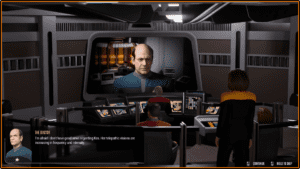
The game’s “what if?” approach is probably its most interesting narrative feature. Instead of simply replaying the show beat for beat, Across the Unknown allows familiar Voyager situations to bend in different directions. That matters because strict adaptation can become boring fast. If every major event must happen exactly as it did on television, then the player is only watching a museum exhibit with buttons. By giving the player space to alter outcomes, the game taps into one of the oldest pleasures of licensed games: asking what might have happened if the crew made a different call. Reporting around the game before release described it as a Voyager survival strategy title built around alternate outcomes, crew management, resources, research, repairs, and decisions that can reshape the journey. This works especially well because Voyager itself was full of moral and practical crossroads. Janeway’s command style, the Maquis/Federation tension, Seven of Nine’s integration, the Borg question, alien diplomacy, and the constant temptation to cut corners all create natural decision points. Across the Unknown benefits from that foundation. Even when the writing or presentation does not hit premium television quality, the concept remains strong because the player is operating inside a scenario that already makes sense as interactive drama. The crew is not just window dressing. Their survival, usefulness, loyalty, and role in events become part of the game’s texture. That is where the game earns a lot of its goodwill, especially for Voyager fans who wanted more than a generic Star Trek skin placed over a random strategy system.
strategy that fits star trek better than action would
Across the Unknown uses strategy and management as its main language, and that is a good decision. Star Trek can support action, but Star Trek is rarely at its best when reduced only to action. The franchise works through problem solving, diplomacy, engineering compromises, ethical pressure, and the quiet stress of command. A survival strategy format gives those ideas more room than a shooter or standard action adventure would. The game asks the player to think about the ship as a fragile system, not just a health bar with nacelles attached. Repairs matter, resources matter, and the journey has to be managed rather than simply survived through reflexes. That does not mean the systems are perfect. Several reviews point toward repetition as one of the game’s weaknesses. Metacritic’s review summary includes criticism that the strategy structure can become repetitive because later systems often repeat what the player has already been doing earlier. Stevivor also praised the way ship combat presents Star Trek visually and mechanically, but noted that it can become boring after enough repeated encounters. That criticism is important because this kind of game lives or dies on variation. If every sector starts to feel mechanically similar, then the fantasy of a dangerous journey through the unknown loses some of its force. Across the Unknown has the right foundation, but it does not always have enough budget, polish, or encounter variety to keep every stretch equally sharp.
presentation: strong atmosphere, visible limits
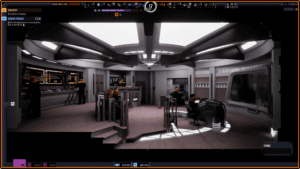
The presentation is where Across the Unknown becomes easier to admire than fully praise without reservation. The game clearly understands Voyager’s identity, but it does not always have the production weight to make every scene land with the force it deserves. The ship, the sound, the interface, and the overall Star Trek mood can work very well, especially when the game is focused on command atmosphere rather than character animation. Steam user impressions also point to strong immediate reactions around the UI, sound design, and the way Voyager itself is presented, while noting that character models can feel rough. That roughness matters, but it does not ruin the game. A large part of the appeal comes from the fact that this is not trying to be a blockbuster cinematic Star Trek production. It is more modest, more system-driven, and more interested in letting the player feel responsible for the ship than in delivering endless high-budget cutscenes. Still, the limitations show. Character models, repeated structures, uneven voice implementation, UI-heavy scenes, and budget-conscious storytelling can make some moments feel less dramatic than they should. A Voyager game should sometimes feel tense, lonely, heroic, and emotionally heavy. Across the Unknown reaches for that, and sometimes it gets there, but it does not always have the presentation muscle to make the Delta Quadrant feel as vast or strange as the show did at its best.
a game built for voyager fans first
The biggest question is who this game is really for. Across the Unknown is not likely to convert players who have no interest in Voyager, management systems, or slower strategy games. It is not a universal recommendation in the way a polished mainstream strategy title might be. Its strongest audience is obvious: Star Trek fans, especially Voyager fans, who understand why being responsible for this ship matters. For that audience, many of the game’s flaws become easier to forgive, because the concept itself is so rare. PC Games, Stevivor, and GameStar review quotes shown on Steam placed the game around the 75–85 range, which lines up with the idea of a strong but imperfect licensed strategy title. That fan weighting is important. A non-Star Trek player may see a functional survival strategy game with some repetition and uneven production values. A Voyager fan sees something more specific: a chance to guide a ship that has lived in their imagination for decades. That does not excuse every weakness, but it changes how the game lands emotionally. Some games are carried by mechanical excellence. Others are carried by how well they understand the fantasy they are adapting. Across the Unknown falls closer to the second group. It is not flawless strategy design, but it is a thoughtful Voyager game, and that counts for more here than raw mechanical novelty.

where the journey feels thin
The main weaknesses are not mysterious. Repetition is the biggest one. Survival strategy games need variety in events, outcomes, encounters, and long-term pressure, and Across the Unknown can sometimes lean too much on familiar loops. Ship combat has strong ideas, but repeated combat rhythm can lose impact over time. Character presentation is also uneven, with models and some performance elements not always matching the emotional weight of the source material. Some review and user impressions also mention UI-heavy or budget-limited moments, which is not surprising for a licensed game working outside the highest AAA tier. The other issue is expectation management. The title and license can make people imagine a massive, fully voiced, cinematic Star Trek command simulator with deep episode-level storytelling across the entire journey. Across the Unknown is not that. It is more contained, more systemic, and more modest. Players who enter with the right expectation will likely appreciate it more. Players expecting a grand, premium, fully animated Star Trek RPG may feel the limits almost immediately. That gap between dream and reality is probably the game’s biggest enemy, especially because Voyager as a concept naturally encourages huge expectations.
why voyager still carries it
Across the Unknown works because its core idea is strong enough to survive the rough edges. Commanding Voyager through a hostile and uncertain Delta Quadrant is simply a good game premise. Managing survival, dealing with crew pressure, making decisions, and watching the journey branch away from the familiar series timeline gives the game a sense of purpose. It does not feel like a random strategy game with Star Trek names pasted over it. It feels like someone understood that Voyager’s premise was always about systems under pressure: ethical systems, social systems, technological systems, and emotional systems. That is why the game deserves a positive score even with clear caveats. It is not a flawless strategy title, but it is a meaningful Star Trek title. It respects the part of Voyager that mattered most: the difficult road home. The best moments come when the player is not thinking about menus or repetition, but about the ship as a living problem. What can be repaired? Who can be trusted? Which sacrifice is acceptable? How far can the crew bend before it stops feeling like Starfleet? Those questions are pure Voyager, and Across the Unknown is at its best when it lets them breathe.