SPECIAL | EXANIMA | EVERY STEP HAS WEIGHT
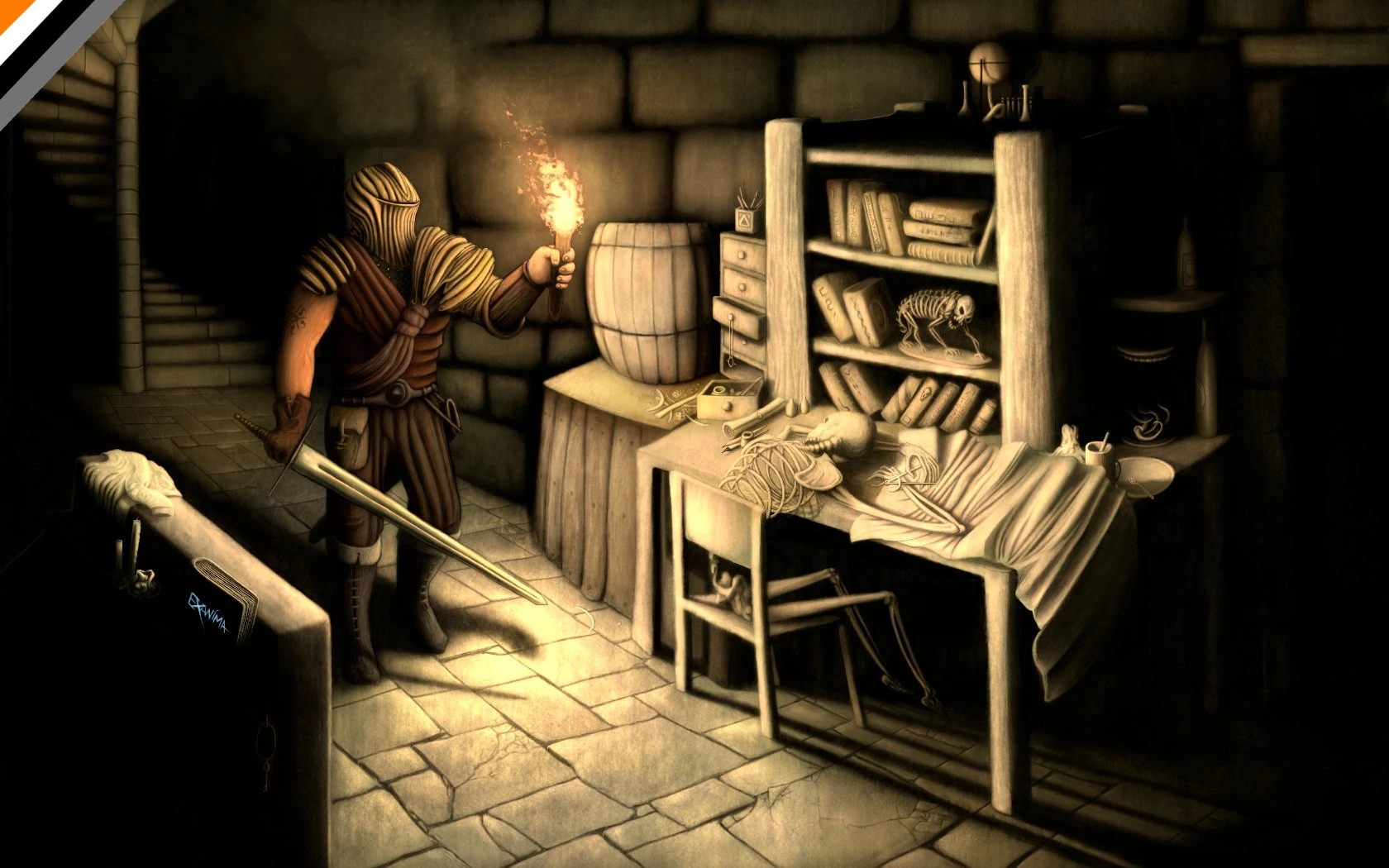
A torch throws uneven light across a stone room while an armored figure carefully moves around an overturned chair, measuring the distance to an opponent holding a long two-handed weapon. There is no dramatic combat music demanding an immediate attack, no glowing marker showing the safest position and no animation waiting to pull the character cleanly toward the target. One careless step can ruin the angle, a wide swing can strike the furniture instead of the enemy, and enough momentum in the wrong direction can leave the attacker struggling to recover while steel is already coming back the other way. This is the point where Exanima stops looking like a strange isometric action RPG and begins revealing what Bare Mettle Entertainment has actually built. Its combat is not a conventional system decorated with physics. Movement, balance, force, contact and the physical properties of weapons are the system, with every encounter emerging from the interaction between the character, equipment, opponent and surrounding space. Released through Steam Early Access in April 2015, Exanima has spent more than eleven years developing this uncompromising idea inside a dark low-fantasy dungeon crawler that serves as a standalone prelude to the larger Sui Generis project. That development has been extraordinarily slow, but the game itself is slow for a more interesting reason. It wants the player to observe before acting, feel the weight behind every movement and accept that mastering a weapon means more than memorizing a combination of buttons. Version 0.9.5, released in May 2026, substantially rebuilt major parts of the technology, movement and content while being described by the studio as the final major update before version 1.0. Exanima is therefore still unfinished, yet it has already become something remarkably complete in identity: a game that refuses to fake the physical consequences of combat simply because a cleaner animation would be easier to control.
a sword is a moving object
Most action RPGs calculate an attack through a familiar agreement between animation and statistics. The character begins a predefined movement, the weapon passes through an active hit area, and the game decides whether damage should be applied. Exanima starts from a different position. The weapon has dimensions, mass, direction and momentum, while the character moving it must maintain enough balance and positioning to produce an effective strike. A sword that barely touches an opponent near the beginning of its motion will not behave like the same sword connecting cleanly near the strongest part of the swing. A polearm needs room to travel, a heavy head can generate serious force, and armor protects the places it physically covers instead of acting only as a general defensive number. Characters move through a combination of procedural animation, simulated musculature and physical forces, which is why two apparently similar attacks can produce noticeably different results. This creates occasional awkwardness, particularly while a new player is still fighting the controls rather than the opponent, but it also gives Exanima a form of physical credibility rarely found in melee combat. Doors can become obstacles, tables can separate fighters, loose objects can interfere with footwork and narrow corridors can completely change the usefulness of a weapon. Even falling down is not merely a brief canned animation. A fighter on the ground occupies real space, needs time to recover and remains dangerously vulnerable while doing so. Version 0.9.5 improved character simulation, muscle behavior, footwork, collision handling, uneven-terrain movement and combat AI, making the system smoother without removing the instability that gives it character. Exanima does not always produce beautiful swordplay, but it regularly produces believable incidents: a shield catching an attack at an unexpected angle, a body collapsing against furniture, a weapon glancing from armor or an overcommitted fighter losing control of the exchange. These moments are not scripted demonstrations. They happen because several physical systems briefly agree on an outcome, and that unpredictability prevents combat from becoming a solved routine even after its basic controls are understood.

slow is not the same as simple
The strange first minutes of Exanima can make its characters look drunk, uncooperative or unnecessarily difficult to control. Mouse movement determines more than aim, positioning matters before the attack begins, and repeatedly pressing the same command usually produces a sequence of weak decisions rather than a heroic combination. The temptation is to force the game into the rhythm of a normal action RPG, but Exanima becomes far more coherent once speed stops being the objective. The player has to watch shoulders, weapon position, distance and the opponent’s movement, then decide whether to step inside a long weapon, move away from a heavy swing or create an opening through pressure and footwork. A successful attack often begins before the weapon starts moving because the angle, range and balance required to deliver it have already been prepared. This makes a one-on-one fight feel less like a damage race and more like an argument over space. Against multiple enemies, that argument becomes far more dangerous. Retreating without seeing the floor can end with a chair, wall or body blocking the path, while moving too aggressively can allow another opponent to attack from the side. The deliberate pace also strengthens the atmosphere outside combat. Opening a door, entering an unlit room or hearing movement somewhere beyond the torchlight matters because the character cannot instantly transform into an untouchable collection of dodges and special attacks. Equipment has presence, movement carries commitment and surviving a bad position requires more than spending another resource. Bare Mettle itself describes the combat as tactical rather than particularly fast and warns that casual button pressing will not carry the player far. That slowness should not be treated as a missing feature or an automatic disadvantage. It is the condition that allows distance, mass and physical space to matter. Exanima would lose much of its identity if movement became sharper simply to imitate modern action games. Its controls require patience and can still produce frustrating misunderstandings, but the objective is not perfect responsiveness detached from the body. The objective is to make the body part of the problem.
the underworld does not provide instructions
Beyond the unusual combat sits a dungeon that is far less interested in guiding the player than in making the player feel genuinely lost. Rooms are not arranged as disposable combat arenas connected by obvious corridors, and exploration is not reduced to following a highlighted path between rewards. The environment contains workshops, abandoned living spaces, locked passages, machinery, storage areas, ruins and stranger places whose original purpose has to be reconstructed from architecture, objects, documents and scattered evidence. Maps exist, but orientation still demands attention, while many discoveries are valuable because the player understands what they mean rather than because the interface announces their importance. This makes ordinary movement through the underworld unusually tense. A door may hide an opponent, a useful route, a mechanism or simply another room filled with evidence of something that happened long before the player arrived. Light becomes practical equipment rather than decoration, but carrying it can affect how a character approaches danger. Healing is limited enough to make careless encounters matter, and the roguelike influence gives mistakes a permanence missing from more generous dungeon crawlers. Thaumaturgy gradually introduces supernatural possibilities without turning the game into a parade of explosive spells, while NPC behavior and interaction have continued to expand alongside the physical simulation. The separate Arena mode offers a more controlled place to study weapons, equipment and combat without requiring another journey through the main game, yet it has grown into a substantial part of Exanima rather than remaining a simple practice room. Version 0.9.5 added a new outdoor arena, more purposeful AI behavior, new dialogue mechanics and an expanded role system, while the campaign received The Gardens, its largest area so far, alongside expanded Catacombs and a complete visual overhaul of the Golems region. The result is a game with two useful faces. Arena exposes the extraordinary depth of combat through repetition and experimentation, while the main dungeon gives that combat consequence by surrounding it with uncertainty, scarcity and environmental storytelling. Neither side needs a quest log filled with instructions because Exanima’s strongest objective is usually more immediate: understand where you are, decide whether you are prepared to continue and avoid making the next room your last.

darkness built from material, not decoration
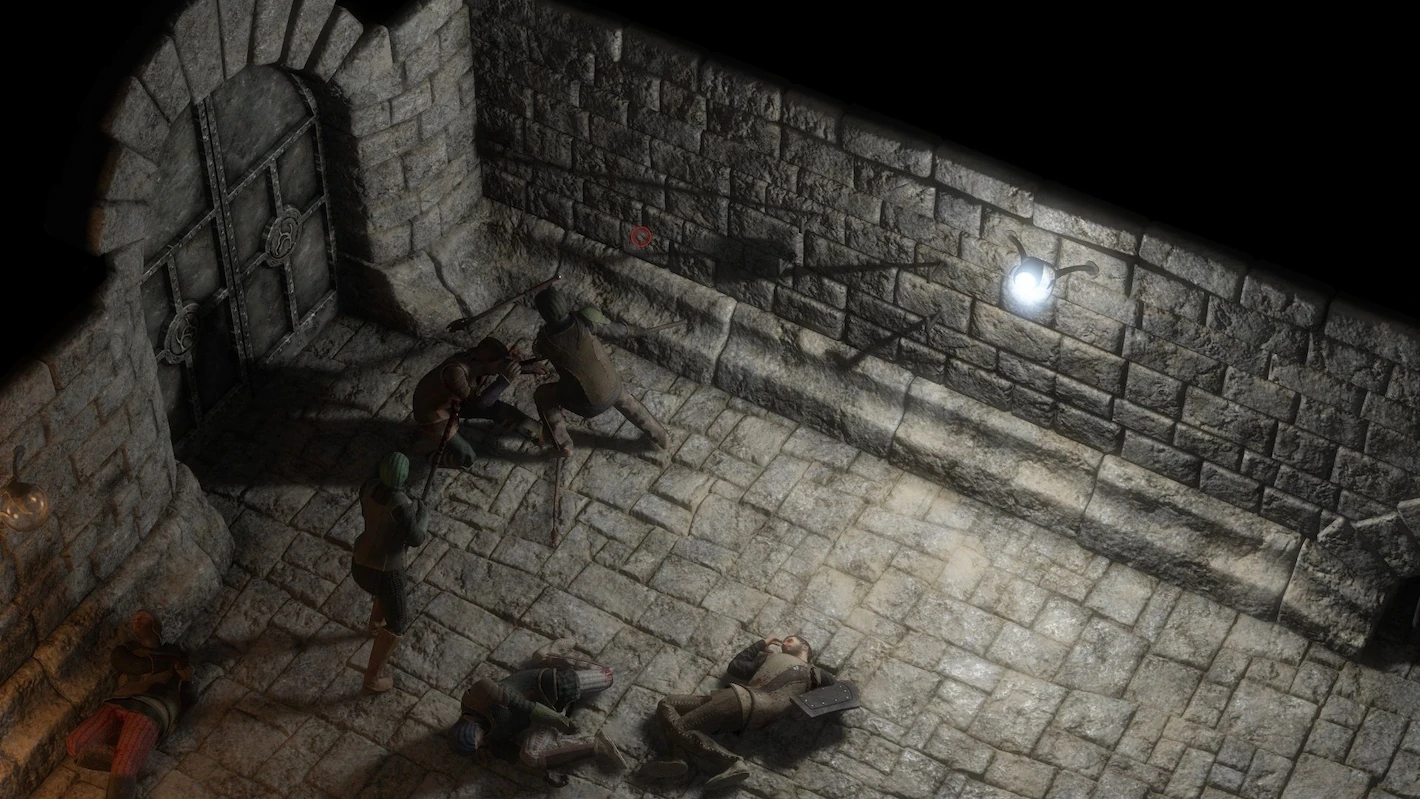
Exanima is not competing through enormous landscapes, cinematic facial capture or the sheer density of modern high-budget assets. Its visual strength comes from consistency and the way rendering supports the physical nature of the game. Stone appears cold and uneven, metal catches narrow lines of torchlight, fabric hangs from bodies rather than looking painted onto them, and rooms remain dark enough for illumination to change how they are read. Shadows stretch around furniture and architecture, giving ordinary objects a presence that matters both visually and mechanically. A table is part of the composition until a fight begins, at which point it becomes cover, obstruction, trap or accidental weapon. Armor does not merely change a character portrait; layers, shapes and materials build a silhouette that communicates protection, mobility and weight. The camera’s elevated position might suggest emotional distance, yet the carefully restricted lighting creates the opposite effect. Darkness hides enough information to make every illuminated area feel small, and the player often advances by carrying a limited island of visibility through spaces that extend beyond it. The Gardens introduced in update 0.9.5 expands this visual identity beyond the earlier grid-like interiors with vegetation, open spaces, complex terrain and a broader variety of encounters. The same update overhauled global illumination, contact shadows, materials, terrain, vegetation, clothing deformation and many older assets, while moving the game to 64-bit and substantially improving loading and performance. None of this turns Exanima into a conventionally spectacular game, and isolated screenshots may not fully explain why it can look so convincing in motion. Its beauty comes from interaction. Light moves over bodies, clothing responds, weapons collide, objects shift and characters struggle to keep their feet. The graphics are successful because they rarely feel detached from what the simulation is doing. Bare Mettle has spent years making its custom technology support that relationship, and the result has a visual weight that many technically newer games fail to achieve. Exanima does not need excessive effects to sell a blow. The position of the body, the sound of contact and the way the opponent folds into the environment usually do enough.

eleven years inside early access
Admiration for Exanima should not erase the uncomfortable scale of its development. The Steam page originally estimated approximately six to nine months of Early Access, yet the game entered the program in April 2015 and remains there in 2026. The difference between that estimate and reality is no longer a minor delay; it is a defining part of the project. Bare Mettle built its own engine, physics system, rendering technology, world-building tools, animation processes and supporting infrastructure while simultaneously expanding the ambitions of both Exanima and Sui Generis. That explains why progress has been difficult, but explanation is not the same as exemption. Players have spent years waiting for systems, story conclusions and features that were presented as part of a much shorter road. Some planned elements listed on Steam, including ranged combat, broader multiplayer support and more extensive interactions, still show how far the original vision extended. The studio itself acknowledged the unusual gap between updates when releasing version 0.9.5, describing the game as something that had grown far beyond its initial scope and become extremely difficult for a small team to develop. That honesty matters, particularly because the update was not a symbolic sign of life. It delivered a huge new map, expanded older areas, more than sixty new or redesigned items, additional encounters, new thaumaturgic content, major AI improvements and extensive changes to physics, rendering, movement and performance. Bare Mettle now identifies version 1.0 as the next major release, with one final area, new NPCs and the conclusion of the current story planned, while smaller updates may arrive beforehand. There is still no firm release date, so confidence must remain measured. Exanima is both an extraordinary technical achievement and an example of development without effective boundaries. Its refusal to compromise produced systems that no practical production plan would easily approve, but the same refusal turned a proposed short Early Access period into more than a decade. That contradiction cannot be separated from the game. It is the reason Exanima exists in this form and the reason its final form has taken so long to arrive.