REVIEW | MIDNIGHT MOMENTS | QUIET NIGHTS, BRIGHT STREETS
The empty grid does not stay empty for long. Midnight Moments does not begin with a grand urban plan, an economy waiting to collapse or a list of objectives pretending to be creative freedom. Instead, it drops you into a compact cyberpunk playground where the only real question is what kind of place you want to build after dark. Buildings can be stacked into dense little clusters, alleyways threaded between them, rooftops dressed with antennas and gardens, signs attached to rain-soaked facades and citizens placed into scenes that gradually stop looking like collections of props and begin looking like corners of an actual city. That simplicity is the foundation of the entire game. Happy Volcano deliberately built Midnight Moments around the absence of objectives, timers and fail states, while the full version expands the construction space beyond the smaller demo and includes features such as saving and structure repainting that were deliberately withheld there. What matters more than the feature list, however, is how quickly its compact structure pulls you in. Large creative sandboxes can sometimes make an empty canvas feel like work before the first object has even been placed. Midnight Moments has almost the opposite effect. The boundaries make the first decision easy, the first building encourages another, and before long a tiny block of anonymous architecture has acquired a street, some light, a rooftop detail and enough visual personality that tearing it down suddenly feels wrong. It is a modest idea, but the modesty works in its favour.

cyberpunk still carries something with it
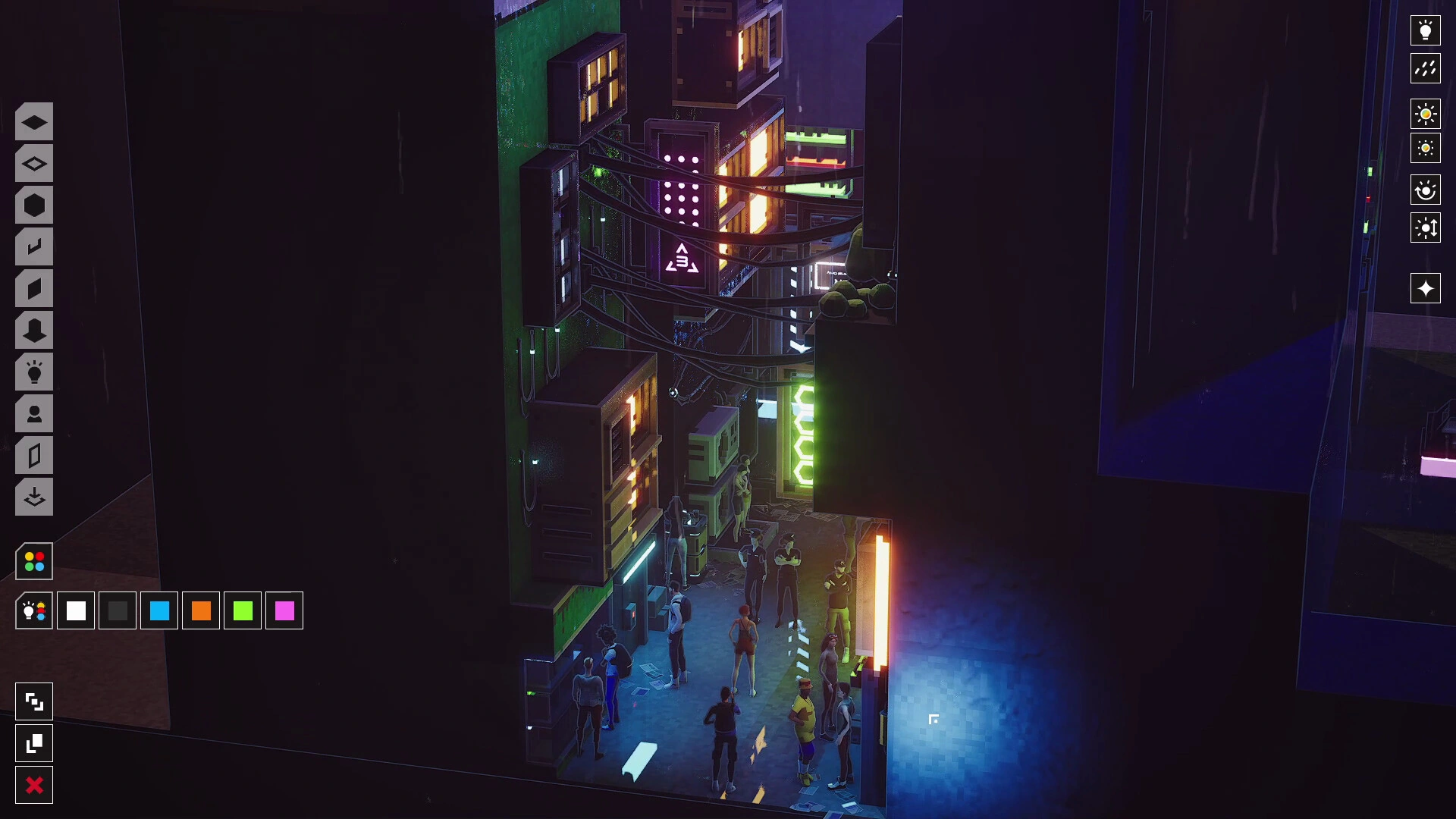
Cyberpunk has been reduced to a visual shortcut often enough that neon signs, wet asphalt and a few cables can feel less like an artistic identity and more like a preset. Midnight Moments gets away with using many of those familiar ingredients because it understands why they remain attractive in the first place. A dark building is just a dark building until a warm window appears halfway up its facade. A narrow passage becomes far more interesting when light leaks into it from a sign above. Rain, reflections, street lamps, clutter and the contrast between inhabited spaces and heavy darkness give even a tiny composition a sense of implied life. The game openly centers that atmosphere: its own description emphasizes rain-soaked backstreets, glowing apartment blocks, quiet neighbourhood corners and the simple pleasure of stepping back to look at what has been created. That cyberpunk Stimmung is one of Midnight Moments’ strongest advantages. It does not need a dystopian corporation, a scripted conspiracy or fifty pages of lore to produce the feeling that something exists beyond the edge of the scene. A well-arranged collection of windows, rooftop equipment and figures can suggest an entire district without actually building one. More importantly, the atmosphere rewards construction itself. Moving an object slightly, changing the density of a street or creating a darker pocket between two illuminated buildings can change the character of the whole diorama. The visual theme therefore is not merely decoration placed after the creative work is finished; it becomes part of the creative process. Midnight Moments understands that cyberpunk is often at its best when a city feels simultaneously crowded and lonely, and miniature scale turns out to be a remarkably good fit for that contradiction.
compact design becomes part of the appeal
The temptation with any building game is to assume that more space, more pieces and more systems automatically produce a better sandbox. Midnight Moments makes a respectable argument for the opposite. Its full build volume is a 10x10x10 grid, compared with the intentionally smaller 6x6x6 area used for the demo, and that limitation establishes an important rhythm: this is about composing a scene rather than conquering a map. Every building consumes meaningful visual territory. Every alley changes the relationship between nearby structures. Rooftops matter because they remain close enough to inspect instead of disappearing into an enormous skyline. Citizens and smaller props have more impact because the player is effectively designing a stage rather than filling square kilometres of empty land. It produces the kind of compact loop that can be surprisingly difficult to leave: add one structure, notice an awkward empty corner, fill it, adjust the lighting relationship around it, notice another possibility and continue. There is no score pushing that behaviour and no progression bar insisting that another ten minutes are necessary. The desire to keep touching the scene comes from the scene itself. That is also why the lack of conventional objectives should not be treated as a missing feature. Midnight Moments tells the player very clearly what it is: a relaxed single-player creative sandbox built around construction, decoration and observation rather than victory conditions. Players looking for management depth or a traditional city builder will obviously find the structure thin, but judged as a diorama tool, its small scale provides focus. The best moments come when the limited area stops feeling restrictive and starts feeling like a frame around a picture.

the pleasure is in arranging rather than achieving
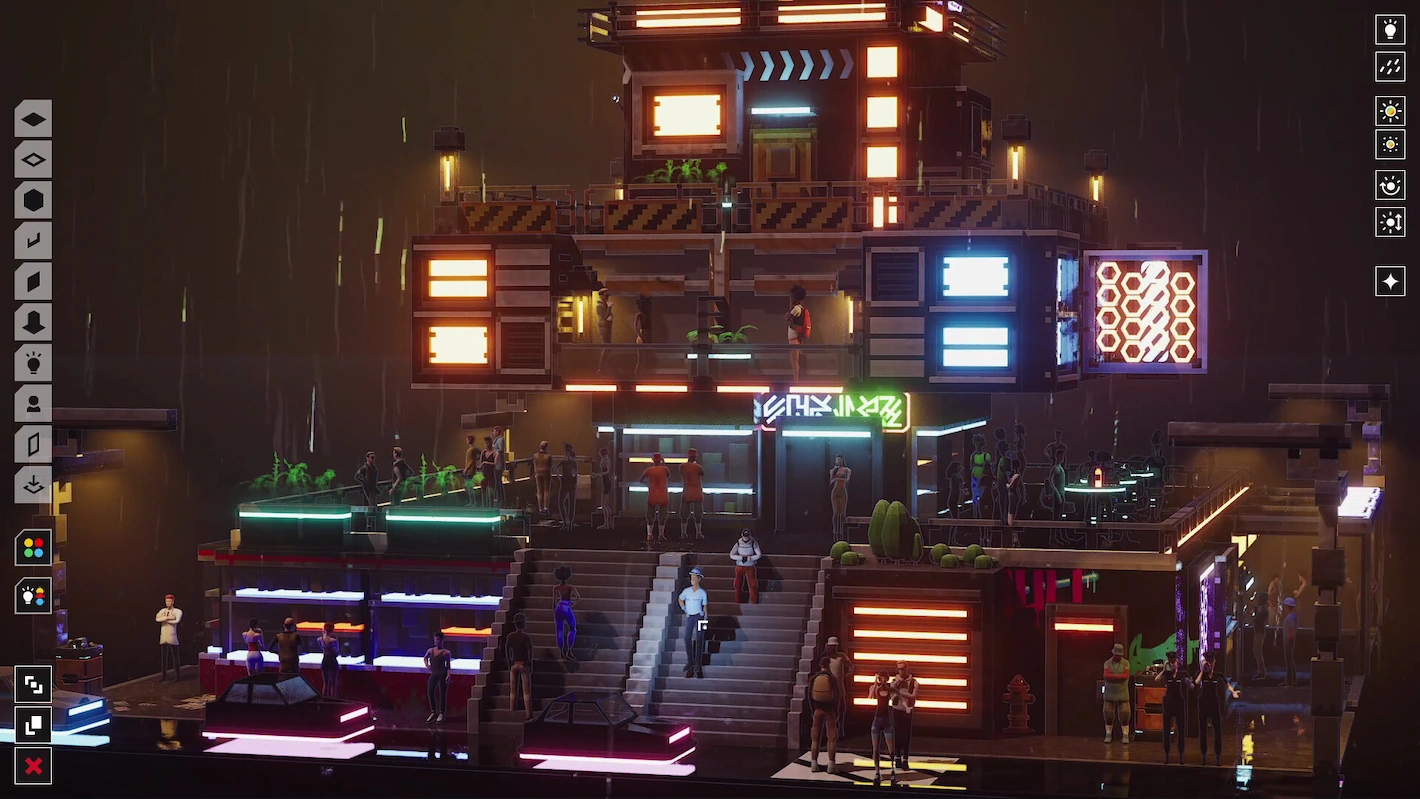
Once that fundamental idea clicks, Midnight Moments becomes an exercise in visual storytelling. Placing citizens is particularly important because architecture alone can look impressive without ever feeling inhabited. A person under a light, a figure near an entrance or a small cluster surrounded by environmental clutter immediately changes the implied story of a location. The game explicitly encourages using citizens and props to bring created districts to life, and that seemingly minor layer gives purpose to details that might otherwise function only as decoration. There is also something pleasantly direct about a creative game that does not constantly reward the player for being creative. No experience points arrive because a rooftop looks good. No achievement tracker needs to approve an alleyway. No economic simulation informs you that the atmospheric little corner you just built has insufficient commercial zoning. The reward is recognizing that the scene looks better than it did five minutes ago. This is where Midnight Moments separates itself from games that merely happen to include building tools. It is closer to arranging a model set, miniature railway landscape or desktop diorama than running a simulated city. That creates an unusually low barrier between intention and result: instead of spending an hour establishing an economy so that the interesting building can eventually begin, the interesting building is the activity. The trade-off is obvious. Players motivated primarily by progression will probably exhaust their interest much sooner than players who enjoy self-directed creation, because Midnight Moments has little interest in manufacturing external reasons to keep going. But within its chosen audience, that restraint feels coherent rather than unfinished.

the frame eventually reveals its edges
Compactness is one of Midnight Moments’ greatest strengths, but it also defines the ceiling the game eventually encounters. A focused toolkit makes it easy to create something attractive quickly; repeated use also means individual ingredients become familiar more quickly than they would in a much larger construction sandbox. Once the initial pleasure of discovering how different structures, signs, environmental pieces and citizens interact begins to settle, the longevity of the experience depends heavily on the player’s willingness to invent new compositions rather than on the game continuously introducing new problems to solve. That is the principal limitation behind our 82 rather than a score in the upper eighties or nineties. The underlying concept is strong, but its appeal is deliberately narrow. There are no conventional objectives to change the rhythm, no management layer to generate unexpected situations and no campaign pulling the player toward a radically different type of challenge. Those omissions are not disadvantages by themselves adding them could easily ruin what makes Midnight Moments pleasant but they do mean that variety must come largely from creativity and the available construction vocabulary. The more often similar visual ideas appear, the easier it becomes to recognize the boundaries of that vocabulary. This is also a game where the difference between someone spending three hours and thirty hours may have very little to do with mechanical skill and everything to do with how much satisfaction that person receives from continuously refining tiny spaces. Midnight Moments does not fail when those limits become visible; it simply makes no attempt to disguise them. The important thing is that there is enough personality inside the frame for reaching its edges to remain enjoyable.