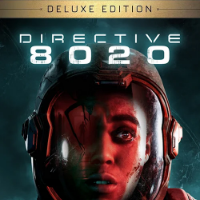
REVIEW | DIRECTIVE 8020 | SLOW SPACE HORROR WITH SHARP TEETH 
A cold corridor in deep space can still do more for me than half the louder horror games released in a year. Directive 8020 understands that at its best. It is not built around constant action, endless combat, or cheap noise. It works better when it slows down, locks the player inside narrow metal spaces, lets the ship breathe around the crew, and makes every quiet room feel like it may already be wrong. That kind of claustrophobic third-person sci-fi immersion is not for everyone, but when it clicks, it clicks in a very specific way. For players who enjoy slower tension, confined environments, story pressure and the feeling of being trapped inside a failing machine far from home, Directive 8020 has more value than its average critical score may suggest.
a ship that does not feel safe
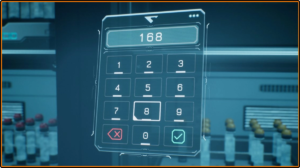
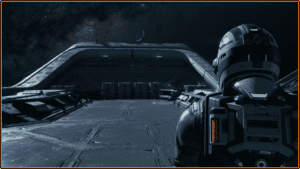
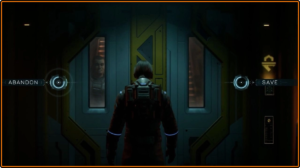
Supermassive Games returns here with a project that feels both familiar and more ambitious than several earlier Dark Pictures entries. Directive 8020 keeps the studio’s usual foundation: cinematic storytelling, branching choices, playable characters who can survive or die depending on decisions, and a heavy focus on relationships, panic and consequence. The difference is the setting and the stronger push toward survival horror movement. Instead of haunted towns, folklore or grounded slasher material, the game moves into sci-fi horror aboard the Cassiopeia, a colony ship tied to humanity’s future and a mission connected to Tau Ceti f. The result is immediately more appealing for anyone who likes space horror as a mood, not only as a genre label. The Cassiopeia is not just a background. It is the main pressure point. The narrow corridors, medical rooms, technical sections, dim industrial spaces and clean sci-fi surfaces slowly start to feel less like a ship and more like a sealed container where the crew is running out of certainty. That is where Directive 8020 works best. It does not need to throw something at the screen every minute. The ship itself creates discomfort. A locked door, a quiet hallway, a flickering panel, a room that seems too calm after everything that happened before those small things carry the game’s best atmosphere.
the thing in the crew
The setup is simple enough to understand, but strong enough to work. Earth is in decline, the Cassiopeia is part of a desperate colonization effort, and the crew finds itself dealing with a threat that can imitate humans. That idea obviously walks in the shadow of classics like The Thing and Alien, and Directive 8020 does not exactly hide those inspirations. Sometimes it leans on them too openly. But the game’s best sections still manage to build their own identity through the ship layout, character suspicion, slow investigation and the constant question of who can actually be trusted. It is not the most original sci-fi horror premise in the world, but it is a strong playground for the kind of decision-driven panic Supermassive likes to create. The imitation angle gives the story a useful kind of paranoia. In a normal monster story, the threat is somewhere outside the group. Here, the fear can sit inside the conversation. A character can sound normal, act normal, and still carry the wrong kind of silence. That does not always reach its full potential, because some scenes still follow familiar horror beats, but the premise does enough to keep the crew dynamic tense. Directive 8020 is strongest when danger is not only a creature in the next room, but a question hanging over the people standing right beside you.
slow pacing that actually helps
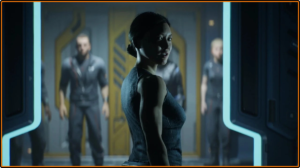
The thing I appreciate most is the pacing. Some players may call it slow, and in a standard action-horror sense, they would not be wrong. Directive 8020 takes its time. Characters talk, walk, search, hesitate, argue and react. The ship does not instantly become a shooting gallery. You spend time inside the atmosphere before the game starts pushing harder. For me, that works in its favor. I like games that allow the environment to settle. I like the feeling of moving through a place rather than being dragged through one scripted explosion after another. Directive 8020 is stronger when it lets the silence sit for a moment, when a corridor feels too long, when a door opens into another room that looks normal but does not feel safe. That slower tempo will be one of the biggest dividing lines. If someone wants a horror game that constantly rewards movement, shooting, upgrades and action spikes, this will probably feel uneven. But if the appeal is atmosphere, presence and slow pressure, Directive 8020 becomes much easier to appreciate. It has that particular kind of sci-fi horror rhythm where the player is not always “doing” something dramatic, but the world is still pressing down on them. That matters. Not every game needs to be fast to be tense. Sometimes a slow walk through a corridor with the wrong sound in the distance is enough.
a visually strong sci-fi horror mood
Visually, the game is easy to respect. It runs on Unreal Engine 5, and while it is not flawless, the general presentation is very solid. The Cassiopeia has that clean-but-damaged sci-fi look where white panels, medical lighting, industrial surfaces and broken systems slowly turn into something colder and more hostile. The game looks especially good in smaller details: faces under harsh light, reflections on metal, dark corners, emergency glow, ship interiors that feel practical enough to believe in. It does not always have the most dynamic environments, and some spaces can feel sparse, but the overall visual identity is strong. For a narrative horror game, that matters a lot because the atmosphere is half the experience. The graphics are not perfect in every moment, but they are more than respectable. Character faces can look impressive in the right lighting, and the ship has enough texture and atmosphere to support the story. Some areas repeat the same sterile sci-fi language, but that also fits the setting. This is not a colorful, open adventure. It is a controlled, metal, oxygen-starved horror space. The visual style supports that feeling well. When the lighting, sound and camera line up, Directive 8020 can look genuinely cinematic without feeling completely passive.
better control, still some stiffness
The third-person control feels better than older Supermassive work, although it still carries some stiffness. Movement is smoother, camera control is more natural, and the player has more physical presence in the world than in the studio’s earlier interactive dramas. That helps Directive 8020 feel less like a movie that occasionally asks for input and more like a game built around cinematic control. Still, this is not Dead Space, and it should not be judged like one. The strength here is not mechanical depth. The strength is mood, tension, choice and survival under pressure. When the game remembers that, it works very well. The controls do enough to support immersion, but they do not always disappear. You can still feel the cinematic design around the edges. Movement sometimes has that careful, slightly guided quality, and some interactions feel built more for pacing than freedom. That is not automatically a flaw in this type of game, but it is noticeable. Directive 8020 wants to be more playable than a pure interactive movie, but it is still not a fully mechanical survival horror game. It lives somewhere between those two approaches, and that middle ground is both its strength and its limitation.
stealth with good ideas, uneven execution
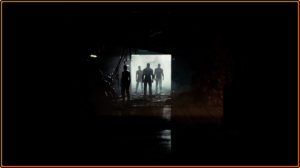
The new stealth and survival elements are more complicated. On paper, they are exactly what this formula needed. Sneaking through a ship while something dangerous may be nearby fits the premise perfectly. In practice, the stealth is not always sharp enough to carry the fear by itself. Enemy behavior can feel readable, some sequences repeat their rhythm, and the actual act of hiding or moving past danger is not as tense as it should be. The idea is right, but the execution is uneven. The best stealth sections add pressure between story scenes. The weaker ones feel like the game wanted to become more mechanical without fully committing to that direction. That is probably where many critics cooled on Directive 8020. The game wants to expand beyond the traditional Supermassive template, but not every new system lands with the same confidence. Some chase moments and danger sequences are effective because they are short, cinematic and tied to character stakes. Others feel more like routine gameplay blocks placed between the stronger narrative parts. This does not ruin the game, but it does stop it from reaching a higher score. A sci-fi horror story about paranoia and survival needs unpredictability. When the player starts to understand the pattern too clearly, some of the fear naturally fades. The stealth is not bad enough to break the experience, but it is not strong enough to become the main reason to play. It works best as seasoning, not as the core meal. When the game uses stealth to increase vulnerability, it succeeds. When it stretches those sections too long, the seams show. This is where Directive 8020 feels like a studio trying to push its formula forward, but still figuring out how far it can go without losing the cinematic structure that defines it.
choices, consequences and second chances
The choice system remains one of the main reasons to play. Directive 8020 gives the player several characters and a branching structure where decisions can affect relationships, traits and survival. The game also introduces Turning Points, a system that allows players to rewind important moments depending on the selected mode. This is a smart feature for players who hate losing a character because of one bad reaction or misunderstood choice, but it also changes the emotional weight of the game. If you know you can go back, panic becomes softer. I prefer the more committed way of playing, where mistakes stay with you, but I understand why Supermassive added the option. It makes the game more accessible without forcing everyone to use it. The branching structure gives Directive 8020 a reason to exist beyond one straight playthrough. Character survival matters, and the game is clearly designed around the possibility that your version of the story may not look exactly like someone else’s. That is still Supermassive’s strongest card. Even when the mechanics are uneven, the pressure of making a decision under stress can work. The best moments are not always the biggest horror scenes. Sometimes they are the small choices where you are not completely sure what information you have, but the game still expects you to act.

a cast built for pressure
The cast is generally good, with Brianna Young standing out as the emotional center of the story. The performances do not always land equally, and some dialogue has that familiar Supermassive awkwardness where people speak slightly more dramatically than the moment needs. Still, the better scenes work. The crew dynamic matters because the whole game depends on doubt, trust and survival pressure. When characters start questioning each other, when leadership cracks, when private fear becomes a public problem, Directive 8020 feels much more confident. It is at its best when horror comes from people trapped together, not just from the thing hunting them. Some characters are stronger than others, and not every personal conflict hits with the same force. But the game understands that space horror needs human friction. A ship full of calm professionals would become boring very quickly. Directive 8020 gives the crew enough fear, ego, loyalty and uncertainty to keep scenes moving. The writing is not always subtle, but the overall group tension works. When the game puts the crew under pressure and lets suspicion spread, it becomes much more engaging than when it simply follows genre routine.
familiar horror, but used well enough
The story will probably divide players. Some will enjoy the familiar sci-fi horror references and the ship-bound paranoia. Others may feel that the game borrows too much from better-known material without always adding enough of its own. I land somewhere in the middle, but leaning positive. Yes, the influences are obvious. Yes, the game sometimes walks very close to genre comfort zones. But I also think Directive 8020 uses those familiar parts well enough to create a strong playable mood. Not every horror game needs to reinvent space fear from zero. Sometimes it needs to understand why that fear works: isolation, mistrust, distance from home, and the ugly thought that rescue may not be coming. That is why the game deserves a little more generosity than a plain average score might suggest. Directive 8020 is not a revolution. It is not the new standard for sci-fi horror. But it has a clear mood, a strong setting and a type of pacing that will speak directly to players who enjoy slow, contained, third-person immersion. In that specific lane, it does its job better than many games that look more polished on a checklist but leave less of a feeling behind.
who should actually play this
For players who want constant mechanical excitement, this may not be an easy recommendation. Directive 8020 is slow, cinematic and sometimes uneven. It asks for patience. It is a better game when played in the right mood, not rushed between louder releases. If you enter expecting a pure action horror game, the quiet stretches may frustrate you. If you enter wanting a dark, claustrophobic, story-heavy space horror experience, those same stretches become part of the appeal. That distinction matters a lot. For me, the game earns more respect than its average critical score suggests because it knows how to build a particular atmosphere. I like this kind of pacing. I like third-person sci-fi horror that allows the player to feel the ship around them. I like the slow pressure of sealed rooms, narrow passages, damaged systems and people trying to stay rational while everything around them becomes less certain. Directive 8020 is not perfect, but it scratches that specific itch better than many cleaner, faster, safer games.
replay value and final weight
It also helps that the game has replay value if you care about branching outcomes. Different choices, character survival, Turning Points and relationship changes give the structure more weight than a single straight horror campaign. It is not a game I would recommend replaying immediately for everyone, because some of its mystery naturally works best the first time. But for fans of Supermassive’s format, the branching design remains part of the attraction. The game is not only about reaching the ending. It is about watching how badly your version of the mission can go, and whether your decisions actually helped or quietly made everything worse. Directive 8020 deserves criticism for its uneven stealth, occasional stiffness, and moments where tension drops instead of rising. It is not a masterpiece, and calling it one would be unfair. But it is also not just an average horror experiment. It has a strong setting, good atmosphere, respectable visuals, a solid cast, and a style of slow sci-fi dread that will land much harder for the right player than for the general audience. That is why a pcdoorz score of 83 feels fair. It recognizes the flaws, but it also gives credit to the experience the game is clearly trying to deliver.