PREVIEW | VERITAS TALES: WITCH OF THE DARK CASTLE | PAGES, STATS & DARK MAGIC
Veritas Tales: Witch of the Dark Castle feels like the kind of PC RPG that does not try to win attention by being louder than everything around it. It goes the other way. It looks small at first glance, almost quiet, built around pages, choices, stats, illustrations, and that old fantasy feeling where a sword, a spell, and a bad decision can carry an entire adventure. Developed by veteran artist Yoshio Nishimura, known for work connected to Vanillaware titles such as Odin Sphere and 13 Sentinels: Aegis Rim, this is not a giant studio production trying to imitate the scale of modern RPGs. It is a handmade storybook RPG shaped over several years, with a strong tabletop flavor and a clear respect for the kind of fantasy games that existed before everything needed a massive open world, cinematic camera, and a hundred icons on the map. That alone makes it interesting for pcdoorz, because PC gaming has always had room for the strange, the personal, and the slightly stubborn.
a storybook rpg with old-school bones
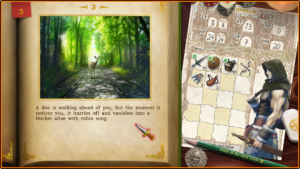
The main hook of Veritas Tales is its presentation. Instead of throwing the player into a fully explorable 3D world, the game presents its adventure like a digital fantasy book. You turn pages, read scenes, face encounters, make choices, check your character details, and move through the story in a way that feels closer to tabletop role-playing and old gamebooks than modern action RPG design. That does not mean it is passive. The game includes stats, inventory, enemies, choices, and combat situations, but its rhythm seems slower and more deliberate. It is not trying to replace Baldur’s Gate 3, Elden Ring, or any other huge RPG. It seems more interested in reminding players that fantasy role-playing can also live inside a page, a portrait, a dice-like decision, and a carefully drawn monster waiting on the other side of a choice. That approach could work well if the writing, pacing, and encounters have enough bite. A storybook RPG needs more than good art. It needs tension inside the page. Every choice has to feel like it matters, every enemy has to feel like it belongs in the world, and the interface needs to feel tactile rather than static. From what has been shown, Veritas Tales seems built around that analog idea: the feeling of sitting with a fantasy book, a character sheet, and a little bit of danger. For players who enjoy fast loot loops and constant movement, this may not be the right fit. For players who like slower fantasy, old-school structure, and RPGs that feel handcrafted rather than processed, this could become one of those small games that stays in memory longer than expected.
hand-drawn fantasy in a digital frame
One of the strongest details around Veritas Tales is the claim that Nishimura created more than 300 illustrations by hand, with no generative AI used in the process. That matters more now than it might have a few years ago. In a period where game art can sometimes feel filtered through the same pipelines, the idea of one artist spending years building a fantasy world by hand gives the project a real identity before release. The screenshots and concept suggest a game that wants its illustrations to carry atmosphere, not just decorate menus. That is important for this format, because the image on the page becomes the place, the enemy, the mood, and sometimes the whole scene. The art direction also has an old fantasy book quality, the kind that does not look overly clean or polished to death. That can be a strength. The best storybook games usually understand texture. A perfect image is not always the most interesting one. Slight roughness, heavy lines, unusual faces, and strange creature designs can do more for immersion than another glossy fantasy render. If Veritas Tales leans fully into that handmade look, it could separate itself from many indie RPGs that use retro inspiration but still end up feeling familiar. This one has a chance to feel more like a personal object than a product built by template.

the sakimoto factor
The music credit is another reason to watch this closely. Hitoshi Sakimoto’s name carries weight for anyone who pays attention to Japanese RPG and strategy game soundtracks. His work across games like Final Fantasy Tactics, Tactics Ogre, Valkyria Chronicles, and multiple Vanillaware-related projects has a certain dramatic, orchestral identity that fits fantasy without needing to become generic. For Veritas Tales, that could be a major advantage. A storybook RPG depends heavily on mood, and music can decide whether turning a page feels flat or ceremonial. This is also where the game’s small scale could become a benefit. A restrained RPG with strong illustrations and proper music can feel more focused than a large game stretched across too many systems. If the soundtrack supports the sense of old fantasy, mystery, and danger, Veritas Tales may have enough atmosphere to carry its slower design. The danger, of course, is that the format could feel too static if the writing and encounter variety do not keep up. But with the right pacing, the combination of illustrated pages and Sakimoto’s music could give the game a very specific identity: not a nostalgia copy, but a modern digital gamebook with serious craft behind it.
why this matters on pc
PC is probably the right home for a game like this. Not because it needs extreme hardware, but because PC players are usually more open to unusual RPG formats. The platform has always supported games that sit somewhere between genres: visual novel, dungeon crawler, tabletop RPG, gamebook, strategy RPG, interactive fiction. Veritas Tales seems to live inside that space. It may not be the kind of game that dominates release calendars, but it has the type of concept that can find a dedicated audience if the execution is strong. The comparison to huge fantasy games should be handled carefully. Veritas Tales should not be expected to compete with Elden Ring or Baldur’s Gate 3 on scale, systems, or spectacle. That would be unfair and honestly not very useful. The better question is whether it can offer something those games do not: a compact, handmade, page-driven RPG experience with a stronger sense of authorship. In that sense, its size may actually help it. A smaller RPG can afford to be weird. It can afford to choose mood over market logic. It can afford to feel like someone’s personal fantasy notebook finally turned into a game.
what we want to see
The biggest question before release is how interactive the game really feels across its full length. A 20+ hour storybook RPG needs enough decision-making, combat variation, character growth, and narrative surprise to avoid becoming repetitive. The page-turning structure is charming, but charm alone will not carry a long RPG. The player needs reasons to keep making choices. The fighter and witch setup sounds promising because it suggests different approaches to encounters, possibly through strength, magic, conversation, avoidance, or tactical decision-making. If those choices meaningfully change the rhythm of the adventure, Veritas Tales could become much more than a beautiful illustrated book. The second question is interface feel. Storybook RPGs live or die by usability. If menus are slow, choices are unclear, or combat lacks feedback, the old-school design can start feeling clumsy instead of charming. But if the interface feels responsive and the pages have that satisfying “one more turn” quality, this could become a very comfortable PC RPG, especially for players who enjoy slower sessions, reading, and role-playing without constant action. It does not need to be modern in every way. It just needs to be clear, readable, and confident in its own pace.