
PREVIEW | PROJECT SUBSTRATA | AUTOMATE A PLANET BACK TO LIFE
A solitary machine moves across land where the sky has lost its clarity, vegetation has disappeared and the structures left by humanity stand without anyone to operate them. There are no colonists waiting for shelter and no settlement asking for expansion. The player controls a self-sustaining AI robot left behind on an abandoned world, with the enormous task of recovering its resources, cleaning its polluted environment and rebuilding the systems that once made life possible. Project Substrata is an upcoming base-building, automation and environmental-restoration simulation from Studio Substrata, currently planned for PC during 2026. Its factories do not exist merely to produce larger quantities of increasingly advanced components. Every drill, processor, transport route and power network contributes to a wider attempt to repair the planet itself. The concept places industrial expansion and ecological recovery inside the same mechanical structure, turning machinery into both the cause of environmental pressure and the tool required to reverse it. Steam currently confirms single-player and online cooperative play, while the game is also expected to support achievements, Steam Workshop integration, cloud saves and leaderboards.
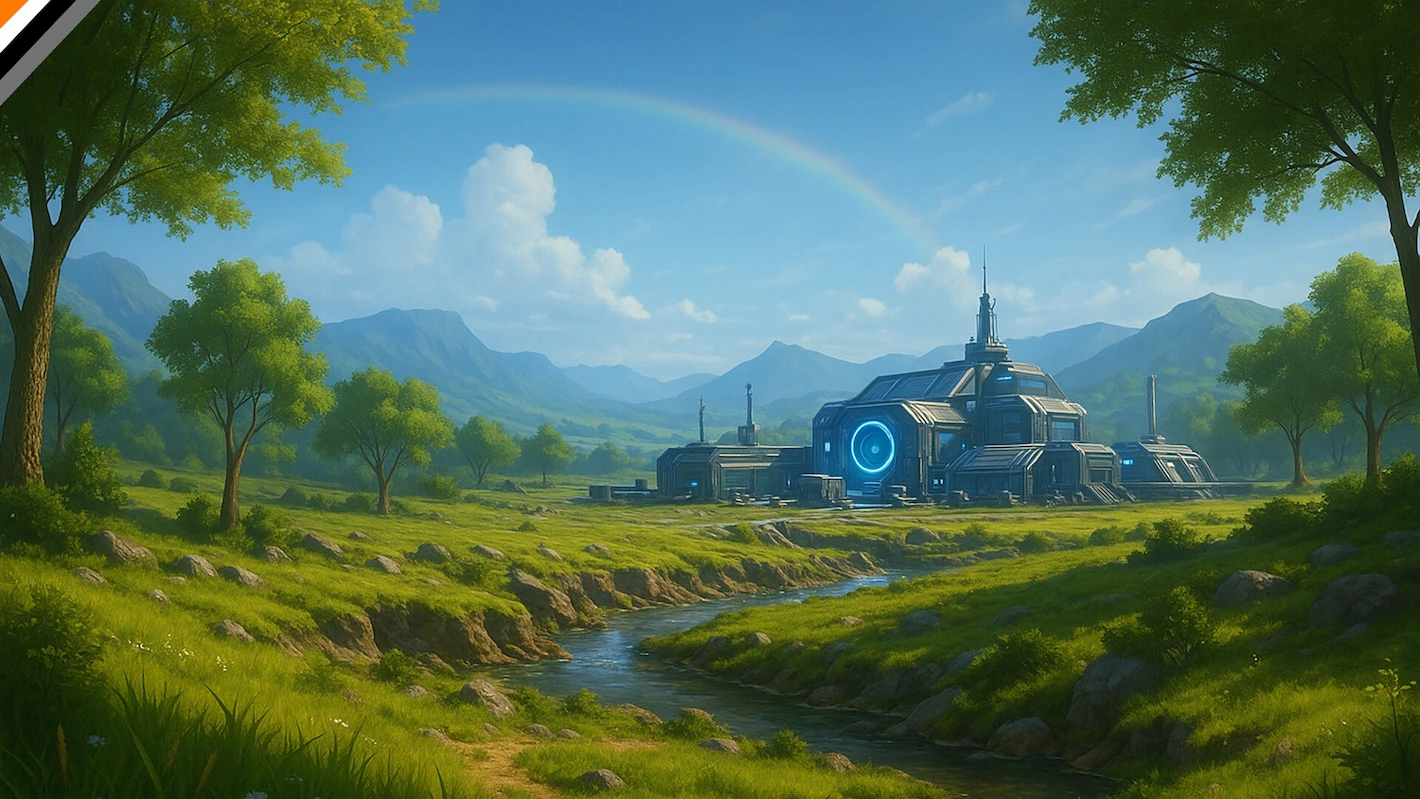
a base assembled around purpose rather than decoration
Construction begins with modular components that can be combined freely into functional facilities. Floors, walls, stairs and control pillars form the physical structure, while connected power and lighting lines communicate the operational state of the machinery through visible changes in illumination. This gives the base more than a collection of disconnected production boxes placed on flat ground. Its architecture is intended to show how energy, materials and control systems move between different areas, allowing form and function to develop together. That visual clarity will be important because Project Substrata appears interested in large, interconnected industrial systems rather than small crafting benches. A well-designed complex should let the player understand where resources enter, how they are processed and where inefficiencies are forming without repeatedly opening layers of menus. The modular approach also leaves room for personal expression, but the strongest designs will likely be those shaped by terrain, logistics and environmental goals rather than symmetry alone. Building a beautiful facility may be satisfying, yet the planet will ultimately judge it by what it produces, consumes and releases into the atmosphere.

automation must balance materials, power, heat and waste
The production system links drills, smelters, compressors, assembly units and other facilities into automated chains. Materials must be extracted, refined and moved through increasingly complex processes, but efficiency is not measured only by output. The official description specifically highlights power, heat and exhaust alongside the movement of physical resources, suggesting that every production line may create secondary pressures that require their own infrastructure. A factory capable of manufacturing advanced components could still damage the recovery effort when its energy demand becomes excessive or its pollution overwhelms the planet’s ability to heal. This is where Project Substrata can separate itself from automation games in which environmental consequences are little more than a colored cloud around the machines. Sustainability needs to become a genuine engineering problem. Cleaner systems should require planning and investment rather than functioning as automatic upgrades, while heavily industrialized solutions may remain useful when rapid expansion matters more than long-term stability. The most interesting decisions will appear when the fastest route toward better technology is not necessarily the safest route toward a habitable planet.

drones turn distant outposts into one industrial organism
As the player’s activity expands beyond the original base, autonomous drones become responsible for connecting remote installations and transporting supplies across the planet. Their route calculations account for distance, weather, cargo capacity and fuel consumption, while larger drone hubs can coordinate groups of units into broader logistics networks. This introduces a layer of planning beyond simply connecting two buildings with a conveyor belt. A distant mining operation may contain valuable resources, but maintaining it could require fuel depots, protected routes and enough transport capacity to prevent production from stopping whenever weather conditions change. Drone swarms also create the possibility of a planet-wide system in which each outpost performs a specialized role instead of duplicating the same production chain everywhere. For that network to remain engaging, however, automation cannot remove every problem once the correct setup has been built. Routes should respond to changing conditions, bottlenecks should remain visible, and expansion should create new logistical questions rather than merely increasing the number of identical vehicles in motion. Project Substrata’s drones are not external generative-AI services; they are ordinary offline gameplay and narrative systems operating within the simulation.

the planet’s recovery is measured through four connected systems
Environmental restoration revolves around four principal values: atmosphere, temperature, water and pollution. Player-built infrastructure directly changes these conditions, gradually clearing the sky, supporting vegetation and restoring biological activity to the surface. This provides a more tangible objective than reaching an arbitrary production total. The factory effectively becomes the respiratory and circulatory system of the world, converting buried materials into the equipment needed to make natural processes possible again. The four-value structure sounds understandable, but its success will depend on how strongly those systems influence one another. Temperature should affect water, atmospheric changes should modify weather, and pollution should create consequences beyond reducing a progress bar. Visible transformation will be equally important. A restoration game becomes far more rewarding when the player can look across an area that was once lifeless and recognize forests, water and clearer air produced by earlier decisions. New materials and technologies are unlocked through research modules, eventually expanding operations from the surface into subterranean regions and moving the project closer to the possibility of humanity’s return.

single-player restoration with optional online cooperation
Project Substrata is confirmed as a single-player game, so the core experience does not depend on assembling a permanent online group. Steam also lists online co-op, although the current store description does not yet explain how responsibilities, progression or ownership will be divided between players. Cooperative construction could suit the game particularly well: one player might design production lines while another establishes drone routes or monitors environmental recovery across distant regions. Steam Workshop support could also extend the project through community-created content, provided the building and automation systems expose enough tools for meaningful modifications. The technical foundation is Unreal Engine 5, with dynamic day-and-night lighting and real-time environmental rendering intended to show both industrial activity and the planet’s gradual transformation. The listed minimum specification currently includes a Core i5-8400 or Ryzen 5 2600, 8GB of memory, a GTX 1060 or RX 580 with 6GB of VRAM and 15GB of storage, although those requirements may change before release.