
PREVIEW | MARS DIRECTIVE | TALK YOUR WAY THROUGH THE CRISIS
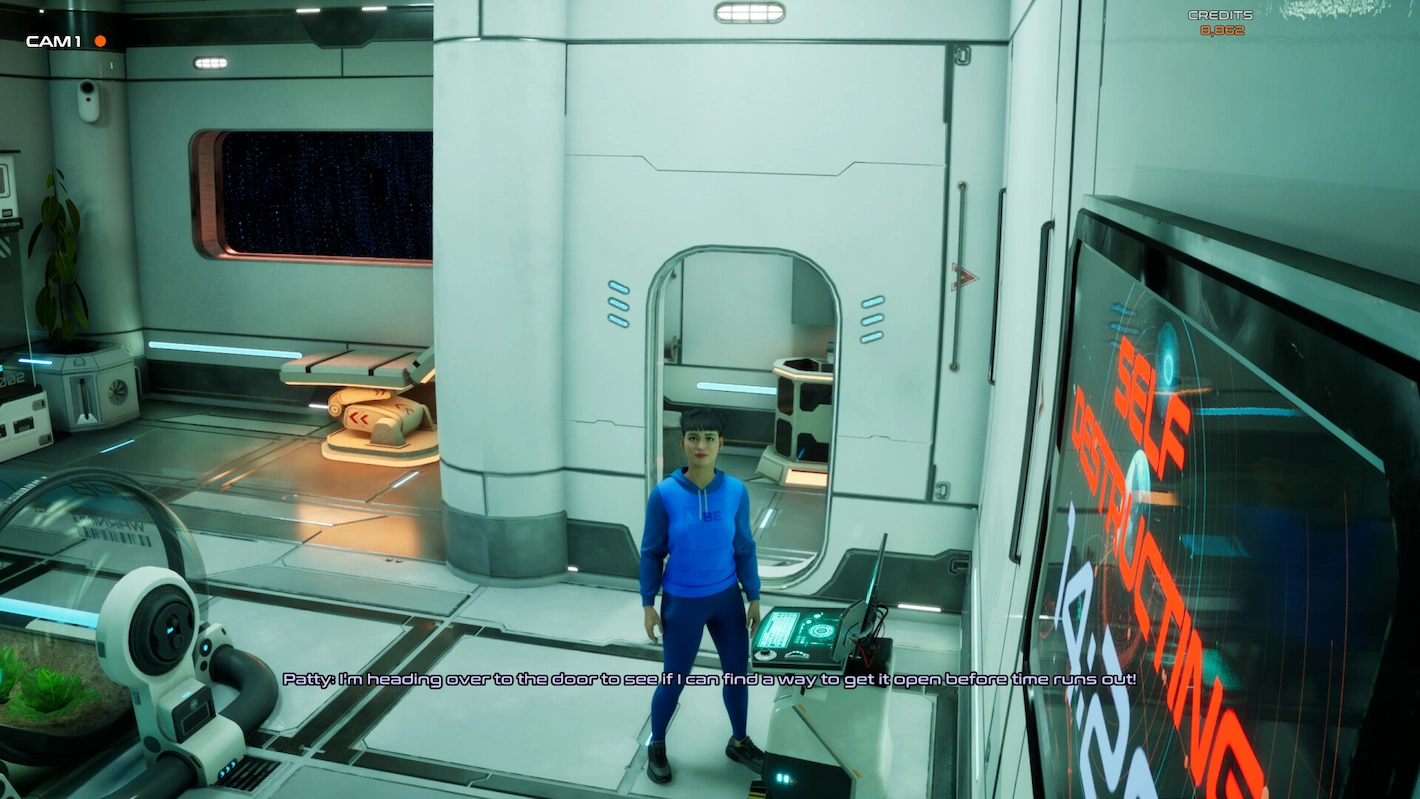
A silent security feed shows a damaged shuttle drifting toward Mars, its systems dark after an unexplained explosion and its surviving crew member unable to remember what happened. The player cannot step into the corridor, search the rooms personally or take direct control of the person trapped aboard. Communication is the only available tool. Through cameras and natural conversation, the player must guide Patty as she examines the vessel, operates equipment and tries to reconstruct the events that left the mission in danger. This unusual separation between instruction and action forms the foundation of Mars Directive, an upcoming single-player science-fiction puzzle adventure from Blackdeep Technologies and Studio 67 GAMES. Rather than presenting Patty as a conventional companion waiting for scripted commands, the developers describe her as an autonomous character capable of observing her surroundings, remembering previous information, reasoning about new situations and deciding how to respond. Mars Directive is currently listed as a free standalone PC experience scheduled for August 2026, but its importance may have less to do with its size than with the experiment at its center: whether an AI-controlled character can become a reliable gameplay partner instead of an unpredictable conversational novelty.
conversation replaces the traditional control scheme
Most narrative games give players carefully limited dialogue options, even when those options are written to suggest freedom. Mars Directive removes that familiar structure and allows communication through ordinary language. There are no predefined responses to select and no visible dialogue tree revealing which sentence will advance the scene. The player can ask Patty to inspect a particular object, explain an observation, reconsider a conclusion or attempt a solution using phrasing that the developers did not manually place inside a menu. Voice interaction is a central part of the concept, turning the experience into something closer to directing a capable person through an emergency than controlling an avatar through standard inputs. This does not mean every imaginable request can become an action. Patty remains limited by the locations, equipment, animations and interactions supported by the game, but the route between discovering a problem and attempting a solution is designed to be more flexible. The player is not searching for the correct dialogue button; the challenge is communicating an idea clearly enough that another character can understand it, evaluate the situation and determine what to do next.
patty must do more than produce convincing dialogue
The use of a large language model will naturally attract attention, but believable sentences are only the surface of what Mars Directive promises. Patty is expected to connect speech with physical context. She can explore the environment, examine objects, operate machinery, retain information from earlier events and use those memories while reasoning about later problems. The developers also state that autonomous characters can communicate with one another, challenge conclusions, exchange ideas and coordinate actions without every step being directly selected by the player. These systems could make a puzzle feel less like a locked mechanism with one predetermined solution and more like a collaborative investigation. A vague observation might lead Patty toward an unexpected object, while an earlier detail could become relevant after another section of the shuttle is opened. However, this is also where the concept faces its most demanding test. A character who speaks naturally but repeatedly forgets evidence, misunderstands the layout or performs actions unrelated to the conversation will damage the illusion immediately. Mars Directive must demonstrate that its AI is grounded in the actual state of the game world rather than simply generating responses that sound appropriate in isolation.

uncertainty could create genuine investigation
The mysterious explosion provides a useful setting for an AI-driven structure because neither the player nor Patty begins with a complete explanation. Information must be gathered through observation, conversation and interpretation, giving the game room to make uncertainty part of the puzzle rather than merely part of the plot. Patty’s missing memory means the player cannot treat her as an encyclopedia that supplies every answer on request. She is another participant trying to understand the disaster, and her assumptions may need to be tested against evidence found aboard the shuttle. This relationship could produce situations that feel more personal than conventional adventure-game puzzles. Instead of placing three objects into an obvious mechanism, the player may need to persuade Patty that a damaged system is safe to approach, explain why two clues appear connected or ask her to reconsider an action after discovering contradictory information. The strongest version of Mars Directive would allow different players to reach similar conclusions through noticeably different conversations. Its puzzles would still require boundaries and designed solutions, but the process of forming those solutions could become less rigid and more dependent on how effectively the player and character establish a shared understanding of the crisis.

the technology introduces serious practical risks
Every feature that makes Mars Directive interesting also creates another way for the experience to fail. Broadband internet is listed among the requirements, meaning the central character system depends on an external connection rather than functioning entirely as a fixed offline simulation. Response delays could interrupt tense scenes, server problems could temporarily affect accessibility, and future availability may depend on continued support for the underlying AI services. Consistency is another major concern. Traditional dialogue trees may be restrictive, but writers know exactly what each character will say and how every response connects to the next scene. A generative system introduces greater variation and therefore requires strong behavioral rules to prevent Patty from contradicting established facts, breaking her personality or revealing information before the story is ready. The developers say character behavior is guided by definitions, gameplay context and rules intended to maintain consistency, but the finished game must show how well those restrictions survive prolonged interaction. Mars Directive does not need to understand every sentence perfectly. It does need to recover gracefully from confusion, communicate its limitations and prevent one misunderstood instruction from bringing the investigation to a halt.