
PREVIEW | LUNAR STRIKE | EXPLORATION OVER ACTION…AS IT SHOULD BE
You don’t often see a game strip things back this much and still feel confident about it. Lunar Strike doesn’t try to grab you with explosions, fast movement, or constant pressure. Instead, it does something that feels almost out of place in modern gaming it slows everything down and asks you to pay attention. Set in 2119 on the Moon’s south pole, the game puts you in the role of someone who isn’t there to fight, survive waves of enemies, or prove anything through action. You’re there to observe, document, and preserve what’s left of a collapsing human effort beyond Earth.

That shift in focus immediately separates Lunar Strike from the usual survival formula. There’s no combat system to learn, no weapons to upgrade, no reflex-based gameplay loop trying to keep you engaged every second. What you get instead is space both literal and mental. Space to explore abandoned structures, to piece together what happened, and to understand the human side of a failed or fading colony. It leans into that quiet tension where nothing is chasing you, but everything feels like it’s slowly slipping away anyway. The premise is simple on paper, but it carries weight. Humanity reached the Moon, built something, and now you’re walking through the remains of it. Your job isn’t to fix it or save it in a heroic sense, but to make sure it’s remembered. That idea alone gives the game a different kind of purpose. It’s not about winning it’s about understanding. And that changes how you approach every interaction, every environment, every piece of data you collect.
What stands out early is how committed the game seems to its tone. This isn’t sci-fi in the flashy, cinematic sense. It’s grounded, almost clinical at times, with a focus on realism and atmosphere rather than spectacle. The environments look designed to feel believable rather than dramatic. Interiors are functional, worn down, and quiet. Outside, the lunar surface isn’t trying to impress you it just exists, vast and indifferent. That kind of restraint usually ends up being far more immersive than anything louder. Gameplay-wise, everything revolves around exploration and documentation. You’re scanning, recording, collecting fragments of information, and slowly building a picture of what happened before you arrived. It’s a loop that depends entirely on how much the player is willing to engage with it. There’s no forced urgency pushing you forward every second, which means the pacing becomes something you control. That’s where Lunar Strike could really stand out. Games like this tend to either fully pull you in or lose you completel there’s rarely a middle ground.
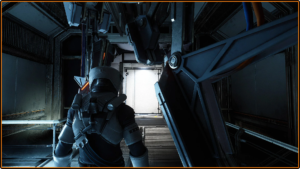
The lack of combat isn’t a limitation here, it’s a design choice that defines the entire experience. Without enemies to focus on, your attention naturally shifts toward the environment, the story, and the small details that usually get overlooked. Every sound, every piece of dialogue, every abandoned object starts to matter more. It’s a different kind of tension quieter, but often more effective. Instead of reacting, you’re thinking. Instead of surviving moment to moment, you’re absorbing the bigger picture. Another interesting layer is the decision-making aspect. From what’s been shown, Lunar Strike isn’t completely passive. The choices you make while documenting and interacting with the world can shape how things unfold, leading to multiple endings. That adds weight to what might otherwise feel like a purely observational experience. You’re not just recording history you’re influencing how it’s interpreted, and possibly what remains of it.
There’s also something worth mentioning about how this fits into the current landscape. Most games are still built around constant engagement something always happening, something always demanding attention. Lunar Strike goes in the opposite direction. It trusts the player to stay interested without forcing it. That kind of confidence usually comes from a clear vision, and whether it fully pays off will depend on execution, but the direction itself is already refreshing. At the same time, it’s fair to say this won’t be for everyone. Players looking for fast progression, combat systems, or traditional survival mechanics might find the experience too restrained. But that’s not a weakness it’s simply a matter of intent. Lunar Strike isn’t trying to compete with those games. It’s carving out its own space, and that space is built around atmosphere, reflection, and immersion.

What makes this particularly interesting for pcdoorz is how naturally it fits into that slower, more deliberate side of gaming that often gets overlooked. There’s value in games that don’t rush you, that don’t try to overwhelm you, and that trust you to engage on your own terms. Lunar Strike seems built exactly around that idea. For now, it remains a game to watch rather than one to judge. There’s enough here to suggest something unique, but also enough uncertainty to keep expectations grounded. If the storytelling holds up and the world feels as alive in its silence as it does in concept, this could easily become one of those experiences people remember long after finishing it not because of what they did, but because of what they felt while doing it. And sometimes, that’s exactly what a game needs to aim for.