
PREVIEW | GLORY TO THE HEROES | MODERN WAR WITHOUT HEROICS
A ruined road, a hastily fortified position and the distant movement of machinery establish a battlefield where individual courage cannot erase the scale of everything happening around it. Glory to the Heroes is an upcoming Ukrainian tactical first-person military simulation set during the Russian-Ukrainian war, developed and published by Deaf Tone Games, formerly known as Spacedev Games. Rather than placing the player in the role of an unstoppable special operator, the project presents an ordinary enlisted soldier working inside a squad, relying on communication, logistics, vehicles and the specialized duties of other personnel. Its planned combination of single-player storytelling and large PvPvE battles is intended to cover both the personal and operational dimensions of modern warfare, with locations reconstructed from real heightmap data and photogrammetry connected to actual battlefields. The Steam page currently lists a 2026 Early Access launch, although no exact date has been confirmed, and the available Playtest reflects a project still moving from pre-alpha toward an initial alpha-quality vertical slice. That status demands caution, but the central direction is already clear. Glory to the Heroes is not being built around effortless battlefield dominance. It wants the player to understand how small one person becomes when artillery, drones, armour, damaged infrastructure and incomplete information begin shaping the same engagement.
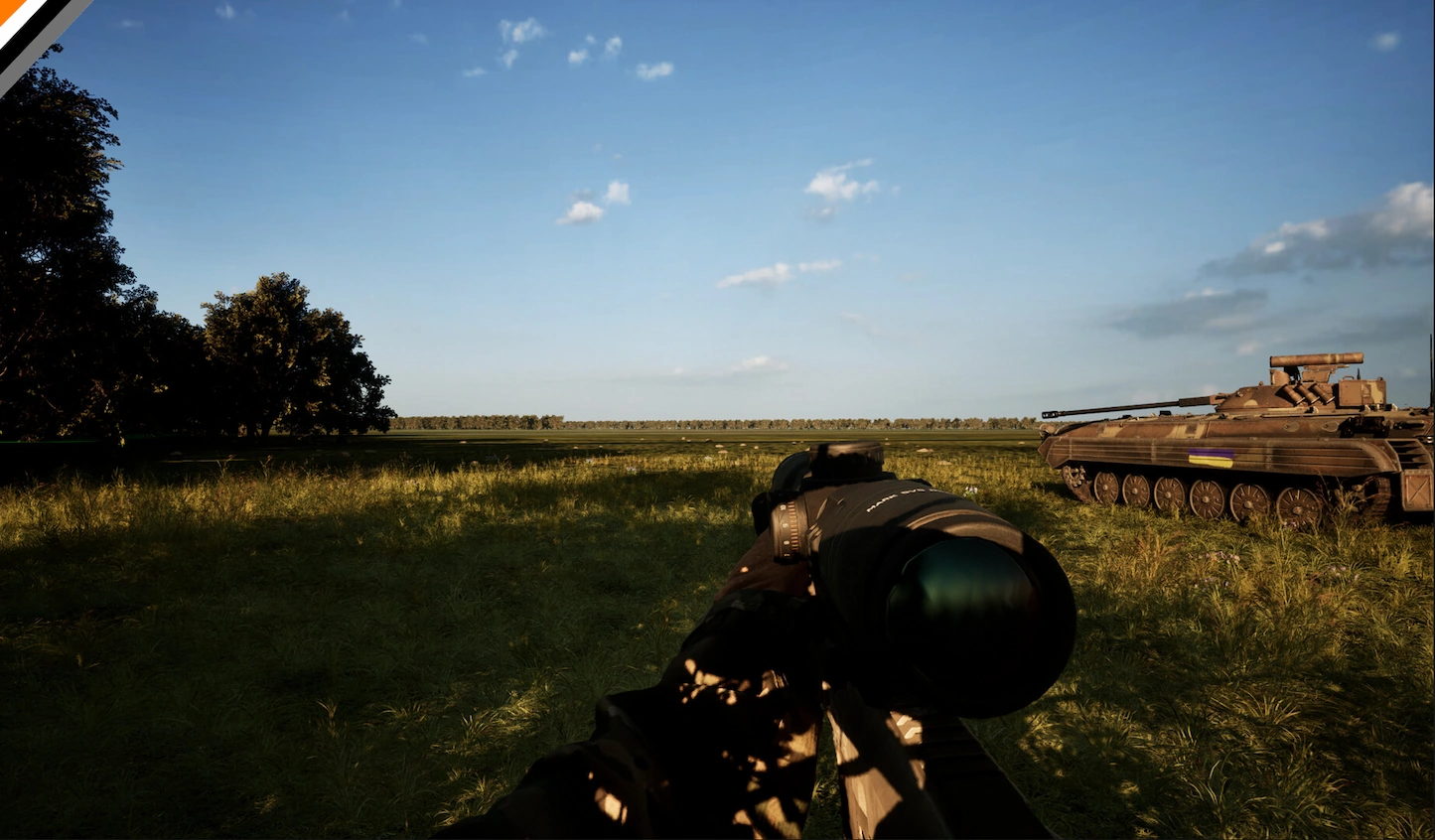
one soldier cannot carry the battlefield
The game’s class structure is built around duties rather than conventional hero abilities. Riflemen, drivers, artillery personnel, assault roles and FPV-drone operators are expected to contribute different functions, while supplies such as ammunition and fuel support fortifications, vehicles and frontline movement. This makes combined arms more than a background spectacle. Infantry requires transport and support, vehicles require resources, defensive positions require construction, and squads must coordinate before their individual equipment becomes useful. Matches are designed to represent larger engagements through control points, changing frontlines and role-specific objectives rather than treating every player as an independent hunter collecting eliminations. The idea is particularly promising because it creates value for players who prefer observation, transportation, communication or logistical work over direct fighting. However, such interdependence can also become frustrating when communication fails or one essential role is neglected. Glory to the Heroes must therefore balance authenticity with readability, ensuring that players understand their responsibilities without turning every match into a technical manual. The strongest military simulations make teamwork necessary while still allowing each participant to see how a small decision affected the larger battle. Deaf Tone Games appears to understand that principle, but the final quality will depend heavily on interface design, onboarding and the reliability of its communication systems.
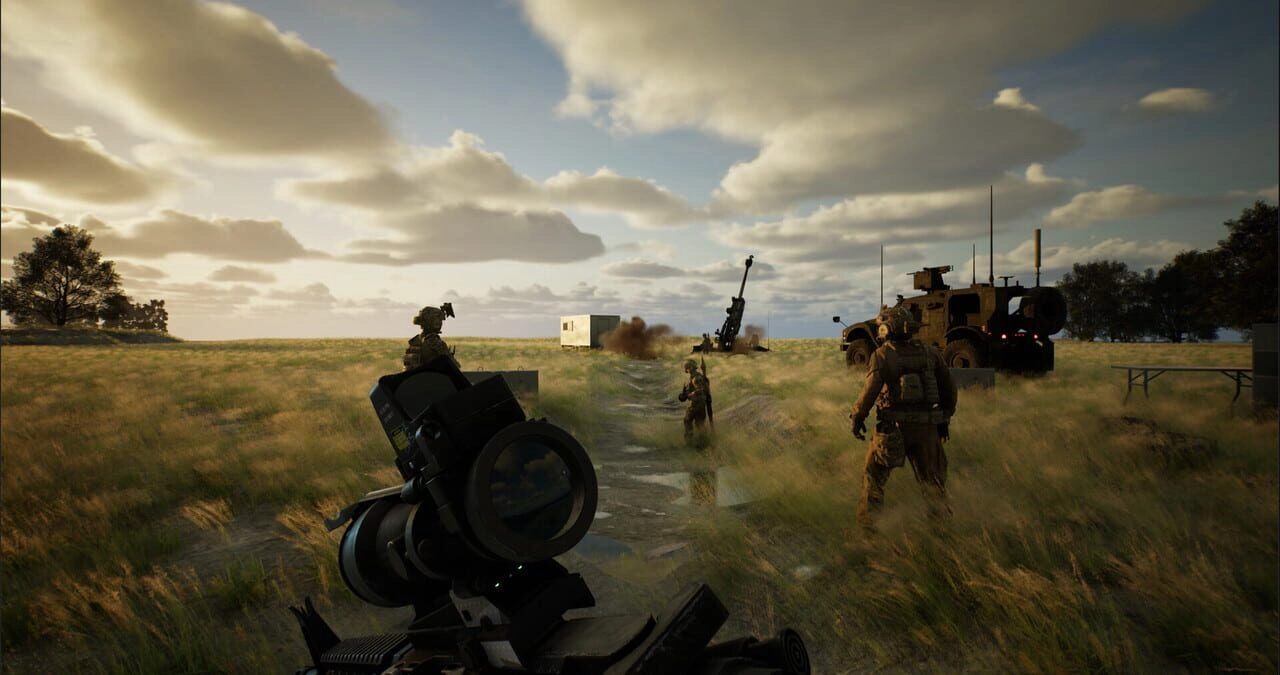
trenches and drones share the same sky
Glory to the Heroes is especially interested in the unusual mixture of old and new methods that defines the conflict it depicts. Defensive trenches, artillery pressure and fortified positions exist alongside reconnaissance systems, UAVs and FPV drones, creating battles where technology does not replace physical terrain but makes it even more dangerous and important. Weather and time-of-day changes are planned to influence visibility, while constructible defences and destructible surroundings allow squads to create or remove cover as the frontline develops. Tactical maps are inspired by Ukrainian systems such as Delta and Kropyva, with navigation, distance measurement and shared markers intended to support coordination between different roles. The developers also list realistic weapon handling, vehicle interiors, manual ammunition management and non-regenerating health among the simulation features. These systems could create an unusually convincing sense of vulnerability, but detail alone will not guarantee immersion. Every additional mechanic introduces another point where controls, animation or interface design can interrupt the experience. A simulation succeeds when complexity produces meaningful decisions; it fails when players spend more time fighting menus than understanding the situation around them. The game’s technology must therefore remain subordinate to battlefield awareness. Drones, artillery and logistics should create tension because they change what squads know and where they can safely move, not merely because the feature list is long.

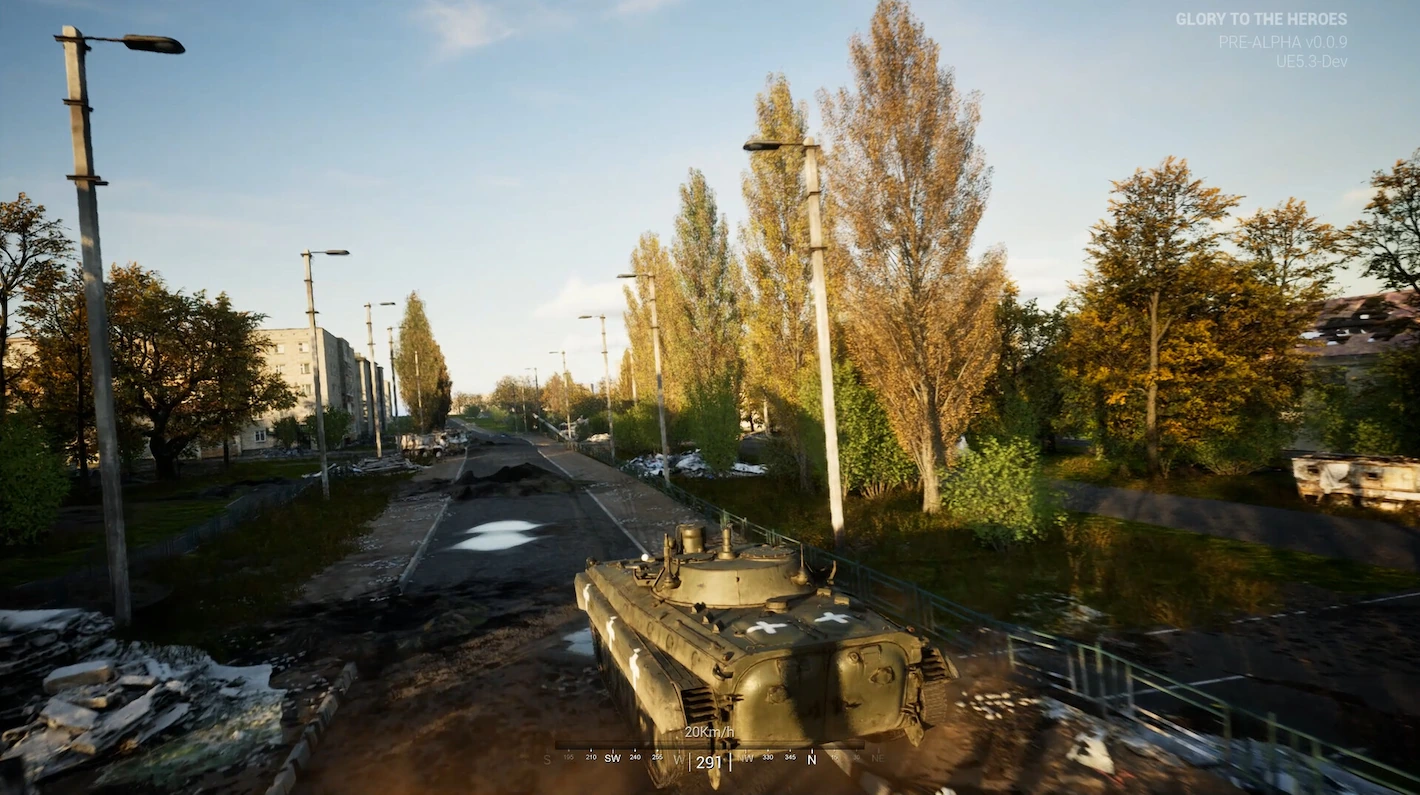
real locations carry real responsibility
The decision to recreate locations associated with an ongoing war gives Glory to the Heroes an identity that cannot be separated from ethical responsibility. Deaf Tone Games states that the project has educational, journalistic and cultural ambitions, while its planned story campaign will present personal “war stories” connected to individuals and historical events rather than treating the conflict only as a collection of multiplayer maps. Photogrammetry, real-world terrain information and scanned military equipment may strengthen authenticity, but visual accuracy is only the beginning. The writing, mission framing and treatment of civilians will determine whether the game communicates human experience or simply converts recognizable locations into dramatic arenas. This is where the single-player campaign may become the project’s most important component. Multiplayer systems naturally reduce events into objectives, resources and victory conditions, while authored stories can preserve uncertainty, loss and the personal cost hidden behind operational language. The developers have emphasized that these stories are intended to be about people rather than battles. That is the correct direction, although it remains largely unproven until substantial campaign material is publicly shown. Glory to the Heroes cannot control how every player behaves, but it can control the tone with which it presents its subject. A title dealing with events that remain painfully current must resist both empty spectacle and easy declarations of heroism.
pvp creates the project’s hardest question
The return of PvP has already created controversy. Deaf Tone Games originally concentrated public attention on PvE, but lead developer Serhiy Voronov confirmed in March 2026 that competitive play was being tested again, with Russian forces represented as the opposing playable faction. The studio argues that PvP is necessary for a convincing and sustainable military experience, while some Ukrainian commentators have criticized the decision because it allows players to assume the role of Russian forces during an ongoing invasion. This is not a minor marketing problem that can be ignored beneath mechanical discussion. It affects how the entire project will be interpreted and who may feel comfortable participating. From a game-design perspective, PvP can provide less predictable opposition and stronger coordination than artificial intelligence, but the subject is not fictional and the factions are not historical abstractions separated by generations. Deaf Tone Games will need clear limits, careful presentation and transparent communication about what competitive play is intended to represent. The game may be capable of distinguishing simulation from endorsement, but that distinction cannot be assumed automatically. Glory to the Heroes is attempting to document, interpret and simulate the same conflict at once. The more accurately it represents uniforms, formations and locations, the more carefully it must explain the purpose behind giving players access to each side.

early access will reveal whether the systems connect
The planned Early Access version is described as a vertical slice containing the main mechanics, a limited number of PvP and PvE maps and modes, and a preview of the single-player campaign. Additional locations, vehicles, weapons, mechanics and story missions are expected to arrive through later updates, with a public roadmap guiding development toward version 1.0. The developers have already used closed testing and community feedback for several years, while the Steam Playtest is intended to continue as an experimental branch even after Early Access begins. This approach makes sense for a simulation whose balance depends on many interconnected roles, but it also means the initial release should not be judged as a complete representation of the concept. Performance may become a particular concern. The current recommended requirements list 32 GB of RAM and an RTX 4070 Ti or RX 7600 XT, although the developers note that these figures reflect the present demo and may change before release. Large maps, detailed vehicle interiors, destructible environments, changing weather and many simultaneous systems create a demanding technical combination. Early Access can provide the time required to optimize those elements, but it can also expose the project before its atmosphere, artificial intelligence and stability are ready to support its serious subject. Deaf Tone Games must ensure that the first public version is limited but coherent rather than broad and unreliable.