PREVIEW | ANVIL EMPIRES | THOUSANDS BUILD, THOUSANDS FIGHT
A fortress does not appear because one commander selected it from a construction menu, and an army does not remain effective because supplies arrive automatically from an invisible economy. Every wall, weapon, meal, transport route and siege engine in Anvil Empires is intended to exist because real players gathered the materials, organized the labour and carried the finished equipment toward a war that may continue for weeks. Siege Camp, the studio behind Foxhole, is applying its experience with persistent multiplayer conflict to a medieval world where thousands of participants share the same campaign and every person controls an individual citizen rather than an army from above. Some players will fight shoulder to shoulder in huge melee formations, while others may spend their entire session farming, hunting, trading, building settlements or moving supplies between distant communities. Both roles belong to the same war, and neither can function properly without the other. Anvil Empires remains in pre-alpha development for PC with no confirmed release date, but its official Steam page already presents a clear and unusually ambitious objective: create a persistent sandbox in which settlements grow from small hamlets into populated towns, player economies support enormous armies and battles can place as many as 1,000 combatants together on one real-time battlefield.

one citizen inside a much larger empire
Anvil Empires is not a traditional real-time strategy game despite the scale of its battles, construction and logistics. The player does not float above the map selecting entire battalions or ordering anonymous workers to gather resources. Each participant enters the world as one individual citizen whose actions become a small part of a much larger collective effort. A soldier standing inside a shield formation, a farmer producing food far behind the front, a builder reinforcing a town and a trader transporting materials between settlements are all controlled by different people working within the same persistent conflict. That perspective is essential because Anvil Empires is built around the idea that no single player should possess complete control. Empires emerge through coordination between dozens or hundreds of people, and even the most successful military leader remains dependent on those who manufacture weapons, maintain supply routes and keep settlements productive. Siege Camp describes campaigns as large-scale conquests lasting weeks, with battles arising organically from player decisions inside an open-world sandbox rather than beginning as isolated matchmaking rounds. The result should feel less like joining another temporary multiplayer match and more like entering an ongoing historical period whose towns, borders and military situations may have changed considerably while the player was offline.
settlements are built by communities, not placed by commanders
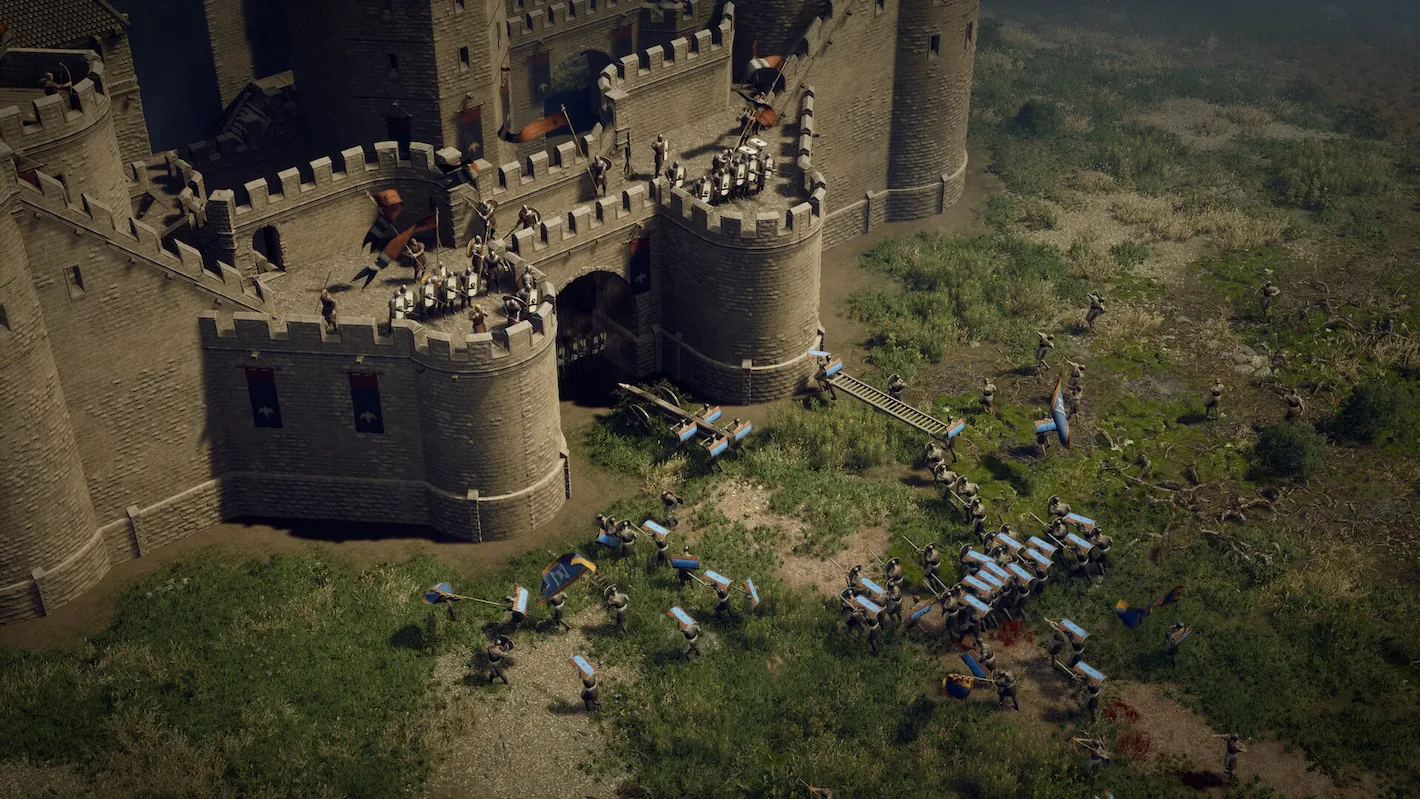
Settlement construction is one of the clearest differences between Anvil Empires and a conventional medieval war game. Players can establish small communities and gradually expand them into busy towns shared by dozens or potentially hundreds of participants, while agriculture, hunting, animal husbandry and trade provide the economic foundation required to keep those settlements alive. The official design allows communities to build elaborate multi-level keeps and fortifications rather than relying exclusively on a small collection of prefabricated defensive positions. Geography should therefore influence how each town develops: a settlement near useful resources may become a production centre, a location beside an important route may grow into a trading post, and a vulnerable border community may invest heavily in walls, gates and protected storage. Recent development work has continued redesigning central town structures, including larger Town Keeps with built-in defensive walls, gates, interiors capable of supporting more players and dedicated locations for important community functions. This is not decoration added around the war system. Towns are intended to be the places where citizens work, exchange goods, recruit characters, organize expeditions and prepare for future conflict, meaning their layout and accessibility may directly affect how efficiently an empire responds when the front line moves closer.
every army depends on somebody carrying supplies
The spectacular part of Anvil Empires will naturally be the sight of hundreds of players colliding outside a fortress, but the more important machinery may remain several kilometres behind them. Siege Camp repeatedly emphasizes that military victory requires a functioning economy and supply chain, not only a larger number of fighters. Armies must be fed, armed and supported through supply camps and logistics routes established by players, while major assaults require preparation before the first soldier reaches the wall. Siege ladders, battering rams and other equipment must be constructed and delivered to the correct position, and prolonged sieges should test whether attackers can maintain their pressure as much as whether they can win the opening clash. This gives transport and planning genuine strategic value. A successful raid against an exposed convoy may damage an enemy campaign without defeating its army directly, while an isolated fortress may eventually become vulnerable if defenders cannot replace damaged equipment or restore depleted supplies. Logistics should also create opportunities for players who enjoy organization more than direct combat. Managing storage, identifying shortages, arranging deliveries and keeping several settlements connected can become an entire role within the empire, and the people performing it may determine the outcome of battles they never personally witness.
warfare on a scale that changes individual combat
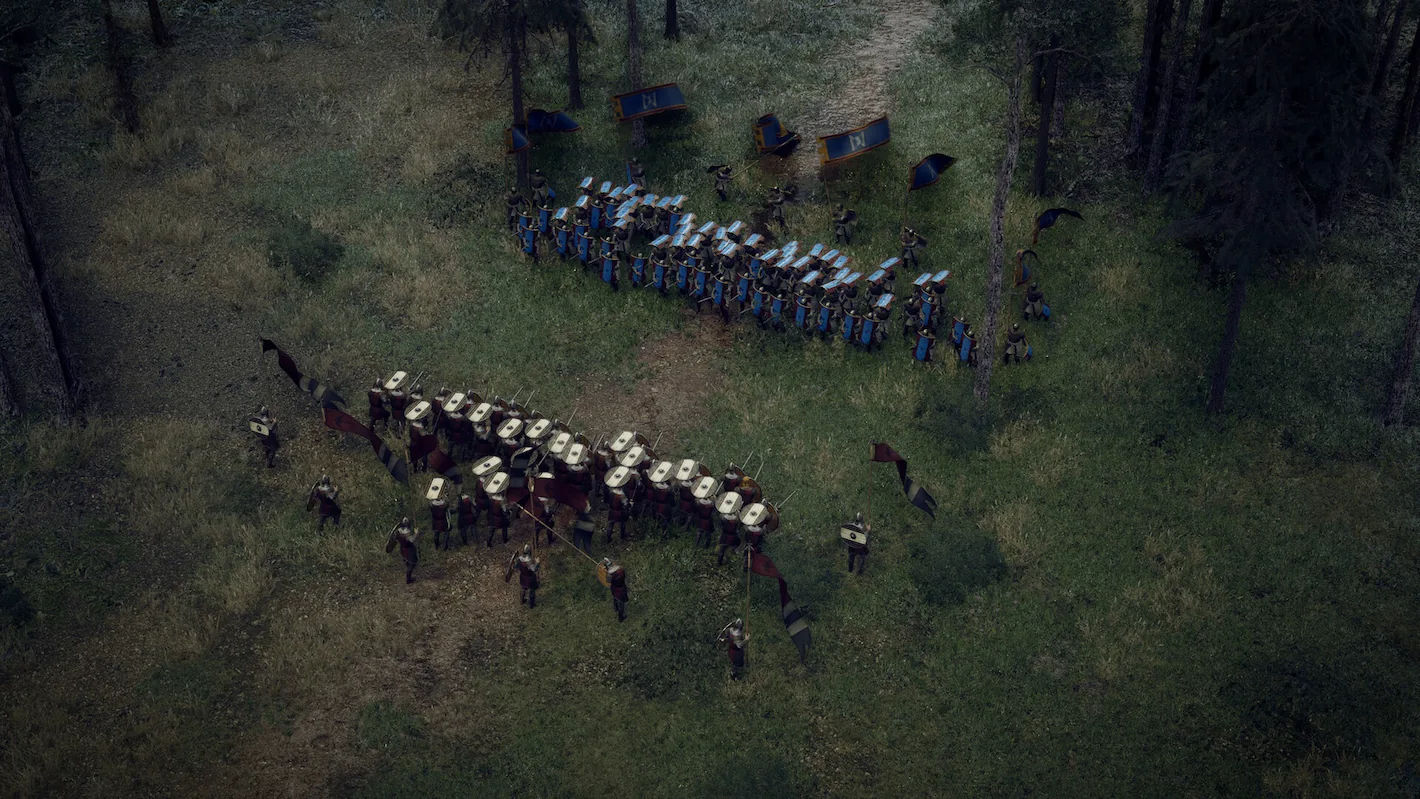
Siege Camp’s custom technology is intended to support as many as 1,000 players fighting together in the same real-time melee battle. That number matters for more than spectacle because medieval combat changes when the player is surrounded by a genuine army rather than a small multiplayer squad. Position inside a formation becomes important, narrow approaches can concentrate hundreds of bodies into dangerous pressure points and the collapse of one section may expose an entire defensive line. A single fighter should not feel like an unstoppable hero capable of deciding the battle alone. Survival may depend on maintaining position beside allies, following a coordinated push and recognizing when a formation is beginning to break. The current pre-alpha combat system is still evolving, with recent changes introducing three attack types that have different speeds and striking patterns, alongside a more deliberate shield system requiring players to decide when protection should be raised or lowered. These revisions suggest that Siege Camp wants large battles to retain meaningful personal decisions instead of becoming uncontrolled crowds trading repetitive attacks. The difficulty will be maintaining clarity when hundreds of players occupy the same space. Animations, equipment silhouettes, friendly formations and attack directions must remain readable enough that scale increases tension without turning every engagement into visual confusion.
sieges begin long before the walls are reached
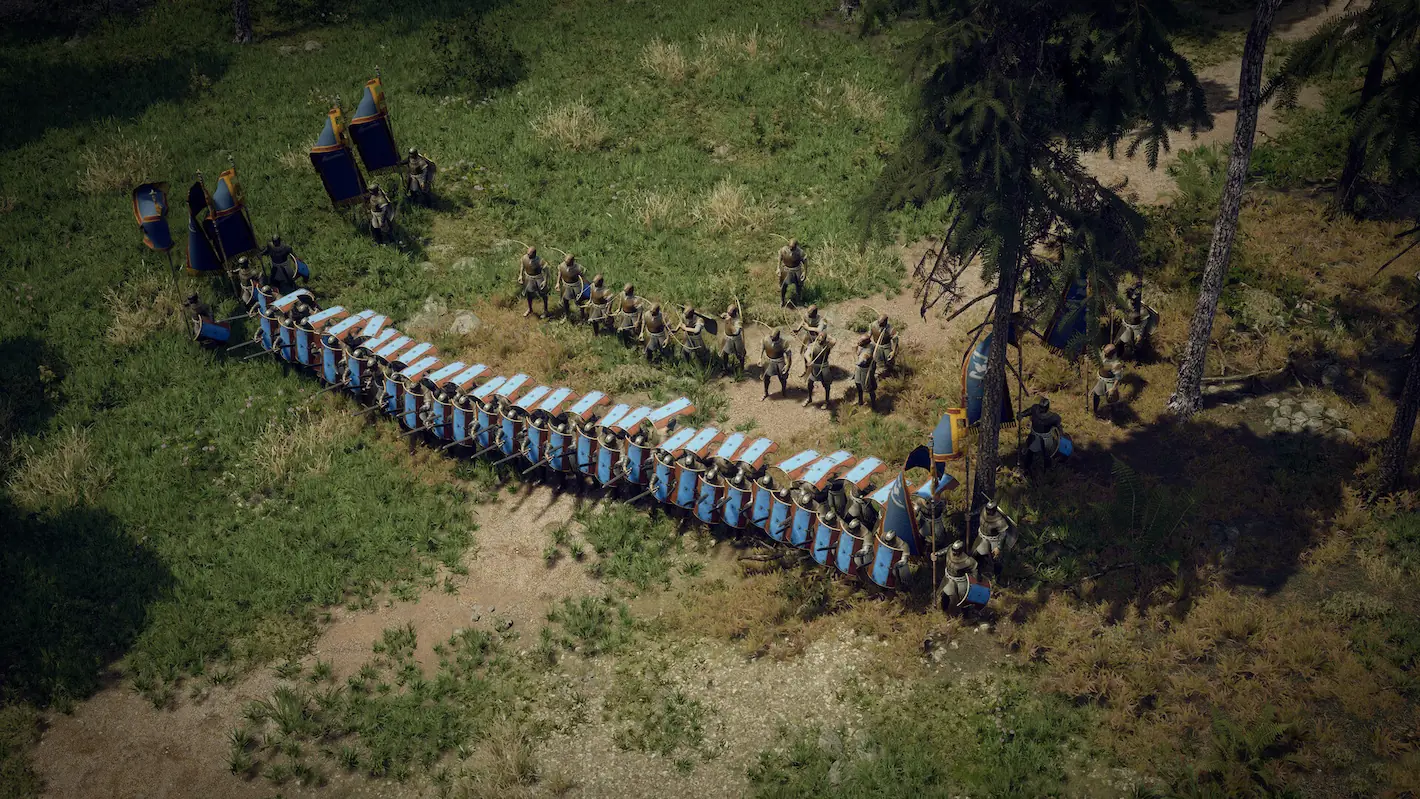
A large fortress assault should represent the final stage of a much longer operation rather than an activity that begins when enough players gather beside a gate. Attackers may need to establish siege camps, transport construction materials, protect supply lines and manufacture equipment capable of overcoming several layers of defence. Defenders have their own preparations to make, including strengthening walls, organizing access points, storing resources and ensuring that enough equipment remains available during a prolonged attack. The official feature set includes siege ladders and battering rams, while towns and fortresses can be designed with multi-level defensive structures capable of resisting sustained pressure. This creates room for battles that develop through recognizable stages: scouting and raiding may weaken the surrounding economy, armies may compete for control of important roads, forward camps can move resources closer to the target, and only then does the main assault begin. The strongest sieges will not be won by endlessly attacking the same gate. They should reward deception, diversion, control of terrain and the ability to preserve supplies longer than the opposing side. A fortress may appear secure while its defenders remain stocked and organized, then become increasingly fragile once nearby farms, roads and supply camps are disrupted.

farming, trade and production are part of the battlefield
Anvil Empires treats civilian labour as part of warfare rather than background activity. Farming, hunting and husbandry support the population and army, while trade between settlements allows communities to specialize instead of producing every resource independently. A town with strong agricultural land may exchange food for metalwork from another settlement, creating relationships that become strategically important once routes are threatened. Recent development updates have expanded systems for buying and selling horses, carts, handcarts and caravans, while players operating productive Homesteads can fulfil orders and earn currency through their contribution to the wider economy. Homestead owners can also rent access to useful facilities such as blacksmiths, furnaces and hearths, allowing important structures to serve a larger community instead of remaining restricted to one private owner. These systems suggest an economy built from practical dependencies between players rather than a universal auction interface detached from geography. Goods still need to exist somewhere, production facilities require access and transport remains part of the transaction. That can give peaceful activity a sense of purpose because the sword carried at the front may represent the work of miners, smiths, merchants and drivers whose combined effort began long before the battle.
raiding gives smaller groups a place in a massive war
Not every meaningful operation needs hundreds of participants. The official Anvil Empires description includes mounted and naval raiding, allowing smaller groups to travel through the world, attack vulnerable settlements and steal silver or valuable resources. This gives individuals and organized companies a way to influence the war without joining the largest battle on the map. A raid may burn farms, interrupt trade or force an enemy community to keep soldiers away from the main front, and its strategic value can become much greater than the number of fighters involved. Smaller operations may also produce the game’s most personal rivalries. A settlement repeatedly attacked by the same group may organize patrols, reinforce weak approaches or launch a retaliatory expedition against the raiders’ home territory. Because the world remains shared and persistent, these encounters can create histories that continue across several sessions instead of ending when a scoreboard resets. The challenge will be protecting the sandbox from becoming permanently hostile to smaller or less organized communities. Raiding must remain dangerous and meaningful without making it impossible for new settlements to survive long enough to become part of the wider economy. Strong warning systems, geography, local defence and political cooperation may become as important as raw wall strength.

persistent characters give the empire a human face
Siege Camp has been expanding an Avatar system intended to represent individual citizens who persist within each empire and improve through equipment and attributes. These characters can differ visually and carry several clothing and armour pieces, while recruitment offers varying levels of experience and capability. The studio has also reworked the underlying character technology to support hundreds of different players being rendered on screen, moving away from systems originally inherited from Foxhole and rebuilding them around Anvil Empires’ larger medieval battles. Light, medium and heavy armour are designed for different battlefield roles, with lighter equipment better suited to ranged combat and heavier sets intended for frontline engagements. Recent changes have also reduced the hidden statistical influence of character attributes in player-versus-player combat. Instead of an opponent dealing unexpectedly high damage because of invisible numerical advantages, stronger attributes now help characters equip more powerful and visibly identifiable gear. This is a sensible direction for a large competitive game because threat should be readable from what the player can observe. An armoured veteran carrying superior equipment may be dangerous, but the source of that danger should be visible rather than concealed inside an unseen progression level.
the world is still being rebuilt around what the tests revealed
Anvil Empires remains a genuine pre-alpha project, and Siege Camp warns that systems shown in development updates may change before release. The studio has recently reconstructed large parts of the world map after years of testing revealed limited usable land and excessive elevation changes that interfered with settlement building, fortress placement and large battles. The redesigned central region uses more even terrain and provides additional space for Homesteads, bandit bases, defensive structures and open conflict, while the wider world is expected to expand outward later. This willingness to replace major systems demonstrates that the project is still defining its final shape rather than simply polishing finished content. Other areas, including the Underworld, have undergone similar reconsideration after the team found that movement, camera behaviour and visual clarity did not meet its standards. New development tools and an upgraded Unreal Engine pipeline are being used to produce a more controlled second version with deeper areas, new resources and stronger encounters. None of this should be mistaken for evidence that release is close. It instead confirms that Anvil Empires remains an active experimental project whose designers are using large-scale tests to discover which ideas can survive real player behaviour.

more than medieval foxhole
The comparison with Foxhole is inevitable because both games come from Siege Camp and share persistent warfare, player-driven logistics, top-down presentation and the idea that each participant is one small part of a much larger conflict. Anvil Empires nevertheless requires more than a medieval visual conversion. Melee formations create different battlefield pressures from twentieth-century firearms, settlements receive greater construction and economic emphasis, and the population must support farming, trade, animals, mounted travel and elaborate fortifications. Medieval warfare also places more players within direct physical contact, which makes collision, animation, shield behaviour and formation control more important. A rifle battle can spread across long distances, but a shield wall succeeds or collapses within a tightly packed space. The slower movement of supplies and armies may also make geography more influential, since roads, rivers, coastlines and safe staging areas determine how quickly an empire can respond. Anvil Empires will succeed when these differences produce their own social and military culture rather than simply reproducing Foxhole’s established loop with swords replacing rifles. Siege Camp already understands how players turn logistics into stories and routine labour into collective achievement; the new challenge is making a medieval society feel broad enough that building, trading and defending a town can be as compelling as joining the army that leaves it.
what anvil empires must prove
The concept becomes impressive very quickly, but scale alone cannot carry the complete experience. Anvil Empires must prove that individual actions remain satisfying when thousands of people contribute to the same war, because most players will not always be present during the decisive siege or witness the result of every resource they produced. Farming, transport, construction and equipment management need enough interaction and progression to remain engaging rather than becoming repetitive obligations performed for the benefit of distant fighters. Combat must preserve personal skill while allowing formations and organization to matter more than isolated heroics. Settlement systems need sufficient freedom to create recognizable communities without producing unusable streets, blocked access or defensive designs that exploit unfinished mechanics. The persistent world also requires strong communication and governance tools so that large groups can coordinate without relying entirely on external applications. Most importantly, the game must protect its dependence on player cooperation without making participation impossible for anyone who cannot commit several hours every day. A war lasting weeks can generate extraordinary stories, but only when people returning after an absence can understand what changed, find useful work and rejoin the wider effort without feeling that the world has moved beyond them.