
SPECIAL | COMMODORE 64 | TWO MACHINES, ONE COMPUTER LEGACY
Reduced to a small black box, connected through HDMI and supplied with a joystick, THEC64 Mini Black Edition can easily be mistaken for another retro console built to deliver a fixed collection of old games and little else. That interpretation stops making sense the moment the machine enters BASIC, accepts programs from a USB drive or connects to an external keyboard. Commodore 64 came from a different branch of gaming history: the home computer, a machine that could entertain its owner in the evening and introduce that same person to programming, digital music or software creation the next morning. It was not designed around cartridges approved by a platform holder, a closed storefront or a single purpose determined at the factory. In that sense, Commodore 64 was one of the great anti-consoles not because it rejected games, but because playing games represented only one part of what the machine allowed its owner to do. Two modern products now approach that legacy from opposite directions. THEC64 Mini Black Edition compresses it into an accessible plug-and-play system built around a curated library of modern C64 releases, while Commodore 64 Ultimate reconstructs the computer through FPGA hardware, a full keyboard, original connections and modern display options. One is made for immediate entry; the other attempts to bring the entire computer back. Neither belongs here as console coverage. Both belong here because the machine beneath their shared name was always a personal computer first.

the black edition looks back by playing something new
The black version of THEC64 Mini avoids the easiest route available to retro hardware. Instead of filling its menu with another selection of famous releases from the early 1980s, it focuses on 25 neo-classic C64 games created long after the original computer disappeared from ordinary retail shelves. Sam’s Journey, A Pig Quest, Steel Ranger, Hessian, Yeti Mountain, Millie & Molly and the remaining titles show that the C64 is not maintained only through memory; developers are still producing games for its architecture, restrictions and unmistakable visual identity. That makes the Black Edition more interesting than a cosmetic repaint. Its purpose is not merely to imitate the appearance of a machine from 1982, but to place newer software created for that machine in front of players who may never have followed the modern C64 development scene. The hardware itself is a 50-percent-scale recreation with a decorative miniature keyboard rather than a fully functional one, while the supplied black joystick uses microswitches and preserves the direct, occasionally unforgiving control associated with the platform. HDMI output runs at 720p in 50 or 60 Hz modes, a CRT filter is available, and four save positions per game remove the need to reproduce every inconvenience of the original experience. It is a streamlined product, but its library prevents it from becoming a museum box. The games may obey limitations established decades ago, yet many of them were designed with knowledge, pacing and ideas gathered from everything that followed.
Its strongest defence against the console label lies outside the included carousel. A USB stick can be used to load other compatible programs, an external USB keyboard can be connected, and BASIC remains available for writing and saving original code. Retro Games even describes the unit as capable of operating as a true home computer, which matters because this functionality preserves the essential difference between the C64 and a closed plug-and-play games machine. The Black Edition does not reproduce every port, every peripheral relationship or the physical experience of typing on the original keyboard, and nobody should confuse it with a complete hardware restoration. Its role is narrower and more approachable: connect it to a modern display, choose one of the installed games, add personal software when desired and enter BASIC without assembling vintage hardware that may require repairs, adapters or specialist knowledge. For many users, that simplicity is not a compromise but the entire appeal. It offers enough of the C64’s open character to move beyond passive nostalgia while remaining easy enough to treat as a one-evening gaming device. The result sits in an unusual space between replica, software platform and miniature home computer. It resembles a retro console because that is the most familiar modern form for such a product, but the software freedom inside the box continues to point toward its computer ancestry.

commodore 64 ultimate brings back the whole machine
Commodore 64 Ultimate begins from a far more demanding question: what would a new C64 look like if the goal were not to simplify the original, but to reconstruct it faithfully enough that old software, physical media and peripherals could continue working? Its answer is an AMD Xilinx Artix-7 FPGA implementation intended to reproduce the original motherboard through hardware logic rather than run the machine as a conventional software emulator. Commodore claims compatibility above 99 percent across more than 10,000 C64 games and peripherals, while the body retains connections for equipment ranging from datassette and disk drives to cartridges, joysticks, mice and modems. Modern additions include HDMI, USB, Ethernet and Wi-Fi, allowing the computer to reach contemporary displays and networks without cutting itself away from the accessories that defined the original ecosystem. The internal specification includes 128 MB of DDR2 memory and integrated Ultimate-II+ functionality with tape emulation and DMA loading, while HDMI output reaches 1080p at 50 Hz for PAL or 60 Hz for NTSC. These numbers are insignificant beside any modern desktop, but raw performance is not the objective. The FPGA exists to preserve timing, behaviour and hardware relationships that can become inaccurate or inconsistent when recreated through ordinary emulation. This is new hardware designed to behave like an old computer, not a modern PC disguised by a familiar shell.

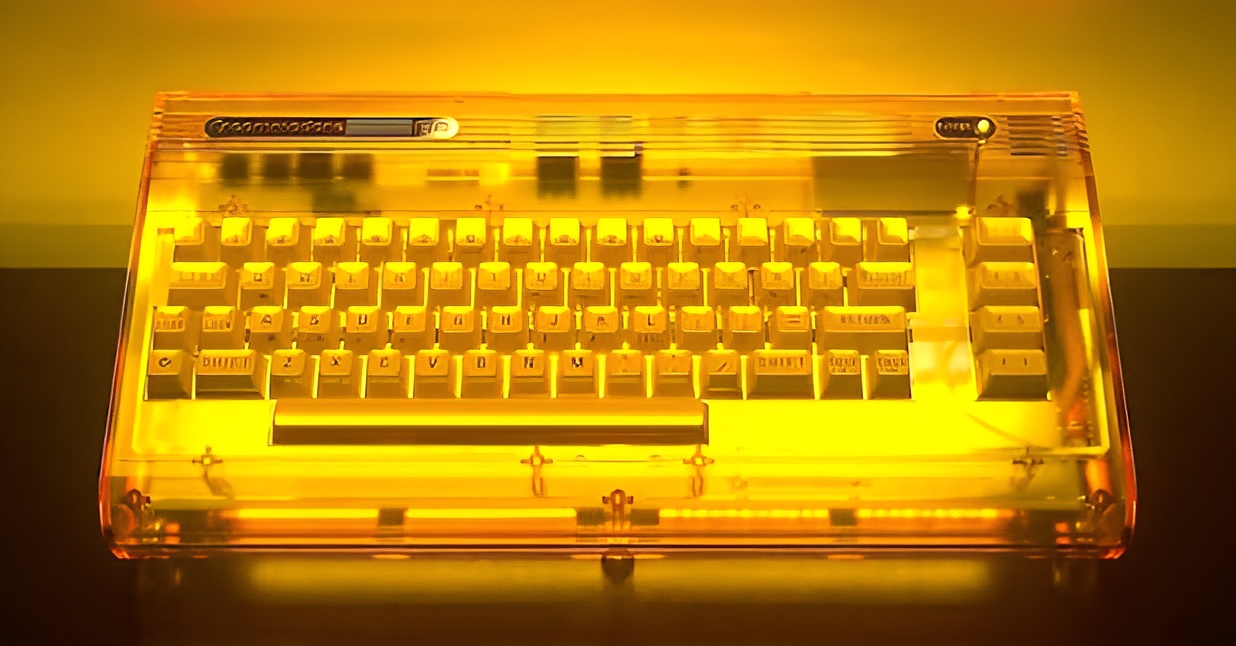
The full-size keyboard changes the relationship immediately. Instead of selecting games from a carousel and occasionally connecting an external keyboard, the user sits in front of a functioning computer whose commands, symbols and BASIC environment remain part of normal operation. Original cassettes, disks, cartridges and controllers can coexist with USB storage, downloadable software and a modern configuration menu. That combination gives the Ultimate considerably more depth than a typical retro recreation, but it also preserves some of the friction. The interface can feel unfamiliar to anyone raised on mouse-driven operating systems, loading and file management still follow C64 logic, and the amount of configuration available may overwhelm players who only want to launch a few games. Firmware support is already extending the system: version 1.1.0 added broader USB mouse compatibility, easier menu navigation and music-reactive LED functionality for illuminated editions. The BASIC Beige version carries the restrained appearance closest to the original breadbin, while Starlight and Founders models use translucent construction, lighting and more elaborate collector details. Current official pricing places the BASIC model at a promotional $299.99 before tax, with other editions positioned above it. That is far beyond impulse-purchase territory, but the Ultimate is not competing with inexpensive emulator boxes. It is aimed at users who kept original software and peripherals, programmers who want to return to BASIC, musicians interested in the SID environment and enthusiasts who consider the C64 a computer worth using rather than an ornament worth displaying.

one is an entrance, the other is a return
Placing these products beside one another reveals how differently nostalgia can be engineered. THEC64 Mini Black Edition removes barriers. It is small, visually clean, immediately compatible with current televisions and structured around 25 carefully selected modern games. The user does not need an old disk drive, surviving tapes or knowledge of commands before beginning. Commodore 64 Ultimate restores those layers instead of removing them. Its physical keyboard, original ports, FPGA board and expanded menus are valuable precisely because they allow the user to move beyond a curated selection and reconnect with the broader C64 ecosystem. The Mini asks how little hardware is required to preserve the experience; the Ultimate asks how much of the original machine can be brought forward without sacrificing modern convenience. Neither answer invalidates the other. Someone interested primarily in Sam’s Journey, A Pig Quest or a compact device for occasional sessions gains little from paying several times more for ports and configuration options that may never be used. A collector with shelves of disks, cartridges and controllers will find the Mini too restricted the moment the first original peripheral has nowhere to connect. The difference is not simply budget versus premium. It is access versus continuity: one introduces the C64 to a modern display, while the other tries to reconnect an entire personal history of hardware and software. Their shared importance also comes from refusing to freeze Commodore 64 at the moment of its commercial decline. The Black Edition proves that developers continue creating games for the platform, while the Ultimate gives those old and new programs fresh physical hardware on which to run. This is more meaningful than printing a classic logo on a generic emulator. The C64 survives because its limitations are understood, documented and still attractive to people who enjoy working within them. New games must respect its memory, graphics, sound and control structure; new hardware must reproduce behaviour that thousands of programs expect. That active relationship between software creators, hardware engineers, collectors and players separates a living retro-computing platform from a nostalgia product built for a single Christmas season. The Mini provides the easiest evidence of that life through its modern game library. The Ultimate exposes the machinery underneath it. Together, they tell a better story than either could carry alone: not that Commodore has suddenly returned to challenge modern gaming PCs, but that one of the most influential home computers still has enough technical and creative gravity to justify new software, new hardware and multiple interpretations of what ownership should mean in 2026.

the anti-console still has a place
Calling the Commodore 64 an anti-console is an editorial description, not a technical category, but it identifies why these machines fit inside pcdoorz without weakening the site’s PC focus. A console traditionally asks the player to accept a controlled relationship: approved hardware, approved software, limited expansion and a primary purpose centred on consuming games. The C64 placed a keyboard and programming language in front of every owner. Games were vital to its success, but the machine never defined the user only as a player. It could become a programming classroom, music workstation, communications terminal, productivity tool or experimental platform according to the software and peripherals attached to it. THEC64 Mini Black Edition preserves only part of that freedom, yet USB loading, keyboard support and BASIC keep the door open. Commodore 64 Ultimate pushes the same idea much further by restoring the physical connections and programmable environment that made the original difficult to classify as a single-purpose entertainment system. The appearance may occasionally resemble the modern retro-console formula, especially in the Mini’s case, but appearance is not architecture and convenience is not closure. These devices revive a computer platform whose identity was built around the possibility that its owner might do more than the box promised. That does not mean every Commodore-branded device deserves automatic celebration. The Mini’s non-functional keyboard remains a visible reminder that much of the original computer has been reduced to shape, and its 720p output and simplified interface are designed more for accessibility than authenticity. The Ultimate is technically richer but expensive, specialised and potentially intimidating to users without prior C64 experience. Its value depends heavily on whether the buyer intends to explore BASIC, original hardware, software libraries and configuration options rather than treat it as another box containing old games. Both products can become shelf decorations if purchased only for their logos. Their real worth emerges through use: discovering a modern game developed under 8-bit restrictions, writing a small BASIC program, loading personal software, reconnecting an old joystick or hearing a SID composition through hardware created decades after the original production lines stopped. Commodore 64 does not need to pretend that it can replace a contemporary desktop. Its modern role is to preserve a different idea of personal computing slower, more visible, more understandable and more directly controlled by the person sitting at the keyboard.