
DLSS 5 OFFICIAL | NVIDIA PREPARES THE NEXT GENERATION OF GAME GRAPHICS
NVIDIA has officially revealed the next step in its AI-powered graphics technology with the announcement of DLSS 5, a new generation of Deep Learning Super Sampling that aims to push real-time game rendering even further. While previous versions of DLSS focused primarily on performance and frame generation, DLSS 5 appears to move into a more ambitious territory: using neural rendering techniques to enhance the visual quality of entire scenes. The technology was presented during NVIDIA’s recent developer presentation, where the company described DLSS 5 as a major evolution of its AI graphics pipeline. According to NVIDIA, the new system relies on more advanced neural networks that can assist the rendering process itself rather than simply reconstructing frames from lower-resolution images. In other words, the AI is no longer just filling in pixels – it is helping generate parts of the scene.
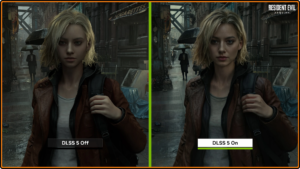
For players already familiar with the DLSS ecosystem, the idea may sound like a natural progression. DLSS originally started as a performance-boosting technology designed to upscale lower-resolution frames while maintaining image quality. Over time it evolved significantly, introducing improvements such as DLSS 2’s much better reconstruction algorithms, DLSS 3’s frame generation, and later refinements that helped stabilize motion and reduce artifacts in fast-moving scenes. DLSS 5 seems to take a step beyond those incremental upgrades. NVIDIA describes the new system as part of a broader move toward AI-assisted rendering, where neural networks work alongside traditional rasterization and ray tracing techniques. The goal is to generate more realistic lighting, materials and scene details without requiring the GPU to calculate every single element through conventional rendering pipelines. In practical terms, this could allow game developers to achieve visual fidelity that would normally be far too expensive to render in real time. By letting AI handle certain parts of the image generation process, GPUs can dedicate more of their raw processing power to other aspects of the scene.
NVIDIA also emphasized that the technology is designed to integrate with modern graphics techniques already used in games today. DLSS 5 is expected to work alongside ray tracing and other advanced lighting systems, potentially helping developers push even more complex scenes without sacrificing performance. Another interesting detail from the announcement is the level of industry support NVIDIA claims to have already secured. Several major publishers and studios are reportedly exploring or preparing to adopt the technology, including companies such as Bethesda, Ubisoft, CAPCOM, Tencent and Warner Bros. Games. While it is still early days, the list suggests that DLSS 5 could appear in upcoming AAA titles once the technology becomes widely available.
The DLSS ecosystem has grown rapidly over the past few years. According to NVIDIA, hundreds of games and applications now support some form of DLSS technology, making it one of the most widely adopted AI graphics solutions in the industry. That expanding adoption has been a major factor in the technology’s success, as developers increasingly rely on it to balance visual quality with performance on modern GPUs. Exactly how DLSS 5 will be implemented in shipping games remains to be seen. NVIDIA has not yet shared detailed performance comparisons or real-world game demonstrations that show the technology running in a finished title. As with previous DLSS releases, those details will likely emerge once developers begin integrating the system into upcoming game engines.
What is clear, however, is that NVIDIA sees DLSS as more than just a performance feature. The company increasingly frames it as a central component of the future graphics pipeline, where AI works together with traditional rendering techniques to produce images that would otherwise be too computationally expensive to generate. If the technology delivers on its promises, DLSS 5 could represent another major shift in how games are rendered in real time. Whether players will notice the difference immediately or only gradually as new titles adopt the system remains an open question, but one thing is certain: NVIDIA’s push toward AI-driven graphics is continuing to accelerate. More technical details about DLSS 5, including hardware requirements and supported GPUs, are expected to be revealed closer to its official rollout in future games.