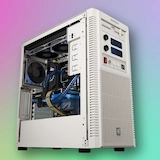
MAINGEAR RETRO98 | A MODERN SYSTEM THAT REFUSES TO LOOK MODERN
Maingear Retro98 doesn’t try to belong to the current PC landscape, and that’s exactly why it stands out. It steps into a space most companies avoid entirely, choosing familiarity over spectacle and memory over innovation as its starting point. It does not pretend to be cutting-edge in how it looks, and that is exactly what gives it weight. Instead of chasing the usual expectations glass panels, RGB layers, aggressive shapes it moves in the opposite direction with a quiet confidence, leaning into a form that feels almost forgotten. And yet, the moment you look at it, something clicks. Not because it is better, but because it feels familiar in a way modern machines rarely do.

Maingear officially released the Retro98 on January 29, 2026, quietly placing it into the market without the kind of aggressive push that usually follows new hardware launches. That approach fits the system itself. It is not trying to dominate headlines or compete in the usual way, but simply to exist as a distinct alternative within a very predictable space. A PC once felt like a quiet part of the room rather than its centerpiece. It did not glow, it did not shimmer behind tempered glass, it did not scream for attention with synchronized lighting and marketing language. It simply existed as a physical object in the room, heavy, beige, slightly awkward, and unmistakably personal. You knew where the power button was without looking. You knew the sound of the fan. You knew the smell of warm plastic after hours of use. Maingear Retro98 does not try to recreate that time perfectly, and that is precisely why it works. It does not chase authenticity through limitation. It chases memory through presence.
Form Over Display
At first glance, Retro98 looks almost confrontational. The beige case feels out of place in a world dominated by black boxes and glass panels, as if it wandered in from a different decade and refused to apologize. The shape is familiar in a way modern PCs are not. It has edges, not curves. Surfaces that do not beg for fingerprints or reflections. It feels like a computer that expects to be used, not admired from across the room. That alone already separates it from most contemporary systems, which are designed more like display pieces than tools. Retro98 feels grounded. Unfashionable on purpose. Confident in its refusal to conform. What makes the Retro98 interesting is not nostalgia as decoration, but nostalgia as intent. This is not a joke build, and it is not a novelty shell hiding cheap hardware. Underneath the retro exterior lives a fully modern system, deliberately hidden rather than showcased. There is something almost rebellious in that choice. In an era obsessed with showing everything, Retro98 chooses restraint. Power is present, but it is not the headline. Performance exists, but it is not the story being sold. The story is the shell, the feeling, the quiet reminder of a time when PCs were defined by ownership rather than spectacle.

Hidden Modern Power
And that contrast becomes even more interesting the longer you think about it. Modern PCs are built to be seen. They are designed around visibility, airflow paths that double as visual features, lighting systems that turn hardware into decoration, and layouts that encourage you to show everything off. Retro98 rejects that completely. It closes the system off again, both physically and visually, returning the experience to something more private. What is inside matters, but it is not meant to be displayed. That changes how you interact with the machine. It becomes something you use rather than something you present. Maingear did not have to make this machine. From a business perspective, it makes little sense. It is niche, expensive for what it represents, and intentionally limited in appeal. And yet, that is exactly why it matters. Retro98 feels like a statement made by people who understand PC culture as something deeper than product cycles. It acknowledges that the modern PC scene did not emerge out of nowhere, but grew from a long lineage of machines that shaped habits, communities, and identities. This system is less about selling a configuration and more about preserving a cultural memory.
Mor Than Nostalgia
Retro98 is not for everyone, and it should not try to be. It is not aimed at buyers who calculate value through benchmark charts or price-per-frame ratios. It is not designed for those who want the most aggressive performance per euro or the latest visual trend. This machine speaks to a smaller audience, one that remembers when opening a PC case felt like crossing a boundary, when installing hardware involved risk, patience, and curiosity. It is for people who see a computer not just as a delivery system for games or work, but as a personal artifact. There is also something quietly critical about Retro98. It exposes how uniform the modern PC landscape has become. Strip away logos and lighting, and most systems blur into the same object. Retro98 breaks that sameness without pretending the past was better in every way. It does not reject modern hardware, modern software, or modern convenience. It simply wraps them in a visual language that reminds us where all of this came from. In that sense, it feels less like nostalgia and more like continuity. The most interesting part is how little it tries to convince you. There is no aggressive messaging, no exaggerated claims, no attempt to justify itself through numbers. Retro98 exists on its own terms. You either understand what it represents the moment you see it, or you do not. And that clarity gives it a kind of authenticity that is difficult to fake. It does not need to compete with other systems, because it is not trying to be part of the same category in the first place.
In a space that constantly pushes forward, chasing performance gains, new standards, and visual trends, Retro98 pauses for a moment and looks sideways instead of ahead. It does not reject progress, but it does question how that progress is presented. It reminds you that a PC can still feel like a personal object, not just a platform. And maybe that is the point. Not to go back, but to remember that there was something worth keeping. Maingear Retro98 is not a trend, and it should not become one. Its value lies in being singular. A reminder that PC culture has texture, history, and personality beyond specifications and marketing cycles. In a digital world that constantly moves forward without looking back, Retro98 stands still just long enough to make you think about what was left behind and whether some of it deserved to stay.