
TOP GUN GAME | A SANDBOX BUILT AROUND ELITE AVIATION
Every time the idea of a Top Gun game appears, it almost automatically collapses into the same narrow space. Cockpits, afterburners, dogfights, missions chained one after another, and little else. It is understandable why this keeps happening. Flying is the obvious surface-level fantasy. Jets are loud, fast, expensive, and visually impressive. But Top Gun, as a concept, was never only about aircraft. It was always about people under pressure, about ego, competition, hierarchy, and the constant fear of not being good enough in a room full of exceptional talent. A modern Top Gun game should finally acknowledge that truth. The fantasy is not just flying fast. The fantasy is earning your place among the best, surviving an environment where everyone is watching, and carrying the weight of expectations long before you even step into the cockpit. That is why a true AAA Top Gun game should be built as a hybrid. Part adventure, part simulation, part RPG, part action sandbox. Flying should be central, but never isolated. The aircraft is a tool. The academy is the world.

the academy as a living, breathing space
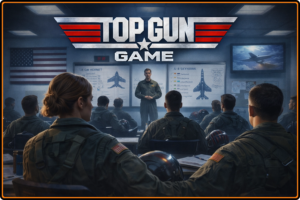
In this imagined game, Top Gun is not a menu or a backdrop. It is a physical place with rhythm, routine, and tension. A naval air base that operates like a small city built entirely around performance. You wake up early. You attend briefings. You train. You fly. You debrief. You repeat. Days blend together, but your position within the academy slowly shifts based on how you perform and how you behave. This is not an open world in the traditional sense, but it is a sandbox defined by systems rather than scripts. You are free to move around the base between missions, interact with other pilots, instructors, and support staff, and decide how to spend your limited time. Do you push yourself harder in training, risking fatigue and mistakes? Do you spend time studying flight data, improving your understanding at the cost of social presence? Or do you invest in relationships, building alliances that may save you later when pressure peaks? The base reacts to you. Atmosphere changes depending on recent events. A crash during training does not just reset the mission. It alters how people look at you. Silence in the hangar becomes heavier. Conversations become shorter. Expectations tighten.
entry, selection, and the fear of not belonging
The game should not begin with confidence. It should begin with uncertainty. Before you are officially part of Top Gun, you are tested, evaluated, and compared. Early gameplay focuses less on mastery and more on adaptability. You are not expected to be perfect. You are expected to learn fast, listen carefully, and understand that arrogance has consequences. Selection missions act as filters rather than tutorials. Failures do not end the game, but they shape how instructors and peers perceive you. A risky maneuver might impress one instructor while deeply irritating another. There is no universal approval. Different personalities value different traits, and the academy itself is divided on what defines excellence. This early phase establishes a crucial tone. You are not special. You are one of many. And that feeling never fully disappears.
relationships as pressure, not decoration
Most games treat relationships as optional flavor. In a Top Gun sandbox, they should be structural. Every pilot you meet has their own motivations, insecurities, and thresholds for trust. Some see you as competition from day one. Others see potential. A few simply want to survive the course without being humiliated. Interactions are not binary good-or-bad choices. They are contextual. What you say after a mission, how you respond to criticism, whether you accept blame or deflect it, all feed into an invisible web of perception. Over time, patterns emerge. You may become known as reliable but cautious, brilliant but reckless, or talented yet difficult to work with. These reputations affect gameplay directly. Who volunteers to fly with you. Who backs you during evaluations. Who is willing to take risks to cover your mistakes. Relationships are not about romance or drama for its own sake. They are about professional survival in an elite environment.
between flights, the real game unfolds
The moments between missions are where this game separates itself from traditional flight simulators. This is where tension accumulates slowly, often quietly. You walk through the base. You overhear arguments. You see someone replaying a failed maneuver again and again. You notice instructors watching from a distance without commenting. Time management becomes a subtle but powerful mechanic. You cannot do everything. Choosing to train longer might increase skill, but reduce focus. Choosing to rest may restore clarity, but slow progression. Choosing to socialize might unlock future support, but cost immediate performance. None of these choices are labeled as optimal. They simply exist, and you live with the outcomes
flying as expression, not spectacle
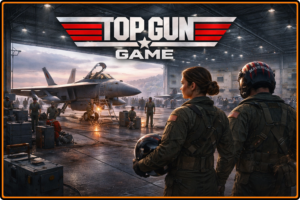
When you finally take to the air, flying feels earned. The mechanics should respect realism without becoming inaccessible. The aircraft behave with weight and consequence. Aggressive flying drains focus. Poor decisions compound quickly. Situational awareness matters more than raw speed. Dogfights are intense, but not constant. Many missions involve coordination, restraint, and discipline. Sometimes the hardest choice is not engaging when you want to. Sometimes the mission rewards patience more than dominance. Importantly, flying performance feeds back into the social layer. A flawless flight might elevate your status, but a selfish one could damage trust. The game constantly asks whether you are flying for yourself or for the team.
missions that reshape the academy
Not all missions are equal. Some are routine training exercises. Others are evaluations with long-term impact. Occasionally, unexpected situations arise that disrupt the structured rhythm of the academy. Emergency deployments. Sudden changes in command. Moments where theory collides with reality. These missions are not isolated challenges. They alter future opportunities. A strong performance under pressure might fast-track leadership roles. A visible failure might quietly close certain paths without explanation. The academy remembers.
rpg systems built around identity
Progression in this game is not about unlocking better jets. It is about refining who you are within the system. Skills focus on mental resilience, communication, decision-making under stress, and tactical awareness. Improving these abilities changes how the game responds to you rather than simply making numbers bigger. Reputation functions as a soft currency. It opens doors and closes others. It determines how forgiving the academy is when you make mistakes. It influences who mentors you and who distances themselves. You are not becoming a hero. You are becoming a professional.
tone, restraint, and maturity
This version of Top Gun does not rely on constant spectacle. It understands the power of restraint. Silence after a debrief can be more powerful than a dramatic cutscene. Exhaustion is allowed to linger. Doubt is not immediately resolved. The game respects the player enough to let moments breathe. Not every success is celebrated. Not every failure is punished loudly. Often, the most impactful consequences are subtle. This is a game about sustained excellence, not explosive heroism.
why this idea matters now
What makes this imagined Top Gun game feel relevant today is not technology, graphics, or even the license itself, but timing. Modern players are no longer satisfied with experiences that only test reflexes or mechanical skill. They want context. They want pressure that extends beyond the immediate objective. They want systems that remember who they are and respond accordingly. A sandbox built around elite aviation culture fits naturally into this shift. The idea of constant evaluation, of being surrounded by people who are just as capable as you, and of having to perform not once but consistently, speaks directly to a generation of players accustomed to long-form progression, layered systems, and consequences that unfold over time rather than instantly. At the same time, licensed games have reached a point where imitation is no longer enough. Simply recreating scenes from films or leaning on nostalgia feels shallow. A Top Gun game that dares to reinterpret the license as a living, systemic experience would stand out precisely because it refuses to play it safe. By focusing on the academy as an ecosystem rather than a backdrop, the game would allow players to explore themes that films can only hint at: insecurity behind confidence, rivalry beneath camaraderie, and the slow psychological cost of maintaining elite performance. In that sense, this concept is not just timely, it feels overdue.