REVIEW | INTEL CORE I5-13400 | BUILD FOR PEOPLE WHO ACTUALLY USE THEIR PCs
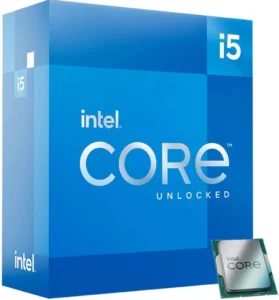
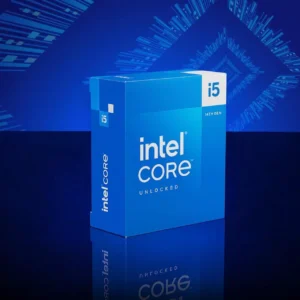
The Intel Core i5-13400 exists in a space that is far less glamorous than flagship launches and benchmark headlines, yet far more important for the majority of real users. It is not a processor designed to dominate charts, nor is it meant to excite enthusiasts who live for overclocking screenshots and thermal graphs. Instead, it sits exactly where most PCs live: in the middle ground between affordability, performance, efficiency, and long-term usability. That position alone already makes it worth a serious, grounded review rather than another spec-sheet summary. What makes the i5-13400 interesting is not that it introduces something radically new, but that it refines ideas Intel has been developing since the introduction of hybrid architecture. It is a processor that feels intentionally restrained. Intel clearly decided not to chase extreme clocks or inflated power limits here, and that decision defines the entire character of the chip. The result is a CPU that behaves predictably, stays cool, integrates easily into a wide range of systems, and delivers performance that feels consistent rather than explosive. For many users, that consistency matters far more than peak numbers. This review is not written from a synthetic benchmark perspective alone. The i5-13400 has been observed in a real system used daily for gaming, general work, heavy browser multitasking, and occasional content creation. No extreme cooling, no exotic motherboard, no artificial constraints. Just a normal PC, running normal workloads, over time. That context matters, because CPUs rarely fail in benchmarks; they fail in day-to-day use, where small inefficiencies and design compromises become obvious.
Architecture, Specifications, and Platform Reality
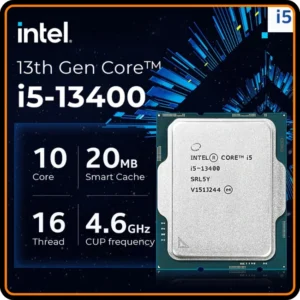
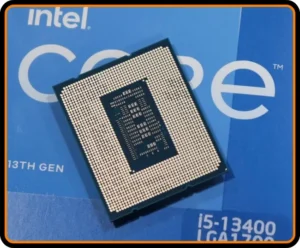
On a technical level, the Intel Core i5-13400 is a ten-core, sixteen-thread processor using Intel’s hybrid architecture. It combines six Performance cores with four Efficient cores, a configuration that immediately signals its intended role. The P-cores handle latency-sensitive and performance-critical tasks, while the E-cores take care of background processes, parallel workloads, and system housekeeping. The maximum turbo frequency of up to 4.6 GHz on the Performance cores is more than sufficient for strong single-threaded performance, while the Efficient cores provide extra breathing room when the system is under load. One detail that has caused confusion since launch is the fact that the i5-13400 exists in two silicon variants. Some units are based on Alder Lake silicon, while others use true Raptor Lake silicon. On paper, this results in small differences in cache size and internal structure, which has led to unnecessary debates online. In practice, the difference is negligible. Gaming performance, application behavior, and power consumption remain effectively the same. This is important to state clearly: no user should base a purchase decision on which internal die they might receive, because it does not materially change the experience. The processor uses the LGA1700 socket, which is one of its strongest practical advantages. It works with both 600-series and 700-series motherboards, offering a level of upgrade flexibility that is increasingly rare. Users coming from a 12th-generation Intel CPU can drop this chip into an existing board with a BIOS update, avoiding the cost of a full platform rebuild. Memory support further reinforces this flexibility, with official support for both DDR4 and DDR5. This is not just a compatibility footnote; it directly affects how affordable and accessible the i5-13400 is for a wide range of users. From a power perspective, the i5-13400 is rated at a base power of 65 watts, with boost behavior that depends heavily on motherboard power limits. In most realistic configurations, it stays far below the extreme consumption seen in higher-end Intel CPUs. This has significant implications for cooling, acoustics, and overall system design, which will be discussed later in detail.
Real-World Performance and Daily System Behavior
Performance discussions often become abstract, detached from how people actually use their computers. The Intel Core i5-13400 is best understood through everyday interaction rather than isolated benchmarks. In daily use, it feels fast in a quiet, unassuming way. Applications open instantly, system responsiveness remains intact even under load, and multitasking does not cause the subtle stutters that older mid-range CPUs sometimes exhibit. In a real system, this processor handles multiple heavy browser tabs, background applications, and active foreground tasks without ever feeling strained. The hybrid core design plays a critical role here. Background processes are quietly pushed to the Efficient cores, leaving the Performance cores free to maintain responsiveness. This separation is not something the user consciously notices, but it is something they feel. The system remains fluid even when it should, on paper, be under stress. This behavior becomes especially noticeable during mixed workloads. For example, gaming while running communication apps, streaming software, or browser windows in the background does not significantly impact performance. The CPU does not aggressively spike clocks or temperatures, and it does not exhibit erratic behavior under load. Instead, it settles into a steady operating pattern, which is precisely what most users want from a CPU that will be used daily. Productivity tasks benefit in a similar way. Light to moderate video editing, image processing, code compilation, and multitasking workflows run smoothly. The i5-13400 is not a workstation CPU, and it does not pretend to be one, but it handles creative workloads far better than older mid-range processors. For users who create content occasionally rather than professionally full-time, it strikes a very comfortable balance.
Gaming Performance and CPU Behavior in Modern Titles
Gaming performance is one of the most important aspects of any mid-range CPU review, and the Intel Core i5-13400 performs exactly as expected in this role. Paired with mid-range graphics cards such as the RTX 3060, RTX 4060, RX 6700 XT, or similar GPUs, it delivers stable frame rates at both 1080p and 1440p resolutions. In most scenarios, the GPU remains the limiting factor, which is exactly where you want the bottleneck to be. CPU-intensive games, including large open-world titles, strategy games, and simulation-heavy experiences, benefit from the additional cores and threads. While the i5-13400 will not match higher-end CPUs in extreme CPU-bound scenarios, it avoids the common pitfalls of older six-core designs. Minimum frame rates remain stable, and frame pacing feels consistent rather than erratic. Modern game engines increasingly benefit from multi-threading, even if scaling is not perfect. The presence of Efficient cores helps absorb background load, preventing sudden performance drops caused by system processes. This results in a smoother overall gaming experience, especially during long sessions where system load fluctuates. It is worth noting that the i5-13400 does not chase maximum FPS numbers. Instead, it delivers reliable, repeatable performance. That reliability becomes more important over time, as games grow more complex and system demands increase. From a longevity perspective, having ten cores and sixteen threads positions this CPU better than older mid-range options that relied solely on six cores.
Thermals, Power Consumption, and Acoustic Impact
One of the most understated strengths of the Intel Core i5-13400 is its thermal and power behavior. In contrast to Intel’s higher-end offerings, which often push power limits aggressively, the i5-13400 operates within reasonable boundaries. This makes it significantly easier to cool and far less demanding in terms of system design. In real systems, the CPU maintains stable temperatures under sustained load without requiring high-end cooling solutions. A solid mid-range air cooler is more than sufficient, and even stock cooling can handle normal operation without immediate throttling. This has a direct impact on noise levels. Systems built around the i5-13400 tend to remain quiet, even during extended workloads. This thermal stability also contributes to long-term reliability. Lower sustained temperatures reduce stress on components and improve overall system lifespan. For users who plan to keep their systems for several years, this matters more than short-term benchmark victories. Power efficiency further reinforces this positive impression. The CPU does not draw excessive power during gaming or productivity tasks, which helps keep energy consumption in check and reduces heat output. This makes it an excellent choice for compact systems, office builds, and any environment where noise and thermals are a concern.
Platform Flexibility and Upgrade Potential
The platform flexibility offered by the Intel Core i5-13400 is one of its most compelling advantages. Support for both DDR4 and DDR5 memory allows users to tailor their builds according to budget and future plans. Those upgrading from older systems can reuse existing DDR4 memory, while users building from scratch can opt for DDR5 if they wish to invest in newer technology. Motherboard compatibility further enhances this flexibility. The ability to run on both 600-series and 700-series chipsets makes the i5-13400 a practical upgrade option for a wide audience. This reduces the total cost of ownership and makes the processor accessible to users who might otherwise be priced out of a full platform upgrade. Integrated graphics, while not a major selling point, add an extra layer of practicality. Intel UHD Graphics 730 handles media playback, basic workloads, and troubleshooting scenarios without issue. While it is not suitable for gaming beyond very basic titles, its presence ensures that the system remains functional even without a discrete GPU.
Value Positioning and Market Reality
Value is where the Intel Core i5-13400 becomes slightly more complicated. In markets where pricing remains reasonable, it offers excellent value for money. However, pricing fluctuations can sometimes place it uncomfortably close to higher-tier CPUs. In those cases, users may question whether it makes sense to stretch the budget for additional performance. The lack of overclocking support also limits its appeal to enthusiasts. While overclocking is less relevant than it once was, some users still value the ability to manually tune their hardware. The i5-13400 does not cater to that audience, and it makes no attempt to do so. That said, these limitations are not flaws so much as deliberate design choices. The i5-13400 is not trying to be everything to everyone. It focuses on delivering a stable, efficient, and balanced experience for the majority of users, and in that role, it succeeds.