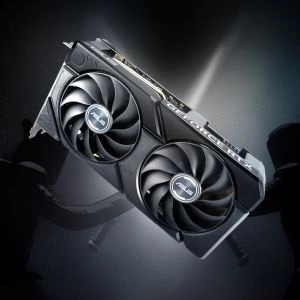
REVIEW | ASUS DUAL FORCE RTX 4060Ti 16GB | RELIABLE PERFORMACE WITH DLSS
There’s a specific moment when you install a new graphics card and you already know how the night is going to end. Not because you’ve seen the benchmarks or watched ten YouTube reviews, but because the system boots quietly, drivers settle without drama, and the first game you launch doesn’t stutter, doesn’t hesitate, doesn’t argue. That was the moment with the ASUS Dual RTX 4060 Ti 16GB. No fireworks, no cinematic reveal. Just a calm, almost boring sense of confidence. And sometimes, that’s exactly what you want from a GPU. This card has been sitting in my PC, not as a guest, but as a daily driver. We tested it together, across real games, real sessions, long evenings that turn into nights. DLSS on, settings maxed, no mercy shown to the hardware. And the result was consistent in a way that matters more than synthetic graphs: everything flew. Not “acceptable.” Not “playable.” It flew. But this isn’t a perfect card, and pretending otherwise would miss the point. The RTX 4060 Ti 16GB lives in an uncomfortable space between what gamers want and what NVIDIA is willing to give them. And that tension defines almost every part of this GPU.
First impressions: quiet confidence, no bravado
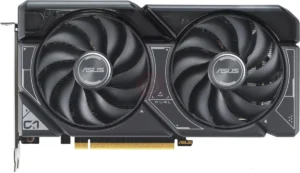
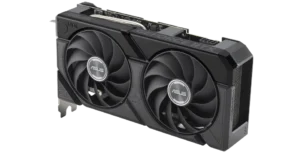
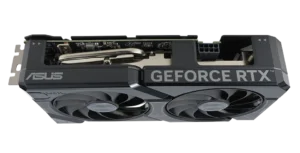
The ASUS Dual design doesn’t scream for attention. There’s no aggressive RGB, no oversized shroud trying to cosplay a flagship. It looks like a tool, not a trophy. And I like that. When you pull it out of the box, the first thing you notice is how compact and restrained it feels compared to many modern GPUs. It fits. Literally and mentally. Once installed, that restraint continues. Thermals are controlled, fans stay polite, and the card never behaves like it’s fighting for survival. Even under long gaming sessions, temperatures remain comfortable, and noise never becomes a distraction. It’s the kind of card you forget is there until you realize you’ve been gaming for hours without once thinking about performance. That matters more than people admit.
Living with the RTX 4060 Ti 16GB
Specs don’t prepare you for how this card actually feels in daily use. On paper, the RTX 4060 Ti has been criticized endlessly: the 128-bit bus, the pricing, the segmentation, the “what could have been.” All of that exists. None of it disappears. But once the card is in your system, running real games, a different narrative emerges. With DLSS enabled, modern titles at max settings simply behave. Frame rates stay high, frametimes stay smooth, and the experience feels effortless. This isn’t brute-force dominance. It’s controlled efficiency. The card knows its limits, and NVIDIA’s software stack does a lot of heavy lifting to keep everything inside those limits. We tested demanding games, not cherry-picked tech demos. Ray tracing on, textures maxed, settings pushed as far as reason allows. And the card didn’t flinch. Not because it’s secretly a high-end GPU, but because DLSS changes the rules. When used properly, it allows the 4060 Ti to punch well above what its raw raster performance would suggest.
DLSS changes everything (whether you like it or not)
There’s a philosophical debate around DLSS that never really ends. Some people treat it as cheating. Others see it as the future. Personally, after living with the RTX 4060 Ti 16GB, I don’t care about the argument anymore. DLSS works. And on this card, it doesn’t just help, it defines the experience. With DLSS enabled, games that would normally stress mid-range hardware suddenly feel relaxed. Frame rates jump, ray tracing becomes viable, and the card stops feeling like it’s constantly negotiating compromises. Image quality remains impressively clean, especially at 1440p, and during actual gameplay, it’s almost impossible to notice the difference from native rendering. Frame Generation, when available, pushes this even further. It’s not magic, and it’s not free performance, but it changes how the card feels in motion. Animations are smoother, camera pans feel lighter, and the overall responsiveness improves in a way that numbers alone don’t capture. This is why the RTX 4060 Ti 16GB should be judged differently than older GPUs. It is built to live inside NVIDIA’s software ecosystem. Without DLSS, it’s a good card. With DLSS, it becomes something much more comfortable to use.
The 16GB VRAM question, in real life
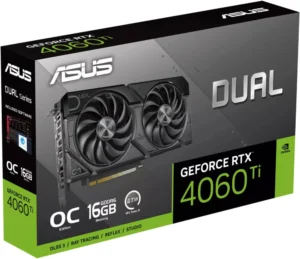
This is the part everyone argues about, so let’s be honest. The 16GB of VRAM feels both excessive and reassuring at the same time. Excessive because the GPU itself will rarely fully exploit that capacity at extreme resolutions. Reassuring because modern games are becoming unapologetically memory-hungry. In real-world use, the extra VRAM does exactly what you hope it will: it stays out of the way. No texture pop-in. No sudden drops caused by memory swapping. No feeling that you’re riding the edge of a limitation you can’t see. It’s quiet insurance. Does the 128-bit bus limit peak performance? Yes. You can feel it in certain edge cases. But during normal gameplay, especially at 1080p and 1440p, the memory configuration feels more like a safety net than a bottleneck. And as games continue to grow in complexity, that safety net becomes more valuable than raw bandwidth numbers on a spec sheet.
Ray tracing without regret
Ray tracing on mid-range cards has always been a compromise. With the RTX 4060 Ti 16GB, that compromise finally feels reasonable. You’re not maxing everything without consequences, but you’re also not forced to turn features off completely. With DLSS active, ray-traced lighting, reflections, and shadows become usable in a way that feels natural. You stop thinking in terms of “can I enable this?” and start thinking in terms of “does this look better?” That shift matters. It changes how you approach graphics settings and removes a lot of the constant tweaking that used to define PC gaming. The ASUS Dual cooling solution helps here as well. Even with ray tracing active, thermals stay under control, and the card doesn’t punish you with excessive noise for daring to use its features.
Power efficiency and daily stability
One of the most underrated aspects of the RTX 4060 Ti 16GB is how little power it needs to do its job, and that efficiency quietly defines the entire experience of living with the card. Compared to previous generations, it sips electricity, and that restraint ripples through the whole system: less heat, quieter operation, and noticeably lower stress on the power supply. In daily use, this translates directly into stability. The card never feels like it’s straining, never behaves as if it’s approaching a thermal or electrical edge. There’s no sense of panic, no aggressive throttling, no audible reminder that the hardware is under pressure. It simply runs, calmly and consistently, the way well-balanced hardware should. Over time, that calm becomes more valuable than raw performance spikes, because it allows the system to disappear into the background while you focus on the games themselves. That sense of balance is what makes the RTX 4060 Ti 16GB easy to live with. You stop monitoring temperatures. You stop listening for fan ramps. You stop adjusting power limits and undervolts. The card fades into the rhythm of everyday use, and in doing so, it earns trust. This is not a GPU that demands attention. It rewards neglect.
Performance boundaries: comfort, temptation, and restraint
After enough hours with the RTX 4060 Ti 16GB, a subtle shift happens. Not disappointment, but clarity. The honeymoon phase fades, and you begin to feel the edges of the card’s design philosophy. Performance doesn’t suddenly collapse, and games don’t stop running well. Instead, you become aware of what the card is unwilling to be. In newer, poorly optimized titles especially, the limits of the memory bus quietly surface. Not as stutters or crashes, but as an invisible ceiling that gently lowers expectations. The GPU wants to remain efficient, wants to stay composed, and sometimes that restraint feels deliberate, almost enforced. You sense NVIDIA’s invisible hand guiding the experience, quietly drawing a line and saying: this is where this card is allowed to live. It’s not a dealbreaker, but it is noticeable. At 1440p, the RTX 4060 Ti 16GB feels completely at home. This is where it breathes, where DLSS feels like a refinement rather than a requirement. Frame rates remain stable, image quality stays sharp, and the card feels like it’s operating inside its natural habitat. At 4K, the tone changes. The card can run games at this resolution, especially with DLSS enabled, but the experience becomes conditional. You stop asking how well it performs and start asking how far you can push it before something gives. This is not a 4K-native GPU, and pretending otherwise only leads to frustration. And yet, the fact that it can even flirt with 4K at all, with 16GB of VRAM quietly preventing catastrophic memory issues, says a lot about how much mid-range hardware has evolved. It’s not comfortable territory, but it’s accessible in a way that would have felt unrealistic just a few years ago.
Value, longevity, and why the score stops at 83
This is where the RTX 4060 Ti 16GB stumbles, not technically, but philosophically. The performance is there. The efficiency is there. The stability is there. What complicates everything is the price positioning. This card feels like it exists because NVIDIA wanted it to exist, not because the market demanded it. The 16GB of VRAM is both a genuine strength and a distraction. It eases long-term anxiety about memory limitations, but it doesn’t transform the GPU into something it isn’t. You’re paying for comfort rather than dominance, for longevity rather than excess. Depending on how you approach PC hardware, that trade-off can feel either reasonable or deeply frustrating. If you value quiet operation, smooth gameplay, and a system that doesn’t fight you every time a new game launches, the price becomes easier to justify. If you chase raw value per frame, it becomes harder to defend. Over time, the RTX 4060 Ti 16GB proves its worth not through standout moments, but through consistency. There’s no driver drama, no sudden performance cliffs, no heat spikes, and no noise fatigue. You stop tweaking settings. You stop worrying about whether a game will run. You stop watching VRAM usage graphs out of habit. The card fades into the background, and the games take center stage. That’s a quiet victory, and it’s why the card deserves respect even from its critics. It doesn’t try to impress you once. It tries to satisfy you every day. An 83 isn’t a punishment. It’s a boundary. The RTX 4060 Ti 16GB does too many things right to be dismissed, but it carries too many deliberate compromises to be celebrated without restraint. The memory bus limits peak potential. The price undermines its value narrative. The reliance on DLSS, while effective, shifts responsibility from hardware to software. And yet, when judged as a lived experience rather than a spec sheet, the card makes sense. It satisfies in practice, even when it frustrates under analysis. And that balance is exactly where its score belongs.