
PREVIEW | PIONERSS OF PAGONIA | A MODERN INTERPRETATION OF SETTLER-INSPIRED STRATEGY
Loading up Pioneers of Pagonia for the first time doesn’t immediately signal anything unusual bare-bones city-builders are everywhere these days. But a few minutes in, it becomes clear this one is structured differently. The world isn’t a single stretch of land but a patchwork of fragmented islands wrapped in magical fog, and every early decision lands with more weight than expected. That foundation alone gives Pagonia a sense of ambition that’s not all that common anymore. Developed by Envision Entertainment (the project was officially announced in 2023) and guided by Volker Wertich, the original mind behind The Settlers, the game sets out to revive and meaningfully expand on that classic philosophy of deliberate settlement building, layered economy, and community-driven progression.

Mechanics and systems
At its core, Pioneers of Pagonia is a city-builder with a serious economy backbone. According to the official factsheet, the game supports over 40 building types and more than 70 different goods/resources, tied together by branching production/manufacturing chains. That depth matters. It means rather than just “build house produce wood trade,” you will need to think several steps ahead: raw materials must be gathered, refined, transported, stored, distributed, sometimes even transformed via multiple stages before reaching final products. In practice, I’ve seen this lead to interesting logistical challenges: supply routes clog if you don’t plan storage hubs well, and workforce assignment becomes non-trivial when you have specialized buildings (smiths, woodcutters, miners, etc.) working in tandem. The 2025 “Major Economy Update” further reworked these mechanics: now there’s a mode where you can start with just a few settlers and no supplies slowly building your settlement from near scratch. This “hard start” option adds another layer of challenge and strategic depth. As a result, the economy feels less like a background loop and more like a living system that reacts to your choices. If you miscalculate workforce distribution, resource balance, or supply lines consequences are visible. That realism and interdependence is a strong foundation.
Procedural Maps, Exploration & Replayability
One of the promises of Pagonia is infinite variety: procedurally generated maps mean that each playthrough can be different. Islands differ in shape, terrain, resource distribution, and strategic layout making early-game exploration and settlement planning feel fresh and unpredictable. This procedural aspect is important: it helps combat repetition, which often plagues city-builders once you’ve memorized the “optimal build order.” Here the variability forces adaptation: a resource-poor island might push you to trade early, or expand cautiously; a resource-rich island might tempt rapid growth but at risk of supply bottlenecks or external threats. Moreover, with the upcoming full release there’s also planned mod-support via a built-in map editor; players will be able to design and share their own islands. That could dramatically extend the game’s lifespan community-driven content has the potential to breathe life into the game well beyond its launch.
Population, Units, and Threats
It’s not just economy and cookies Pagonia also layers in threats, survival, and community management. The world is dangerous: beyond scarcity, threats include hostile factions — bandits, scavengers (Scavs), mythical creatures like werewolves and ghosts (especially after the calamity that fragmented Pagonia) and the environment itself. Populating your settlement requires balancing jobs, housing, food and safety. Each inhabitant from a miner to a craftsman to a soldier has a role. You must ensure they are fed, housed and protected; otherwise, morale (or morale-equivalent) and workforce efficiency suffer. The game reportedly supports up to 3,000 inhabitants in a fully developed settlement. Units such as “Pioneers,” guards or fighters can be assigned to defend or expand, but combat and defense seem more abstracted than in an action-RPG: combat resolution leans on “unit strength statistics” and less on player-controlled tactics. That design choice shifts the focus toward strategic planning and macro-management rather than micro-control appropriate for a city-builder with heavy economy elements. That said: while this abstraction allows for smoother large-scale management, it also means combat lacks depth fights are resolved quickly, unit details matter, but battles rarely feel cinematic or mechanically rich. For players expecting tactical complexity, this might feel like a trade-off.
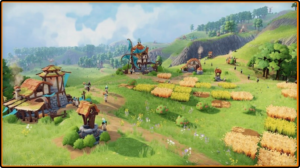
Interface and overall polish feel early, yet clearly improving
Because Pioneers of Pagonia is navigating from Early Access (launched December 2023) toward full 1.0 (planned 11 December 2025), the current build still carries some rough edges. From my (and community) experience: Tutorial and onboarding: With the latest updates, the tutorial map and beginner interface have improved: the “hard start” mode adds a more gradual learning curve, which makes sense for new players you’re not immediately overwhelmed with resources, buildings, and complex chains. Performance & stability: On average modern PC hardware, the game runs smoothly on default map sizes. The procedural generation and population animations don’t seem to overtax the engine. That said very large maps with thousands of units and dense economy networks can introduce frame drops or UI lag, especially when many events (crafting, transport, combat) happen simultaneously. UI/UX clarity: The building menus, resource chains, production lines, and population overview are laid out logically. The developers have tried to make resource flows, storage, and logistics transparent which is good because complexity without clarity quickly becomes frustration. However, balancing all these layers (production, logistics, defense, population morale) can become overwhelming for newer players. Graphics & presentation: Pagonia doesn’t attempt hyper-realism; visuals are modest but serviceable: units, buildings, environment animations are clear enough to distinguish events, but they won’t wow if you expect AAA-level detail. Yet this stylistic modesty supports readability: even with many entities on screen, you rarely lose track of what’s happening. In short: yes there are rough edges. But the core systems are well-structured, and the user experience is thoughtfully designed. For a game scaling toward full release, that’s a good sign.
What the upcoming full version promises
According to recent developer announcements and media coverage: Full 1.0 release on 11 December 2025, including a 30-hour story campaign. The campaign will be playable solo or in co-op mode with up to four players. That dramatically expands the scope from sandbox building to narrative-driven progression. New mechanics: enhanced settlement-building, refined economy and production systems (thanks to the Major Economy Update), new buildings, and rebalanced resource flows. Community tools: a map editor will be released before or at 1.0, enabling players to create and share custom maps potentially turning Pagonia into a platform for community-made content, custom challenges, sandbox experiments. Continued modding support and community feedback the developers emphasize open communication and improvements based on player input. What this means if all goes well is that Pioneers of Pagonia might not just be another city-builder, but a flexible foundation: sandbox + story + community tools. For fans of strategy / simulation games, that combination is rare and potentially very rewarding. Still: success depends on polish at launch (bugs, balance issues, performance) and how robust the campaign and editor tools prove to be. There’s always the risk that scope might stretch too thin.
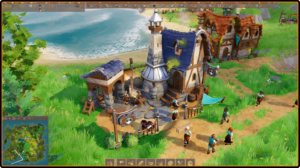
A strong successor with room to mature further
I like what Pioneers of Pagonia tries to do. There’s ambition beneath the simplistic buildings and resource icons a structure of interlocking systems, emergent complexity, and a world that demands careful planning and adaptation. The procedural islands, resource management, population logistics and threat systems combine to give depth. If the developers deliver on the upcoming 1.0 with a solid story campaign and stable map editor plus smooth performance Pagonia could very well stand out among current city-builders. It may even carve a niche as a “modern classic” for players who enjoy deep simulation rather than flash. Yet, I can’t ignore the caveats: when complexity meets large populations, there is a danger of micromanagement fatigue; UI complexity may overwhelm some; and the abstraction of combat & threat resolution might disappoint players who expect more tactical or action-oriented gameplay. In short: Pioneers of Pagonia promises a multifaceted, systemic sandbox with room for creativity and management depth. It’s not perfect but it doesn’t need to be. What matters is that the foundation is solid, and the vision is clear. For strategy and city-builder fans especially those nostalgic for thoughtful, system-rich building games Pagonia deserves close attention. If you ask me: I’m onboard. I’m ready to rally the settlers, chart the islands, optimize the economy and see whether this fog-shrouded land can become a thriving, bustling society once more.