
PREVIEW | ACES OF THUNDER | A PERSONAL FLIGHT INTO HISTORY
Aerial combat has always fascinated me, but not in the abstract, cinematic way most games present it. For me, planes especially those from the WWII era have always carried weight. Real weight. They’re not just machines; they’re stories suspended between sky and ground, bravery and fear, survival and loss. That’s why Aces of Thunder instantly caught my attention, long before it had a confirmed release date or a clear roadmap. I’ve always been drawn to WWII aircraft. The shapes, the exposed mechanics, the sound of piston engines pushed to their limits. These were machines that demanded respect. Pilots didn’t just fly them they wrestled with them. There was no automation, no safety net. Every maneuver mattered. That fascination is also personal. My grandfather was a WWII pilot, and knowing that gives games like this a different weight. When a game chooses this period, it’s not just borrowing aesthetics it’s touching history. Now that Aces of Thunder has an official release date set for February 3, 2026, anticipation finally has a solid anchor. The game is coming to PC and PlayStation 5, with full VR support as its core experience, while also offering a complete non-VR (flat screen) mode. That decision alone makes it stand out. This isn’t a VR experiment pretending to be a full game it’s designed to work both ways, which suggests confidence in the underlying mechanics.
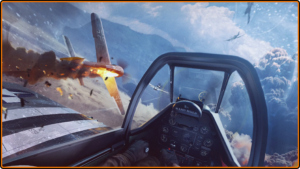
The focus is on historical aerial dogfights, primarily from the WWII era, with aircraft recreated to emphasize close-range combat rather than long-distance engagements. From what has been shown so far, the game leans toward a middle ground between simulation and accessibility. This isn’t a hardcore flight sim meant only for veterans with flight sticks and manuals, but it also doesn’t look like an arcade shooter where physics barely matter. Energy management, positioning, and awareness appear to be central to survival. Cockpit perspective plays a major role, especially in VR. The idea isn’t just immersion for immersion’s sake, but tension. Checking your surroundings, tracking enemy movement, and managing instruments all happen in real time. Even outside VR, the developers seem intent on preserving that sense of vulnerability rather than turning the game into a detached third-person spectacle.
Aces of Thunder will feature both single-player content and multiplayer dogfights. The single-player component is expected to focus on structured missions inspired by historical scenarios, while multiplayer is positioned as the long-term competitive core. That balance matters. Aerial combat games live or die by how meaningful their single-player experience feels once the novelty fades, and how fair and readable multiplayer engagements remain over time. There are still unanswered questions. How deep will aircraft handling really go? Will planes feel heavy, temperamental, and dangerous the way WWII aircraft should? How punishing will mistakes be for newcomers? These details will define whether Aces of Thunder becomes a lasting experience or a short-lived curiosity. For me, this preview isn’t driven only by features or bullet points. It’s driven by the idea of stepping into a sky that once meant everything to real people. A sky my grandfather once flew in for real, without retries or respawns. If Aces of Thunder manages to capture even a fraction of that tension and respect for history, it won’t just be another flight game. It’ll be a reminder of why this genre still matters.