
OCCT | WHEN PERFORMANCE MEANS NOTHING WITHOUT STABILITY
Most PC problems do not announce themselves with fireworks. They creep in quietly. A random crash here, a stutter there, a strange freeze that only happens once every few days and then disappears long enough for you to doubt your own memory. The machine still boots. Games still launch. Benchmarks still show respectable numbers. On the surface, everything looks fine. But under the hood, something might be barely holding together. This is the uncomfortable space many PC users live in, especially those who build or tweak their own systems. We are told to chase higher frame rates, better scores, prettier graphs, yet the question of whether a system is truly stable is often treated as an afterthought. Stability is boring. Stability does not give you screenshots to brag about. Stability only matters when it fails, and by then it usually fails at the worst possible moment. That is why tools like OCCT exist, and why they quietly earn respect not through hype, but through the calm confidence they give when everything passes under pressure.
For a long time, PC culture has been shaped by benchmarks rather than stress tests. Cinebench, 3DMark, and similar tools are everywhere because they produce numbers that are easy to compare. Numbers feel objective. They give a sense of progress. You upgrade a GPU, your score goes up. You tweak your CPU, your multi-core result improves. It is satisfying. But benchmarks are not designed to break your system. They are designed to measure performance under controlled, repeatable workloads. Stress testing lives in a different psychological space. A proper stress test does not care about your pride or your scores. Its job is to push your hardware into uncomfortable territory and stay there long enough for hidden weaknesses to surface. That difference matters more today than it did ten years ago. Modern PCs operate closer to their limits by design. CPUs boost aggressively, GPUs pull huge bursts of power, memory profiles push timings that would have been considered reckless in the past. Everything is tuned for performance out of the box. That makes systems faster, but it also makes them more fragile in subtle ways. OCCT sits right in the middle of this reality, less glamorous than a benchmark, but far more honest about how your PC behaves when things get heavy.
Benchmarks vs Stress Tests: Why Stability Is a Different Problem
It is tempting to believe that if a system can run demanding games for a few hours, it must be stable. In practice, that is not how instability works. Many hardware issues live in narrow corners of the performance envelope. A game might never hit the exact combination of CPU load, memory usage, and power draw that triggers a problem. A benchmark might run for two minutes and exit before thermals have time to saturate or before a power delivery issue shows up. Stress testing, when done properly, is about sustained pressure. It is about heat soak, power delivery consistency, and memory integrity under prolonged load. OCCT approaches this with a kind of blunt honesty. It does not try to look pretty. It tries to make your PC uncomfortable. That is its entire philosophy. You are not testing how fast your system is. You are testing whether it can remain coherent when everything is pushed at once. This distinction becomes especially important when people start tweaking. Overclocking and undervolting are no longer niche hobbies. Many GPUs ship with factory overclocks. Many users enable XMP or EXPO profiles without a second thought. These are reasonable choices, but they move a system away from conservative defaults. The moment you do that, you are no longer in the safe, boring zone that manufacturers validate most thoroughly. You are in the grey area where stability is still likely, but no longer guaranteed. OCCT becomes a way to ask a simple question: does this system behave like a solid tool, or is it a ticking time bomb waiting for the wrong combination of heat and load?
What OCCT Actually Tests, and Why That Matters
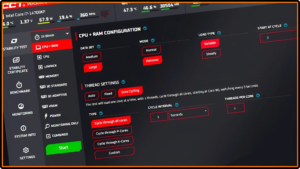
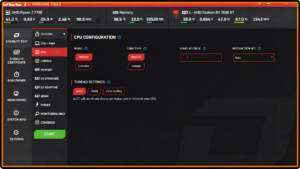
One of the strengths of OCCT is that it treats the PC as a system, not as a collection of isolated parts. You can stress the CPU in different ways, load the GPU, hammer the memory, and even put pressure on the power supply by combining loads. This matters because real-world failures often happen at the intersections. A PSU that is technically “enough” on paper might struggle with transient spikes from a modern GPU. Memory that passes a quick check might throw errors when the CPU is also under heavy load and the system is hot. VRM cooling on a motherboard might look fine in short bursts, but sag under sustained stress. OCCT’s approach exposes these interactions. It does not promise that if you pass its tests your PC will never crash again. No software can offer that guarantee. What it offers is something more grounded: a way to dramatically reduce the chance that your system is secretly unstable. There is also a psychological aspect to this. Running a proper stress test is an act of facing reality. You are choosing to find out if something is wrong now, in a controlled environment, rather than later in the middle of a game session, a render, or a work deadline. That mindset alone is valuable. It shifts your relationship with your PC from hopeful optimism to informed trust. When everything passes, you do not just assume your system is stable. You have evidence. It might sound small, but that difference in confidence changes how you use your machine. You stop waiting for the next random crash. You stop second-guessing every stutter. You start treating your PC like a tool that has been tested, not a fragile experiment held together by luck.
The Emotional Side of Trusting Your Hardware
There is a quiet relief that comes from watching a system endure heavy load without flinching. No dramatic spikes. No sudden shutdowns. No creeping temperatures that spiral out of control. Just steady behavior under pressure. That feeling is hard to quantify, but it matters. Building or upgrading a PC is an emotional investment as much as a financial one. You choose parts, you assemble them, you tune settings, and then you hope everything works as intended. Stress testing turns that hope into something closer to certainty. Passing an OCCT run does not make your PC invincible, but it changes the tone of your relationship with it. You stop treating it like a potential liability and start treating it like a reliable partner in whatever you want to do, whether that is gaming, content creation, or just everyday use. This is also where OCCT’s lack of flash becomes a strength. There is no dopamine hit from a high score. There is only the quiet satisfaction of stability. In a culture obsessed with performance bragging, that kind of satisfaction feels almost old-fashioned. Yet it is deeply practical. A stable system is more valuable than a slightly faster but unpredictable one. The difference might not show up in a benchmark chart, but it shows up in your day-to-day experience. Fewer crashes. Fewer unexplained hiccups. Less time spent troubleshooting instead of enjoying your PC.
Where OCCT Fits in a Modern PC Workflow
OCCT works best when it is treated as part of a broader workflow rather than a one-off ritual. After a new build, it makes sense to stress test before you commit to daily use. After a hardware upgrade, it helps to verify that the new component plays nicely with the rest of the system. After changing voltages or enabling aggressive memory profiles, it becomes almost a responsibility. Even for stock systems, an occasional stress test can act as a health check. Dust builds up. Thermal paste ages. Fans wear down. Over time, a system that was once stable can drift toward the edge. OCCT can reveal that drift before it turns into a failure. There is also a broader point here about how we evaluate software tools in the PC space. Many utilities exist to optimize, tweak, and squeeze out extra performance. Far fewer exist to tell you uncomfortable truths. OCCT belongs firmly in the second category. It is not trying to make your PC look better on paper. It is trying to tell you whether your configuration makes sense in reality. That honesty is valuable, especially in an ecosystem where marketing language often blurs the line between “capable under ideal conditions” and “reliable under real conditions.”
Limits, Misuse, and Common Misunderstandings
It is important to be clear about what OCCT does not do. Passing a stress test does not mean your system is immortal. It does not guarantee that no future driver update will cause issues, or that no software bug will ever trigger a crash. It also does not mean that your cooling is optimal or that your power supply is the best possible choice. It simply means that under the specific loads you tested, your system behaved as expected. There is also the risk of misuse. Running stress tests for extreme durations without proper cooling can be unnecessarily harsh on hardware. The goal is not to torture your PC for the sake of it. The goal is to reveal weaknesses. Once you have confidence in stability, there is no need to turn every test into an endurance marathon. Another common misunderstanding is to treat stress test results as performance indicators. OCCT is not about how fast your system is. It is about whether your system remains coherent under load. Mixing up those goals leads to confusion and misplaced expectations. If you want to compare performance, benchmarks are still useful. If you want to trust your system, stress testing is the right tool. They answer different questions, and pretending they answer the same one only leads to disappointment.
Why Tools Like OCCT Matter More Than Ever
Modern PC hardware is powerful, but it is also complex. Power delivery is more dynamic. Thermal behavior is more aggressive. Automatic boosting algorithms push components closer to their limits by default. This complexity makes it easier to build incredibly fast systems, but it also increases the number of subtle failure modes. A decade ago, instability often came from obvious mistakes. Today, it can come from edge cases that only appear under specific combinations of load, temperature, and time. OCCT is valuable precisely because it targets those edge cases. It does not promise perfection. It promises visibility. It gives you a window into how your system behaves when it is stressed in ways that normal use might not replicate. There is also a cultural aspect to this. The PC community often celebrates experimentation, tweaking, and pushing limits. That spirit is part of what makes the platform interesting. But experimentation without validation is just guesswork. OCCT acts as a reality check. You can push your system, but you can also test whether those pushes make sense. That balance between curiosity and verification is what separates a fragile setup from a robust one.