NEOCLASSIC GAMES | THE ELDER SCROLLS V: SKYRIM | LEGENDS NEVER DIE
I’ll be honest there are days when I think the only proper way to start talking about The Elder Scrolls V: Skyrim is by admitting that I still get chills hearing that opening theme, with the deep Nordic chants echoing against a backdrop of snow‑dusted peaks. There’s a raw, timeless thing about Skyrim that refuses to fade. It’s also worth noting that, as a game released in 2011, it falls squarely into the NeoClassic Games category, alongside other modern titles that have redefined their genres. For many of us, it’s more than just a release date it’s a mood. A memory. A broken pair of boots that still fit like no other. In this piece I want to walk you through what makes Skyrim worthy of the “NeoClassic Games” badge: its strengths, its flaws, and why, even now, it hits a certain note that newer titles struggle to match.
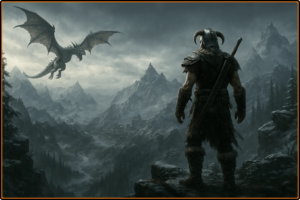
The Spell Still Works: What Skyrim Nailed from Day One
When Skyrim dropped in November 2011, it wasn’t just another entry in a fantasy RPG series it felt like a door to a world so big you’d need a lifetime to explore it. You, the player, became “Dragonborn” not some afterthought “hero,” but a legend in the making. A heavy title, sometimes absurd, but one that carried weight: dragons exist. Dragons roam. Dragons kill. And with that, Skyrim offered freedom. Freedom to wander, wander off the road, get lost in pine forests, stumble into bandit caves, maybe awaken a dragon by accident. Even today, that sensation of a living world full of unpredictability can still slap you in the face. What gave that freedom teeth was scale and atmosphere. Skyrim didn’t give you tight corridors it gave you open skies, bleak mountain ridges, deep valleys, crowded cities… and small taverns tucked between wooden houses. Snow would fall. Wolves would howl. Dragons would scream across the night sky. And when you first draw your steel, or wield fire magic under torchlight, you feel the world shift under your boots. It’s not perfection. It doesn’t hold your hand. But it gives you space to breathe. To roam. To lose or find yourself. Then came new editions: The Elder Scrolls V: Skyrim – Special Edition (2016), and later The Elder Scrolls V: Skyrim – Anniversary Edition (2021). The Special Edition polished up graphics, lighting, FX enough to give players a reason to return, or to discover the world anew without feeling like they’re stuck in 2011. Anniversary Edition added more layers: expansions bundled in, plus a host of official mod‑type content via the creation club more quests, items, odds and ends, keeping things fresh. But here’s the real kicker (and why Skyrim deserves “NeoClassic” status): its engine Creation Engine was, even at the start, flexible enough to let community modders amateurs, fans, do‑it‑yourselfers ripple through the code and build on the world. That decision alone ensured longevity. In short: Skyrim didn’t just build a world. It built a sandbox. A world you could bend, stretch, reshape.

The Age Shows: But Not Always Badly
Of course and I’m not gonna sugarcoat Skyrim has wrinkles. Dark circles under the eyes. The engine that gave it freedom also gave it baggage. Physics hiccups, awkward animations, weird NPC behavior, clipping problems, bugs that make you scratch your head, or laugh if you have dark humor. A dragon lands inside your bedroom? Totally possible. Your horse walks into a wall? Happens. NPCs teleporting? Welcome to the show. Mechanically combat, stealth, archery, magic, stats they’re fine. Fun even. But they can feel shallow compared to modern RPGs that flaunt complex systems, ultra-realistic animations, tactical depth, or hyper‑real physics. Inventory management, lockpicking, stamina, basic stealth sometimes they feel like relics from a simpler era. And the world yes, huge. But also repetitive in parts. Dungeon rooms that look alike, reused assets, interior corridors that become blur after the tenth time you wander through them. Side‑quests that sometimes boil down to “go kill X, pick up Y, return for gold.” Voice‑acting and writing are hit‑or‑miss: some stories are memorable, some NPCs forgettable. After 100, 200, 300 in‑game hours, even the bravest wanderer can feel the fatigue. So yes Skyrim creaks. It stumbles. Sometimes it falls flat. But and this is the big “but” I’ve always believed that imperfections don’t kill the magic. They are the magic. Because when Skyrim hits right when it catches you off‑guard with a sunset behind mountain peaks, when a dragon roars in the night, when you’re holed up in a tavern with a mug of mead after a fight the world feels alive. Raw. Unpolished, yes but with character. Maybe it doesn’t aim for shiny realism. Maybe it doesn’t deliver flawless combat animation. But it delivers soul.

Mods: The Lifeblood That Kept Skyrim Breathing
If Skyrim were a human mods would be its blood. Because without them? Tough. Without them, Skyrim gets old. But modders they gave it immortality. As of 2024, there are over 72,000 mods for Skyrim lurking on NEXUS, and tens of thousands on other platforms (Steam Workshop, community sites, etc.). That makes it one of the most modded games in history. And mods vary wildly. From minor “quality‑of‑life” tweaks (better UI, smoother menus, inventory fixes) to full‑blown overhauls: new quests, new lands, new magic systems, sometimes even total‑conversion mods that make you forget you’re playing Skyrim at all. You want realism? There are mods for HD textures, dynamic weather, better lighting, improved snow, better interiors. Want a fresh storyline? There are fan‑made expansions with dozens or hundreds of hours of content, new characters, lore-friendly quests even voice acting. One of the coolest things: the modding community didn’t stop at aesthetics or side content they fixed longstanding issues too. Bugs, engine quirks, gameplay balance modders often patched and polished what official updates left rough. That’s a rare thing: a community stepping in to “finish” the game when the original devs moved on. On top of that: new official content via the Creation Club (after Anniversary Edition) gave the game a base layer of renewed interest even for those wary of modding. But for many mods remain the real heart. For me and many other players playing Skyrim modded is like putting on a suit that never goes out of style. It’s familiar, slightly rumpled, but it fits.
It’s a Benchmark For Better and for Worse
Because Skyrim got big. Huge. And because it launched almost 15 years ago, it became the yardstick. “Feels like Skyrim.” “Open world like Skyrim.” “Dragon‑RPG like Skyrim.” You name it. That legacy is a double‑edged sword. For new games, developers often chase that formula: big world, dragons, freedom, freedom to roam. But many miss the point. They deliver polish, cinematic presentation, shiny graphics but often strip away the rough edges, the unpredictability, the soul. So what you get sometimes is a hollow shell. Less fun in subtle ways. Less weirdness, less “happy accidents”, less room for player creativity. Because modern games are afraid to be broken. But Skyrim wasn’t. On the other hand for modders, for fans that benchmark is heavy. It reminds you what Skyrim did right. But it also raises a question: can anything released now with smoother bugs, prettier graphics ever feel as “real” as Skyrim did when you nearly froze to death on a mountaintop, swinging at a thief with nothing but a rusty sword? Maybe not. But that’s okay. Because Skyrim doesn’t need to be topped. It needs to be felt.
Who Should Jump In, Even Now and What To Watch Out For
If you’ve never played Skyrim or you played a bit back in the day and drifted away here’s my take, straight from the heart: Yes it’s worth it. But come with the right mindset. Be ready for rough edges. The game can feel dated. Bugs, weird animations, clunky UI, reused interiors they exist. Don’t treat them as flaws to hate; treat them as part of Skyrim’s character. Consider modding. If you care about immersion, freshness, or just want to fix or improve things mods can transform Skyrim from “classic RPG from 2011” into “living, evolving world in 2025.” Not mandatory, but highly recommended. Patience helps. The magic rarely hits in first hour. It sneaks up: a dragon fight at dusk, stumbling onto a hidden ruin, that first time you craft a home or light a fireplace in a snowy hold those moments stay. Don’t hunt for perfection. If you expect deep tactical combat with modern realism, or cinematic fidelity you might be disappointed. But if you come for freedom, atmosphere, discovery you’ll find what you came for.

Verdict: Skyrim earns its NeoClassic status through its enduring world and immersive charm
Let’s not sugarcoat things: Skyrim has flaws. It creaks under the weight of its own ambition. Sometimes it stumbles. Sometimes it trolls you with bugs or loops you into repetitive quests. But and this is the important bit when it works: it punches you in the gut. It humbles you, awes you, sometimes frustrates you but rarely leaves you cold. It feels like a world older than time, hungry and dangerous but living. A 2011 game, sure. But thanks to soul, atmosphere, and an endless modding community, it keeps breathing. And in a world full of hyper‑polished AAA games chasing realism and cinematic sheen, Skyrim stands as a testament: you don’t always need perfection. Sometimes you need character. So yes I slap the NeoClassic badge on Skyrim not because it’s old, but because it continues to live, shift, evolve, bite, surprise. Because when the wind whispers through pine trees, when dragons scream across valleys, when you light the torch in a dark tunnel and hear the drip of water echo you don’t feel like you’re playing a game from 2011. You feel like you entered a world. If you haven’t walked Skyrim’s snow‑paved roads yet maybe it’s time. Grab your sword, or your spells. Let the wind hit your face. And don’t look back.