NEOCLASSIC GAMES | DEAD SPACE 2 | STILL OUTCLASSES MODERN HORROR
Dead Space 2 is one of those games that doesn’t really announce its importance loudly, yet somehow ends up sitting firmly in that space where you realize, years later, that very few titles have managed to do what it did. You come back to it expecting something slightly outdated, maybe a bit clunky, maybe carried mostly by nostalgia, and instead you get a game that still feels composed, deliberate, and surprisingly modern in how it handles tension, pacing, and player control. It doesn’t try to impress you immediately with spectacle or scale. It pulls you in through control, atmosphere, and the quiet confidence of a game that knows exactly what it’s doing. And the longer you stay with it, the clearer it becomes that this wasn’t just a good sequel at the time, but a game that understood its own identity early and never really drifted away from it.
A sequel that understood the original
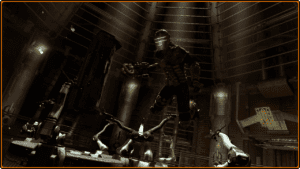
To really understand why Dead Space 2 works the way it does, you have to look at Dead Space 1 first, because the relationship between the two is what defines the sequel. The original game was built around restriction. It slowed you down, forced you to think about every step, and made sure that even basic movement felt like a commitment. There was a weight to everything, from the way Isaac walked to the way the camera framed the environment. The Ishimura itself felt like a living trap, constantly closing in on you, and the game used that claustrophobia to create tension that didn’t rely on constant action. It was about anticipation, about silence, about the feeling that something was always just around the corner. Dead Space 2 doesn’t abandon that philosophy, but it definitely shifts its focus. Instead of tightening the space even more, it opens it up, not in a way that makes things easier, but in a way that changes how you experience danger. The Sprawl is larger, more varied, and more unpredictable. You’re not just moving through industrial corridors anymore; you’re moving through places that were meant for people to live in, places that still carry traces of normal life. That contrast between what the space was and what it has become creates a different kind of discomfort. It’s less about being trapped and more about witnessing collapse. What’s impressive is that the game doesn’t feel like it’s trying to top the first one by doing more of everything. It feels like it’s trying to refine what worked and expand where it makes sense. That’s a much harder thing to pull off than simply making something bigger or louder, and it’s probably one of the main reasons why Dead Space 2 still holds together as well as it does.
Isaac Clarke becomes a real character
One of the most significant changes, and one that could have easily gone wrong, is Isaac himself. In Dead Space 1, he was silent, which worked for the kind of experience the game was aiming for. You were meant to project onto him, to feel isolated not just in the environment but in your own perspective. But that approach also created a certain distance. You were experiencing things, but not necessarily sharing them with a character. Dead Space 2 removes that distance. Isaac talks. He reacts. He argues, questions, breaks down. And instead of weakening the horror, it actually deepens it. You’re no longer just navigating a hostile environment; you’re watching someone struggle to hold onto his sanity while everything around him, and inside him, is falling apart. His hallucinations are not just visual tricks meant to scare you, they are part of his character, part of the story, and part of how the game communicates its themes. This shift makes the narrative feel more grounded, even when it leans into more surreal elements. You understand what’s at stake on a more personal level, and that changes how you engage with the game. You’re not just trying to survive because the game tells you to; you’re trying to survive because Isaac needs to, and that subtle difference makes the experience more cohesive.
Combat that still feels deliberate
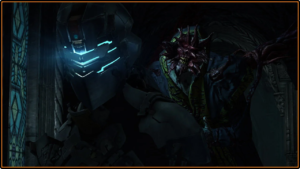
The combat system is where Dead Space 2 really proves that it hasn’t aged in the way many games from that era have. At its core, it’s still about dismemberment, about targeting limbs instead of going for headshots, about controlling the battlefield rather than reacting blindly to it. But everything around that core idea is sharper. Enemies are faster, more aggressive, and often designed to force you out of familiar patterns. There’s a constant sense that you’re being tested, not just in terms of reflexes, but in terms of decision-making. Which weapon do you use? Do you conserve ammo or go all in? Do you focus on one enemy or try to control the group? These decisions happen quickly, but they matter, and the game gives you just enough pressure to make them feel meaningful without becoming overwhelming. What’s important is that even when the game leans more toward action compared to the first one, it never becomes mindless. You can’t just run forward and shoot everything without thinking. The mechanics are designed to keep you engaged, to make sure that every encounter has a structure, even when it feels chaotic on the surface. That balance between intensity and control is something a lot of modern games struggle with, and Dead Space 2 manages it with surprising consistency.
Atmosphere beyond simple horror
If the first game was about isolation, Dead Space 2 is about collapse. The Sprawl isn’t just a setting; it’s a statement. It shows you what happens when something goes wrong on a massive scale, and it does it without relying too heavily on exposition. You see the aftermath in the environments, in the way spaces are broken, abandoned, or repurposed into something disturbing. The game uses variety to its advantage. You move through different types of locations, each with its own tone, but all connected by the same underlying tension. There’s a sense that no place is safe, not because the game constantly throws enemies at you, but because the environment itself feels unstable. Even in quieter moments, there’s a lingering discomfort that keeps you alert. Sound design plays a huge role here. It’s not just about loud noises or sudden scares; it’s about subtle cues, distant sounds, and the way silence is used to build anticipation. You’re constantly listening, trying to figure out what’s coming next, and that engagement with the environment is what keeps the atmosphere effective over time.
The shift toward action – strength or compromise
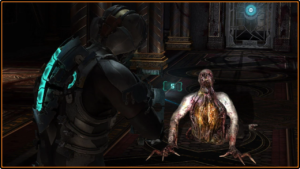
One of the most common discussions around Dead Space 2 is whether its shift toward action was the right move. Compared to the first game, there are definitely more combat-heavy sections, more moments where you’re dealing with multiple enemies in quick succession, more situations that feel designed to test your combat skills rather than your nerves. It’s fair to say that this changes the tone. The slow, creeping dread of the original is less dominant here. But what the game gains is a sense of momentum. It doesn’t linger too long in one place, it keeps pushing forward, and that constant movement creates its own kind of tension. Instead of wondering if something will happen, you’re dealing with the fact that it already has, and now you have to react. Whether this is a compromise or an improvement depends on what you value more. If you prefer pure horror, you might miss the slower pacing of the first game. But if you look at it from a broader perspective, Dead Space 2 feels more balanced. It offers different kinds of tension, different rhythms, and a wider range of experiences, all within the same framework.
Why it still works today
What really defines Dead Space 2 as a neoclassic is not just that it was good at the time, but that it still functions without needing to be reinterpreted or excused. You don’t have to adjust your expectations. The controls feel responsive, the mechanics make sense, and the pacing holds up in a way that many games from that period simply don’t. There’s also a clarity to its design. It doesn’t overload you with systems, it doesn’t try to be everything at once. It focuses on a set of core ideas and executes them well. That kind of restraint is something that often gets lost in larger, more ambitious projects, but here it works in the game’s favor. When you play it now, you don’t feel like you’re revisiting something outdated. You feel like you’re experiencing something that has already figured itself out. That’s a rare quality, and it’s what gives the game its lasting value.