DUNGEONS & DRAGONS ON PC | ROLLING THE DICE DIGITALLY
Dungeons & Dragons has always been more than a ruleset. It’s a social ritual, a spark that builds entire worlds from nothing but imagination. Long before PCs were powerful enough to render vast forests or simulate complex combat encounters, players sat around tables, scribbling notes, arguing over the odds of a ridiculous plan working, and rolling dice with the kind of anticipation no computer could replicate. Yet as gaming technology matured, something interesting happened: digital RPGs began trying sometimes clumsily, sometimes brilliantly to capture that same energy. Not by copying the tabletop experience verbatim, but by leaning into the spirit of improvisation, agency, and consequence that defines D&D at its best. The transition wasn’t just a matter of convenience or modernization. It was a natural evolution driven by players themselves.

People wanted the worlds they imagined to become visible, to have shape and color, to react with speed and complexity that manual rules couldn’t always deliver. While a Dungeon Master can improvise on the spot, they can’t instantly calculate every possible outcome for a dozen moving parts. A computer, however, can simulate hundreds of variables without breaking a sweat. That allowed developers to paint stories with greater scope cinematic conversations, branching arcs, atmospheric sound design and yet the guiding principle remained intact: the player’s choices matter. Whether you were choosing a dialogue response, casting a spell, or simply deciding to explore a hidden corner of a map, the goal was to preserve that sense of freedom that fueled decades of tabletop campaigns. As D&D’s digital form matured, it began attracting players who had never touched a tabletop version. For some, PC games became the first real window into that universe of spells, monsters, and moral quandaries. The thing that made the tabletop so special that organic, evolving narrativefound its own space to breathe in the digital landscape. The language changed from dice rolls and rulebooks to UI elements and scripted triggers, but the intention stayed the same: create a world that feels responsive, reactive, and shaped by the person behind the keyboard.
How Early CRPGs Defined D&D on PC
The late 1990s were pivotal for PC RPGs. When Baldur’s Gate appeared in 1998, it was more than a game it was a statement that PCs were finally capable of telling stories with the same complexity and freedom that tabletop fans were used to. Powered by the Infinity Engine and built on the AD&D 2nd Edition rules, the game embraced classic D&D mechanics without being shackled by them. The engine handled attack rolls, saving throws, and modifiers quietly in the background, leaving players free to focus on strategy and exploration. The storytelling was deeper, more nuanced, and more personal than what most video games offered at the time. Players forged relationships with companions, made decisions that rippled through the narrative, and crossed landscapes that felt alive not just because of graphics, but because of how reactive the world was. Planescape: Torment followed shortly after, rejecting the standard fantasy formula entirely and proving that D&D adaptations could stretch into philosophical, strange, emotional territory without losing the essence of the ruleset. Instead of relying on hack-and-slash combat, Planescape sunk its teeth into dialogue, memory, identity, and existential themes. It showed developers worldwide that D&D wasn’t limited to swords and spells it was a playground for deep storytelling. Meanwhile, Icewind Dale delivered the opposite side of the experience: tactical combat, dungeon crawls, and a structure closer to traditional modules. It offered the balance of familiarity and challenge, giving players a combat-centric experience that still felt authentically D&D without overwhelming them with narrative branching. These early digital interpretations weren’t perfect, but they were formative. They demonstrated that CRPGs could be as reactive and meaningful as tabletop campaigns not by copying every mechanic, but by capturing the emotional core of role-playing. The decisions mattered. The worlds felt hand-crafted. The rules served as a foundation, not a cage. And all of that laid the groundwork for everything that came next.
Where Modding Turned Neverwinter Nights Into a Platform
Neverwinter Nights changed the landscape again in 2002 by introducing a revolutionary concept: that players themselves could become digital Dungeon Masters. The Aurora Toolset wasn’t a side feature—it was the identity of the entire game. While the official campaign was solid, the real power came from the tools that let anyone craft their own world, design quests, script events, and invite others to experience them. For the first time, the PC platform didn’t just simulate a D&D world it allowed players to build one, share it, and refine it collaboratively. Modding communities exploded, producing thousands of modules ranging from experimental story-driven adventures to massive persistent worlds that essentially functioned as early MMOs. This era introduced something vital to the legacy of D&D on PC: the understanding that creativity is central to the identity of the franchise. Tabletop D&D thrives because players can bend, adjust, or completely disregard rules if they want to. Neverwinter Nights brought that same flexibility to the digital space, offering tools that didn’t restrict imagination but encouraged it. Players learned to create dialogue trees, environmental scripts, choices that branched in unexpected ways all skills that mirrored the improvisational heart of tabletop DMing. The boundaries between developer and player blurred, and the result was an incredibly active ecosystem where each person’s contribution added new layers to the shared universe.
Baldur’s Gate 3 and the New Bar for Digital D&D
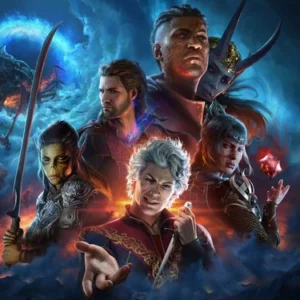
Fast forward two decades, and then suddenly the genre hit another monumental milestone: Baldur’s Gate 3. Larian Studios managed something incredibly difficult—they found the exact intersection between the freedom of tabletop play and the expectations of modern players who demand cinematic presentation, reactivity, and systemic depth. Instead of trying to simplify D&D’s 5th Edition rules, they embraced them, letting digital dice rolls become visible, tactile, and emotionally impactful. Rolling a d20 on screen shouldn’t feel meaningful, but it does, because the game presents failure not as a punishment, but as an opportunity for story variety. BG3 didn’t just adapt 5e mechanics; it recreated the feeling of sitting at a table where anything can happen. Climbing onto rooftops, shoving enemies off ledges, casting spells in unconventional ways all of these were things tabletop players did for decades. The difference now was that a mainstream PC game was finally able to embrace that chaos instead of restricting it. And the results were extraordinary. With a 96/100 Metacritic score, the game achieved critical acclaim rarely seen in modern RPGs, redefining not only D&D games but the entire CRPG genre. It proved that turn-based combat, heavy narrative branching, and old-school RPG depth still had a massive audience. What BG3 really accomplished, though, was emotional authenticity. Companions weren’t just checkboxes they had arcs, flaws, personal boundaries, believable reactions. Storylines curved organically instead of moving in straight lines. The game rewarded experimentation and curiosity, not just min-maxing. And that, more than any mechanic, is what made it feel like a true D&D experience.
The Expanding Digital D&D Ecosystem
Beyond the games themselves, Dungeons & Dragons has built an expansive digital ecosystem that supports both new players and veteran Dungeon Masters. Tools like D&D Beyond streamlined character sheets, automated math, clarified rule interactions, and gave players a single unified hub for managing campaigns. Virtual tabletops Roll20, Fantasy Grounds, Foundry VTT offered full-featured online environments where groups could meet regardless of distance. Dynamic lighting, integrated rule automation, digital dice rollers, fog-of-war systems, and custom maps turned remote campaigns into full visual experiences. What’s fascinating is how these digital tools have begun blending with the PC gaming side of D&D. Some players now switch seamlessly between single-player CRPGs and virtual tabletop sessions. The line between “playing D&D” and “playing a D&D-inspired video game” continues to thin, not because one replaces the other, but because both feed into the same creative loop. Streaming culture added yet another dimension. Shows like Critical Role, Dimension 20, and other actual-play series brought millions of viewers into the hobby. Instead of reading rulebooks, new players watched charismatic casts breathe life into characters and narratives. This cultural shift not only revived tabletop popularity it encouraged developers to push PC adaptations further, knowing that audiences today expect deeper emotional engagement and story-driven experiences.
The Limits of Coding Tabletop Freedom
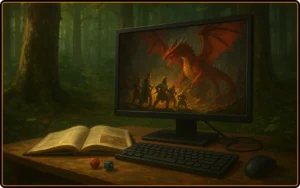
Trying to transform a tabletop session into a digital experience comes with persistent challenges. No matter how advanced scripting becomes, a video game can never replicate the limitless improvisation of a human Dungeon Master. When a player makes a bizarre, unpredictable decision during a tabletop session, a DM can react instantly changing encounters, inventing characters, or reshaping the environment on the fly. A game, no matter how reactive, is limited by what was programmed, recorded, animated, or tested. Developers walk a tightrope. Too much automation, and you lose the tension of chance. Too many rules or menus, and newcomers get overwhelmed. Too much structure, and you lose the spirit of improvisation. Too little structure, and the game collapses under the weight of uncontrolled freedom. Some experiments, like Dark Alliance (2021), leaned heavily toward action and spectacle but sacrificed depth, ultimately failing to satisfy fans who expected meaningful character progression and narrative choice. Others, like Temple of Elemental Evil, went so deep into rules accuracy that they felt more like interactive spreadsheets than adventures. The future may lie in hybrid approaches: AI-driven story prompts, reactive systems that adjust to player behavior, or procedural generation enhanced with human-written frameworks. But even if technology evolves dramatically, the core design challenge remains the same build systems flexible enough to mimic creativity without overwhelming the player.
Where Digital RPGs and Player Creations Merge
Looking ahead, the future of D&D on PC doesn’t feel linear. Instead, it resembles a convergence point where everything CRPGs, modding tools, virtual tabletops, AI-assisted storytelling begins to blend into a unified ecosystem. Imagine a world where a player finishes a story arc in a single-player RPG, then jumps into a virtual tabletop session with friends using the same characters. Or where AI-powered assistants help Dungeon Masters generate encounters, maps, and NPC personalities on the fly, reducing prep time and maximizing creativity. We’re already inching toward this future. Foundry VTT is integrating increasingly complex automation. Homebrew tools powered by advanced language models are giving DMs ways to generate lore or stat blocks instantly. Modding frameworks are making it easier than ever to build custom worlds. And as streaming continues to grow, there’s a rising expectation for deeper narrative flexibility something both tabletop and PC games are gradually trying to satisfy. What hasn’t changedand likely never will is the core appeal. Players want stories where their choices mean something. They want to explore unknown worlds, push boundaries, and see what happens when plans fall apart. Dungeons & Dragons still thrives because it offers agency in a way few other games do. The PC adaptations strengthen that appeal by layering visual detail, technical complexity, and long-term persistence on top of it. Together, they expand the hobby rather than redefining or replacing it.
Notable D&D-Themed PC Titles
Baldur’s Gate (1998) A foundational CRPG built on AD&D 2e rules, launching the Infinity Engine classics.
Baldur’s Gate II Shadows of Amn (2000) Expanded narrative, richer characters, widely ranked among the best CRPGs ever.
Baldur’s Gate III (2023) Modern revival using 5e rules, cinematic storytelling, and turn-based combat critically acclaimed.
Icewind Dale (2000) & Icewind Dale II (2002) Dungeon-focused CRPGs using Infinity Engine; challenging combat and replayability.
Temple of Elemental Evil (2003) Faithful adaptation of D&D 3.5 rules with grid-based, turn-based combat in the Forgotten Realms.
Neverwinter Nights (2002) & NWN 2 (2006) Built on D&D 3e/3.5 rules; introduced the Aurora Toolset and a thriving modding community.
Dungeons & Dragons: Dragonshard (2005) Hybrid RTS/RPG set in Eberron; praised for innovation, though limited in depth.
Dungeon Hack (1993) Roguelike, grid-based dungeon crawler in the Forgotten Realms; high replayability.
Dungeons & Dragons: Daggerdale (2011) Action-RPG featuring simplified 4e mechanics fast-paced but lighter in depth.
Dungeons & Dragons: Dark Alliance (2021) Hack-and-slash action in the Icewind Dale setting mixed reviews, servers closed in 2025.
Planescape Torment (1999) Deep, philosophical storytelling set in the Planescape universe, widely acclaimed for its narrative.
Neverwinter Online (2013) MMORPG in the Forgotten Realms with cooperative dungeons and ongoing updates.
Dungeons & Dragons Tactics (2007) Turn-based strategy RPG set in the D&D universe with tactical combat and party management.
Sword Coast Legends (2015) Party-based RPG in the Forgotten Realms with real-time combat, cooperative play, and Dungeon Master mode.
Pool of Radiance (1988) Classic turn-based RPG set in the Forgotten Realms, pioneering the D&D computer adaptation with tactical combat.
Dungeons & Dragons Online (2006) MMORPG set in the Eberron universe with real-time combat, cooperative quests, and persistent online worlds.