
CLASSIC GAMES | FAR CRY | WHEN A CLASSIC FPS CHANGED EVERYTHING
I still remember it like it was yesterday: hearing about a shooter that wasn’t another dark corridor with zombies, but a sunlit island with palm trees, beaches, boats, cliffs, and dense jungle where you could barely see five meters ahead. That was Far Cry. Playing it for the first time felt like jumping out of a stuffy room straight into bright wilderness. It wasn’t just a new FPS. It was a shock to the system. Released on March 23, 2004, developed by Crytek and published by Ubisoft, Far Cry was a turning point for shooters. It broke the idea that FPS games must be tight hallways and scripted encounters. Suddenly, you had space. You had choices. And you actually felt small in a world that wasn’t built around you. Nearly two decades later, when I boot it up again yes, the foliage still dances in the wind, and yes, the water still sparkles I immediately remember why the game left such a heavy mark on me.
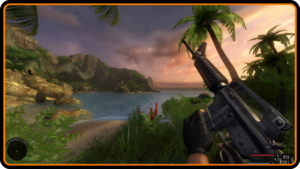
The Jungle, the Freedom
When you start Far Cry, you don’t get the usual tunnel with one way forward. You get an island. A whole island. Blue water, bright sand, jagged rocks, and thick green jungle that hides everything except your own breathing. The game’s CryEngine pushed visuals in a way most of us didn’t even think was possible at the time. The sun pierced through palm leaves, cliffs revealed hidden sniper spots, and the ocean made you forget just for a second that you were about to get shot at. And then, somewhere deep in the trees, gunfire. Suddenly every sound feels like a warning. That mix of beauty and danger defined Far Cry. The game didn’t just show a world; it wanted you to feel it. The silence before a firefight. The tension when you crouch in the bushes listening for footsteps. The panic when a patrol boat suddenly swings its spotlight your way. For 2004, that level of immersion was wild. But not all of it aged gracefully. The freedom to approach encounters from different angles water, cliffs, jungle trails sometimes broke the game’s balance. Enemy AI could be unfairly sharp, or strangely blind. Exploring an open area sometimes meant wandering in circles until you found the “right” bush to crouch in. Back then, I didn’t notice. Today yeah, the cracks show. But the core idea still holds up.
The Story and the Descent Into Chaos
You play as Jack Carver, an ex-special forces guy trying to leave his past behind and enjoy a simple life. Of course, life doesn’t cooperate. A boat explodes, a journalist goes missing, and Jack ends up stranded on a tropical island full of mercenaries with assault rifles and extremely bad manners. The story starts grounded tropical mercenary trouble but slowly shifts into something more bizarre. Hidden labs. Genetic experiments. Strange mutated creatures crawling in the dark. And suddenly the island that looked like a vacation brochure becomes a nightmare. The writing isn’t Shakespeare, and the characters aren’t crafted to rival modern cinematic RPG heroes. The plot is straightforward, sometimes a bit too on-the-nose, and yes, some motivations make sense only when you don’t think too long about them. But the atmosphere? The pacing of escalation? The moment you realize this paradise is anything but peaceful? That still works. The island becomes hostile in a way you genuinely feel. The tone shifts from survival to horror-light, but it never completely abandons its adventure spirit. It’s messy, but in a charming early-2000s way.
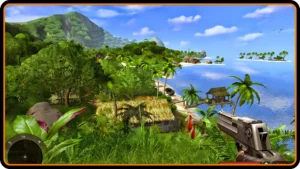
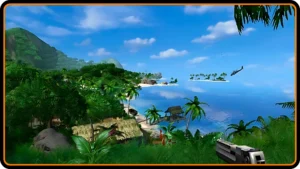
Gameplay: Freedom, Mistakes, and Pure Adrenaline
Far Cry lets you decide how to handle almost every encounter. Want to approach from the water? Take a boat. Want to go quiet? Sneak through bushes. Want to cause chaos? Hop into a jeep or grab a mounted gun and see how long you last. For 2004, this was groundbreaking. Most shooters of the era guided you through tight, linear levels. Far Cry, on the other hand, gave you open spaces jungle valleys, beaches, cliffsides and let you improvise. But with freedom came frustration. Enemy soldiers had inhuman eyesight. Health disappeared faster than a chocolate bar at a gaming marathon. Save checkpoints weren’t always where you needed them. And sometimes enemies acted so strangely that you didn’t know whether to laugh or cry. Yet every victory felt earned. Every time you cleared an outpost without getting shredded, you felt like a genius. Every ambush that worked made you feel like a strategist. And every failure made you rethink your approach instead of blaming the game. What made Far Cry special wasn’t just what you did, but what the game made you feel. There was always that tension in the air the kind that makes your palms sweaty long before anything actually happens. It wasn’t scripted suspense; it was the sort of dread that grows naturally when you’re crawling through brush, hearing footsteps, and praying nobody spots your bright Hawaiian shirt of a protagonist. I remember another moment that stuck with me: climbing a hillside at sunrise, half-asleep, thinking the area was clear. The jungle looked peaceful for maybe five seconds… and then bullets started cutting the leaves around me like some angry gardener with a machine gun. I panicked, sprinted downhill, tripped into a river, and somehow survived by pure luck. And honestly, that messy, chaotic escape felt better than any perfectly choreographed set piece. Far Cry thrived on these unscripted stories little disasters and little victories stitched together by your own recklessness. And the game let you lean into that. It encouraged experimenting, failing, and trying again, not because it held your hand, but because it shoved you into situations where instinct mattered more than perfect aim. That’s what Far Cry did better than most games even today it made you doubt yourself in all the right ways.
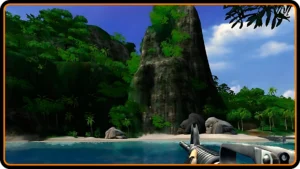
Why Far Cry Still Matters Today
Playing Far Cry today is a strange mix of nostalgia and respect. Yes, the graphics aged. Yes, the animations look stiff. And yes, sometimes the AI behaves like it skipped brain day at school. But the soul of the game the thrill of exploring unknown terrain and feeling completely vulnerable hasn’t aged at all. What makes Far Cry memorable isn’t perfection. It’s ambition. It dared to be different. It dared to break away from corridor shooters and offer huge environments long before “open-world FPS” became a marketing bullet point. Booting it up now still gives you a sense of discovery. And as soon as you step onto the beach, rifle in hand, listening to the distant rumble of a patrol boat, you remember why it mattered. But there’s something else hidden in its legacy: that raw, almost experimental energy games don’t often have anymore. Far Cry feels like a team swinging for the fences not worried about being safe, not concerned about ticking feature boxes, just trying to build something wild and fresh. It has that scrappy charm where you can tell the developers were excited about what they were making, even when the tech got in the way. And honestly, that’s why revisiting it hits different. You don’t just replay a shooter; you revisit a moment in gaming history when boundaries were being stretched, sometimes to the breaking point. There’s a certain magic in walking through those jungles again, the kind that modern polish can’t replace. The world feels dangerous, unpredictable, and strangely honest. If you never played the original, give it a chance. Don’t expect a modern masterpiece. Expect a bold one. If you did play it maybe it’s time to wander back to those cliffs, the mercenary camps, the secret labs. See if that old spark is still there. Spoiler: it probably is.
Conclusion
Far Cry is one of those rare titles that manages to leave a mark far deeper than anyone expected at the time. You look back at it now and realise how many modern shooters borrowed, copied, or flat-out reinvented what Far Cry first attempted. Its wide-open arenas, the sense of being hunted rather than just running forward, the freedom to improvise all of that set a standard long before the genre knew it needed one. Even the rough patches, from the occasionally unfair AI to the sudden difficulty spikes, ended up giving the game more personality than frustration. It felt like a world that didn’t bend for you, and that’s something we honestly don’t see often anymore. What makes Far Cry continue to stand out isn’t just nostalgia. It’s the way the game blends chaos and calm those slow, quiet minutes of moving through dense jungle, only to have everything erupt the moment a patrol spots you. It’s the contrast between breathtaking landscapes and pure panic that gives the game a pulse you can still feel today. Plenty of shooters have arrived with better graphics, smoother controls, or more cinematic storytelling, but very few have captured that mix of freedom and vulnerability so well. Even with its ageing corners and occasional quirks, Far Cry remains an example of what happens when developers push past the safe formula and try something bold. The ambitious level design, the freedom of approach, the mix of adventure and tension all of it contributed to something that felt fresh then and still feels respectable now. If I had to score it today, I’d give it an 85/100. Not because it’s perfect, but because it tried really tried to be bigger and braver than everything around it.
And honestly, that’s why we still talk about it.