CLASSIC GAMES | BALDUR’S GATE | EXPLORING THE CRPG THAT DEFINED A GENERATION
Walking into the world of Baldur’s Gate is like stumbling into a dusty tavern at the edge of a dying road the fire’s low, embers glow faintly, and you realize that this place carries stories, scars, regrets…and maybe hope. For many people, including those who never touched pen‑and‑paper RPGs before, this game felt like a promise that video games could carry weight. Not just flickering lights and flashy animations, but something deeper a world haunted by choices, loyalty, betrayal, guilt. And a weird kind of belonging. Baldur’s Gate hit the scene in late 1998, developed by a tiny team at BioWare by then still a scrappy group working “out of a basement.” With a modest budget and a ton of ambition, they built the game using what became known as the Infinity Engine. The engine wasn’t flashy by modern standards, but it allowed for something rare: a sprawling RPG world, built not tile‑by‑tile, but with individually rendered backgrounds, giving each location a distinct feel. And what this meant to players at the time? Magic. Real magic.
A world beyond “kill‑monsters, get‑loot”
The premise seemed familiar enough: you begin as an orphan “the Ward” sheltered in a fortress‑like monastic library known as Candlekeep, under the care of a mentor named Gorion. The life is quiet, studious safe, in a way. Until one night everything shatters. Forced to flee under mysterious circumstances, tractor‑beam style distrust pulls you out of safety, and all of a sudden the world outside Candlekeep feels cold, unpredictable, dangerous. That abrupt shift from sheltered comfort to harsh reality is what sets the tone for everything that comes next. As you cross the threshold, Baldur’s Gate doesn’t hand you a neat roadmap. There’s no glowing arrow pointing where to go. Instead, you get a rough landscape, half‑dark, with creaking wooden doors, foggy forest paths, bandits lurking in shadows, and whispers of darker things behind the Iron shortage crippling the whole region. Every decision, from words in a tavern to whom you trust in a lonely inn, ripples. Sometimes in tiny, barely noticeable waysother times with consequences that echo. The game divides itself into seven chapters (plus interludes of dialogue), giving that sense of a long, meandering journey one that doesn’t hold your hand. There is freedom. Exploration. Danger. And constant uncertainty.
Party, companions: the messy heart of the journey
One of the bold moves Baldur’s Gate makes and one that still earns it admiration is how it treats companions. This isn’t “you and faceless lackeys.” The cast you pick up along the way thieves, mages, bards, warrior they aren’t silent extras. They have voices, attitudes, grudges, loyalties. Their judgments sometimes clash with each other, sometimes with you. Their secrets sometimes make you second‑guess your own. You might assemble a party of up to six (including you), slowly chipping away at the world’s mysteries together. And over time, this ragtag crew doesn’t just become “my party.” They become companions. People whose successes feel like yours, failures burn you. The beauty lies in the imperfections. Sometimes a party member disagrees with a choice and storms off. Sometimes they forgive, sometimes they betray. Sometimes you laugh around a campfire, trading quips and tales. Sometimes you loot a corpse in silence, uneasy. And sometimes you stand in a ruined village at dawn, wondering whether what you did was right. That complexity moral ambiguity, emotional weight was rare in 1998. Even by today’s standards, it still hits.
Combat and mechanics: rough edges, but honest ones
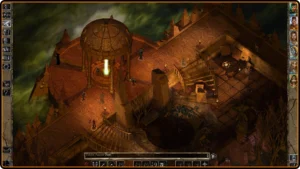
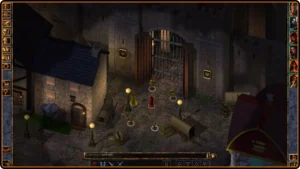
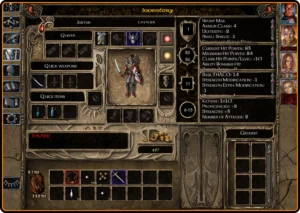
Mechanically, Baldur’s Gate adapts the rules of the tabletop RPG Advanced Dungeons & Dragons 2nd Edition (AD&D), but shifts them into real‑time (with pause). What that gives is a hybrid rhythm: the tension of real‑time action, combined with the tactical breathing room of pause‑and‑decide. It means every fight can morph from chaotic to calculated if you remember to pause, to plan, to watch your party’s stamina, positioning, spells. But also yes the clunkiness of older design. Inventory management is finicky. Spell targeting can feel messy. Crowded battles sometimes devolve into confusion. For a game that expects patience and attention, it rewards if you give in but it can punish if you rush. And there are moments when the game shows its age. Long journeys on world maps can feel empty. Town‑to‑town travel sometimes feels like filler. Back then, those old‑school transit bits were part of the RPG flavour but now, after decades of streamlined fast‑travel and quest‑markers, they often test your patience. Still when it works when your mage casts Fireball just right, your fighter holds the line, your thief backstabs from the shadows there’s a satisfaction there. A sense that you earned that victory. No flashy QTEs. No quick‑time magic. Just old‑fashioned strategy, luck, and probably a badly timed pause.
Story, intrigue, and awakening, not heroic glory, but shadows lurking
The storyline of Baldur’s Gate doesn’t try to be a grand “save‑the‑world” epic. At least not in a cartoonish way. Instead, it weaves conspiracies. Iron shortages. Political machinations. Hidden bloodlines. Betrayal. The world feels grey. Wet with rain, muddy roads, cold seas. You start off not knowing who you truly are. Raised behind safe walls in Candlekeep, sheltered. Then you’re thrust out. As the journey unfolds, small hints gather: rumours, shadowy figures, prophecies. You learn that your origins once cloaked bear a stain hard to wash off. The game doesn’t spoon‑feed the truth. Instead, it reveals in fragments dreams, overheard whispers, betrayals, deaths. That slow trickle the gradual unfolding builds tension. Not the sort that makes you grip the controller. The sort that leans into memory. Regret. Consequence. Sometimes, the hardest fight isn’t against an ogre or a bandit, but the quiet of a companion deciding they no longer trust you. Or twenty guards marching down a city gate because of something you said. It doesn’t always deliver closure. It doesn’t always end with a triumphant choir and a sunlit castle. Sometimes, it ends with scars. Maybe a hollow victory. Maybe a question: did we do the right thing? And yet there’s a sense of purpose. Even if the world remains messy, morally ambiguous, half‑rusted and broken, survival means something. Loyalty means something. Sacrifice means something.
Flaws, aging, and why Baldur’s Gate feels like a relic yet a living one
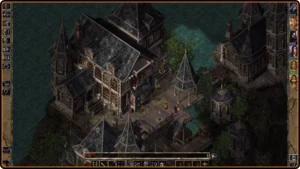
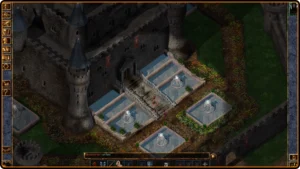
Make no mistake: Baldur’s Gate shows its age. The UI is archaic. Inventory feels clumsy. The load‑times, the UI navigation, the lack of hand‑holding it demands patience. There’s no minimap plastered in the corner, no quest journal that always points the way. Instead, you get notes, memory, whatever you scribbled down mentally. Graphics? Well the hand‑painted isometric backgrounds, the static sprites, the old‑school animation for some, it’s charming. For others, it’s like seeing a childhood home before it was remodeled for modern tastes: familiar, but faded. And the world isn’t always kind. The long stretches between major events walking across the Sword Coast, silent roads, empty towns can feel empty. Some side‑quests carry weight; others are filler. Some fights feel unfair, especially if your party isn’t optimized or if random encounters pile up. The balancing well, it’s not seamless. But that clunkiness, that roughness it has character. It reminds you: this was built by a team of humans pushing themselves beyond what seemed possible. Rough hands, late nights, cramped basements. You feel the edges. The imperfections. And maybe that makes the world feel more alive than some glossy modern RPG.
Legacy: Why Baldur’s Gate didn’t just survive, but shaped what came after
When Baldur’s Gate launched, it wasn’t just another game. It was a statement. A whisper first, then a roar that computer RPGs could capture more than loot, levels, boss fights. They could carry human stories. Political intrigue. Moral grey zones. Friendships and betrayals. Losses that hurt like in fiction, but felt real. It paved the way for a wave of RPGs that would follow games that dared to ask: what if the companions matter more than the hero? What if your choices resound? What if a video game could move you, unsettle you, leave you wondering long after you press “Exit”? The influence radiates out: in later titles by BioWare and by other studios. Titles that learned: players don’t always want shiny graphics sometimes they want world‑weary realism. Or the illusion of it. Titles that suggest: maybe a character’s knife‑edge loyalty means more than how many swords they carry. Even decades later, the game draws people in new players, curious about why so many still speak of it in hushed, reverent tones. Nostalgia plays a part. But there’s more: the strength of its writing, the depth of its world, the weight of its choices those age slowly, like leather boots that keep getting more comfortable the more you wear them. The rejuvenation came in the form of Baldur’s Gate: Enhanced Edition a modern‑friendly version released in 2012 by Beamdog. It brought widescreen support, UI tweaks, compatibility with modern platforms but kept the heart of the original intact. A testament: old stories don’t always need polishing. Sometimes they need room to breathe.
So, what does Baldur’s Gate feel like now?
Booting it up today is like flipping through a weathered journal. The writing’s a little faded; some pages creased; maybe a few paragraphs hard to read. But the story? Still gripping. The world? Still dangerous, alive, ugly-beautiful. For a modern gamer used to auto‑pointers, quest‑popups, cinematic camera angles, Baldur’s Gate might feel slow. Sparse. Unforgiving. But there’s a trade-off: space. Space to think. To wonder. To feel. To regret. To choose and to ask, “Was that the right choice?” It isn’t perfect. It doesn’t pretend to be. It doesn’t shine. It doesn’t hold your hand. But maybe just maybe that’s why it endures. Because it trusts you. Trusts you with a world that isn’t black‑and‑white, with companions who bleed and question, with endings that don’t promise glory.