REVIEW | S.T.A.L.K.E.R. II: HEART OF CHORNOBYL | SURVIVES THE TEST
Returning to the Zone in S.T.A.L.K.E.R. II: Heart of Chornobyl doesn’t feel like launching a sequel. It feels closer to reopening an old wound you were never sure had fully healed. The landscape is familiar, yet distorted by time. Buildings stand where you remember them, but they feel heavier, more tired, as if the years have pressed down on their concrete bones. This is not nostalgia in the comfortable sense. It’s the kind that unsettles you, because it reminds you that you are older now too, and that the things which once left an impression still carry weight. The road to this release was long, fragmented, and burdened by circumstances that go far beyond normal development hell. Delays, engine changes, technical uncertainty, and the very real struggles faced by GSC Game World made it difficult to know what to expect. I approached Heart of Chornobyl cautiously, almost defensively. I didn’t want to project hope onto something that might not be able to carry it. But the moment the fog rolled in, the Geiger counter started ticking, and the Zone quietly reasserted its presence, that caution gave way to something more familiar. Not comfort, but recognition. This wasn’t a polished reinvention, and it didn’t try to be. Instead, it felt like a continuation shaped by hardship, carrying scars rather than hiding them. And that, strangely enough, feels right for S.T.A.L.K.E.R.
The Story and the Weight of the Zone
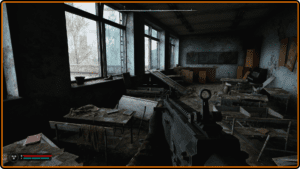
The story of Heart of Chornobyl begins without ceremony. Skif is not a chosen hero, nor is he framed as someone special. He is simply a man whose already fragile existence collapses when a mysterious artifact appears in his life, pulling him back toward the Zone. There is no dramatic buildup, no cinematic insistence that this journey matters. The Zone does not care about your importance, and the narrative mirrors that indifference. You are not invited into a grand tale; you are dragged into a situation you can no longer ignore. What stands out is how restrained the storytelling is. The game rarely explains itself directly. Instead, it trusts the player to read between the lines, to listen carefully, and to pay attention to what is not being said. Conversations feel grounded in exhaustion rather than exposition. Stalkers speak like people who have long accepted that survival comes before meaning. Their dialogue is filled with half-finished thoughts, dry humor, and quiet resignation. You get the sense that many of them stopped asking big questions a long time ago. Environmental storytelling does much of the heavy lifting. Abandoned camps, scattered belongings, and half-collapsed structures tell stories of lives interrupted without spelling them out. The Zone feels like a place where history is layered on top of itself, never fully erased. Even anomalies feel like narrative elements, scars left behind by a reality that never recovered from what happened here. The story doesn’t push you forward; it pulls you inward, asking you to endure rather than to resolve.
Atmosphere, Tension, and Constant Unease
Atmosphere has always been the heart of S.T.A.L.K.E.R., and Heart of Chornobyl may be the most effective entry yet in capturing that suffocating sense of unease. The Zone feels observant, almost sentient in its indifference. Fog doesn’t just limit visibility; it warps perception. Distances feel unreliable, landmarks deceptive. Industrial ruins loom out of the mist like memories you’d rather not revisit. Sound design plays a crucial role in sustaining this tension. Radiation crackles softly in the background, metal creaks in the distance, and anomalies emit subtle hums that you learn to fear long before you see them. Silence itself becomes threatening. There are moments where nothing happens, and those moments are often the worst. You move slower, not because the game demands it, but because experience has taught you that the Zone punishes impatience. What makes this atmosphere so effective is its lack of theatricality. There are no cheap scares, no scripted moments designed to make you jump. Fear emerges organically, born from uncertainty and consequence. You never feel fully in control, and that lack of control is precisely what gives the game its identity. The Zone doesn’t need to chase you. It simply waits.
Survival Gameplay Built on Consequence
Survival is not a feature layered on top of Heart of Chornobyl; it is the foundation everything else rests upon. Ammunition is scarce, supplies are limited, and every item you carry has weight both literally and metaphorically. Hunger, radiation, bleeding, and fatigue quietly shape your decisions, forcing you to think several steps ahead. Ignoring these systems doesn’t result in an immediate game over, but in a slow, grinding deterioration that feels far worse. Combat encounters are rarely empowering. Gunfights are tense, often chaotic, and frequently end with you limping away rather than standing victorious. Weapons degrade, armor wears down, and preparation matters more than raw skill. Charging headfirst into danger is almost always a mistake. Knowing when to disengage is as important as knowing how to fight. Faction relationships add another layer of consequence. Aligning with one group can close off opportunities elsewhere, sometimes hours later. These decisions aren’t always clearly labeled as moral choices, and that ambiguity strengthens the experience. You are not asked to be good or evil. You are asked to survive within a system that doesn’t reward purity.
Exploration, Artifacts, and Environmental Storytelling
Exploration in Heart of Chornobyl feels deliberate rather than indulgent. The world invites curiosity, but it also demands respect. An anomaly field is never just an obstacle; it’s a test of patience and awareness. Artifacts, the Zone’s most coveted treasures, are never handed to you casually. Finding them requires careful observation, risk-taking, and a willingness to accept failure. Each artifact changes the way you approach survival, encouraging experimentation without ever feeling like a power fantasy. The act of retrieving one is often more memorable than the reward itself. Failure is common, and each failure reinforces the Zone’s rules. The environments themselves are rich with unspoken history. Burned-out vehicles, collapsed apartments, and forgotten camps all hint at lives that didn’t make it. These spaces feel authentic because they aren’t designed to impress. They exist to remind you that this world has already consumed countless others.
Combat That Punishes Mistakes
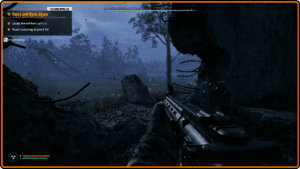
Combat in Heart of Chornobyl is grounded, tense, and often unforgiving. Firearms have weight, recoil matters, and maintenance is non-negotiable. A poorly maintained weapon can jam at the worst possible moment, turning an already stressful encounter into pure panic. AI behavior can be inconsistent, occasionally breaking immersion, but more often than not it forces you to adapt rather than rely on patterns. Stealth exists, but it is unreliable enough to keep you cautious. Sometimes it works beautifully, allowing you to avoid unnecessary conflict. Other times, a single misstep spirals into chaos. Melee combat remains limited and underdeveloped, reinforcing the game’s emphasis on firearms and positioning. What makes combat effective is not spectacle, but feeling. Relief after surviving an encounter is genuine. Victory rarely feels clean, and that’s exactly the point.
Visuals and Audio Anchored in Reality
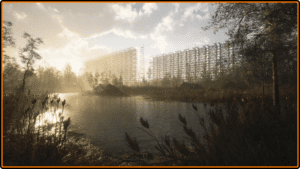
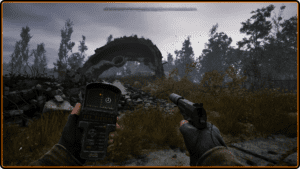
Built on Unreal Engine 5, Heart of Chornobyl presents a version of the Zone that feels visually impressive without ever slipping into spectacle for its own sake. This is not a world designed to constantly show off technology, but one that uses it quietly, almost modestly, to reinforce mood and believability. Lighting plays a crucial role in shaping how spaces are perceived. Early morning light cuts through abandoned structures with a cold, washed-out tone, while overcast skies flatten the landscape into something bleak and oppressive. Weather conditions don’t just change how the world looks; they alter how safe or exposed you feel while moving through it, turning familiar routes into uneasy territory under the wrong conditions. Fog deserves special mention, not as a visual trick but as a defining layer of the Zone itself. It obscures distance, softens outlines, and constantly interferes with your ability to read the environment clearly. Combined with detailed textures and environmental wear, it creates spaces that feel genuinely abandoned rather than artificially ruined. Buildings aren’t just broken; they look tired, eroded by time, weather, and neglect. Rust, dirt, and decay are used with restraint, making locations feel lived-in and forgotten rather than theatrically destroyed. Audio design is just as important, if not more so, in grounding the experience. Sound frequently becomes your primary source of information. The faint crackle of radiation, the distant echo of movement, or the subtle hum of an anomaly often warn you of danger before you can see it. This encourages a slower, more attentive playstyle, where listening is as important as scanning the horizon. Music is used sparingly and with purpose, never overwhelming the ambient soundscape. Long stretches pass with no soundtrack at all, allowing wind, footsteps, and environmental noise to dominate. When music does appear, it reinforces tension rather than relieving it. Together, visuals and audio work in quiet harmony, never competing for attention. They support the same goal: immersion through restraint. The result is a Zone that feels tangible and oppressive, a place that exists whether you’re there or not, and one that never lets you forget how small and vulnerable you are within it.
Performance and Technical Reality
From a technical standpoint, Heart of Chornobyl remains one of the game’s most uneven aspects, and it’s impossible to ignore that reality. On high-end systems, the experience can be genuinely impressive, with stable frame rates, strong visual clarity, and smooth transitions between environments that allow the Zone’s atmosphere to fully breathe. In these conditions, the game’s ambition feels justified, and the underlying technology fades into the background, letting immersion take over. On mid-range hardware, however, the experience is far less consistent. Stuttering can appear without warning, particularly when moving between dense areas or during sudden weather shifts. Texture pop-in occasionally breaks visual continuity, reminding you that the engine is still struggling to balance scale and detail. Crashes are not constant, but they do occur often enough to be frustrating, especially when they interrupt longer sessions or tense moments where progress feels hard-earned. While post-launch patches have clearly improved stability compared to earlier builds, performance remains sensitive to hardware configurations and system optimization. These technical issues don’t render the game unplayable, but they do chip away at immersion when they surface at the wrong time. Moments of quiet tension can be disrupted by frame drops, and intense encounters sometimes feel rougher than they should. That said, Heart of Chornobyl manages to maintain its identity despite these shortcomings. The atmosphere, world design, and survival mechanics are strong enough to carry the experience even when technical flaws become noticeable.What’s important is that the foundation is solid. The problems feel like issues of refinement rather than fundamental design failures. With continued updates and optimization, many of these rough edges can realistically be smoothed out. As it stands, the game delivers a compelling and emotionally engaging experience, even if it occasionally stumbles on the technical side.