
REVIEW | THE CALLISTO PROTOCOL | FROM SILENT CORRIDORS TO SCREAMING MUTATIONS
There’s something magnetic about stepping into a horror game that already carries a weight of public opinion before you even touch the menu. The Callisto Protocol felt like one of those cursed artifacts the internet had already stamped with failing grades, half-baked jokes, and endless comparisons long before release, as if the entire world collectively agreed that this thing should be thrown into the cold void of its own setting. Maybe that’s why I approached it the way I did. A little cautious. A little stubborn. A little ready to prove people wrong or prove myself wrong. Or maybe it’s simply that third person horror always had a soft corner in my gaming brain, a familiar place filled with dark corridors, heavy breathing, metal floors echoing under reluctant footsteps, and mutated silhouettes waiting in that small patch of darkness your eyes keep drifting toward even when they shouldn’t. Whatever the spark was, Callisto dragged me into its orbit instantly.

It doesn’t waste time pretending to be gentle. It doesn’t flirt with subtlety. It pushes you straight into a cold metallic nightmare before you’re fully aware what’s happening. The opening hits you with that heavy cinematic punch, the kind that tells you the game wants to be a movie as much as it wants to be a game. There’s no warming up, no easing into the universe, no friendly guided tour. You’re dropped into Black Iron Prison like a rock into deep water, and whether you swim or drown is entirely on you. And I appreciate that kind of confidence, even when it shows its cracks later. I’ve always believed horror works best when it doesn’t hold your hand. When it lets you feel lost. Isolated. A little stupid. A little too human. Callisto definitely does that. Sometimes intentionally. Sometimes by accident. But the feeling is there, crawling under the skin, and that’s worth something.
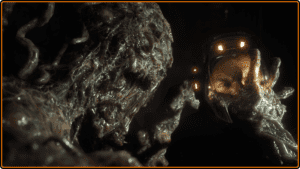
The prison moon and its cold personality
Black Iron is not just a backdrop. It’s a character with its own moods, its own rules, its own temper. It’s the kind of place that makes you feel like the walls are listening. The metal corridors hum with a low industrial growl that never stops, the lights flicker like they’re exhausted from simply existing, and even the shadows feel heavier than in most games. It’s not the polished, futuristic vision of space horror. It’s the dirty, rusted, mechanical side, the kind where every bolt looks a little corroded and every pipe feels like it might burst at any moment. The sound design is a monster of its own. Every noise carries weight. Every echo feels deliberate. When something moves in the distance, it doesn’t sound like a generic scare cue it sounds like an actual object shifting under stress or something crawling inside a vent. I found myself stopping more times than I care to admit just to listen. That’s the kind of immersion I crave from this genre. Not constant loud jumpscares, but the quiet pressure that builds until even silence feels suspicious. But what I didn’t expect was how the game balances its environment with emotional presence. Jacob isn’t a superhero. He’s tired, confused, angry, and sometimes almost fragile. The setting amplifies that feeling, pressing you with a loneliness that gets stronger the deeper you go. It’s not peaceful isolation. It’s suffocating isolation, the kind that whispers that no one is coming to help you. The prison traps him physically, but it traps the player psychologically too. There were sections where I simply had to stop and breathe. Not because the game overwhelmed me mechanically, but because its atmosphere is dense enough to sit on your shoulders like extra weight. The lighting is brilliant at enhancing this, using just enough illumination to lure you forward while keeping most corners unfriendly. Horror thrives on discomfort, and Callisto understands that. But the game also knows when to shift gears. Suddenly you’re in a larger industrial hall, machinery screaming around you, alarms blaring through darkness, and it all feels like the prison is waking up in anger. These loud moments contrast beautifully with the stillness before and after them. The pacing isn’t flawless, but the emotional rhythm of fear definitely works.
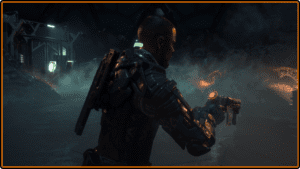
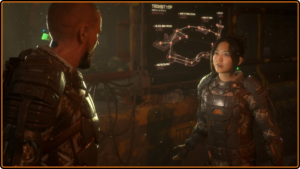
The Horror that gets under your skin
Callisto’s horror isn’t purely visual and isn’t purely mechanical. It’s psychological, atmospheric, and occasionally personal. The enemies aren’t just mutated lumps designed for shock value. They feel like twisted byproducts of the prison itself, as if Black Iron infected the people inside it long before any biological transformation began. They’re uncomfortable to look at. Not because they’re grotesque for the sake of grotesque, but because there’s something disturbingly human buried deep under all that deformity. A reminder that these creatures were once prisoners, workers, people who probably had no idea what nightmare was being cultivated in the dark corners of this moon. The game rarely relies on cheap scares. It prefers anticipation. It makes you walk slower. It makes you question whether you should open the next door. It makes you turn the camera a little too often because you swear you heard something behind you. Darkness becomes a presence, not an absence of light. You start imagining shapes, movements, silhouettes that don’t exist. That’s how you know the horror is working when your brain becomes its accomplice. The loneliness contributes heavily to this emotional profile. Jacob doesn’t quip his way through danger, doesn’t try to break tension with jokes. He trudges forward like a man who understands he might not make it out alive but has no better option. That vulnerability enhances the experience, making every encounter feel like a legitimate threat rather than a scripted enemy spawn. Sometimes the game gives you eerie calm, those moments where everything suddenly quiets down. Not safety just silence thick with unsaid warnings. I loved those stretches. They pulled me deeper into the mindset the game wanted from me. Not adrenaline, but dread. The good kind. The cinematic kind. The kind that feels like someone dimmed the lights in your room without telling you. Even the creature encounters play into this. Some fights feel like chaotic wrestling matches in narrow corridors, while others feel like ritualistic tests of skill. It’s a strange duality, and it occasionally frustrated me, yet it left an impression that stuck long after playing. Horror doesn’t have to be clean. Sometimes it’s better when it’s messy.

Brutal combat and its strange allure
Ah yes, the combat. The most divisive part of the entire experience. Some players hated it instantly. Some forced themselves to tolerate it. Some, like me, found a weird charm in it once the rhythm finally clicked. Let’s be honest: the melee system is unusual. The dodge mechanics feel like they belong to a different game, the camera sits uncomfortably close to Jacob’s shoulder, and some enemy attacks track you with supernatural precision. In the beginning, I questioned every design choice. Why is everything so close? Why does every fight feel like a fistfight in a broom closet? Why does the game practically force melee instead of allowing more strategic spacing? And then, slowly, something changed. The timing began making sense. The heaviness of Jacob’s swings became deliberate, not sluggish. The dodges felt like raw survival rather than awkward quick-time events. The combat transformed from clumsy to visceral, from irritating to strangely addictive. There’s a brutal intimacy to hitting enemies with the stun baton, a physicality you don’t get in many games. It’s flawed, absolutely. Sometimes deeply flawed. But it has personality, and I respect systems that dare to be different even when they stumble. When ranged weapons come in later, the combat gains depth without losing its weight. Shooting off limbs mid-swing feels like a chaotic but satisfying tactical choice. It’s messy, but memorable. And in horror, memorable is worth more than perfect. There’s also something fascinating about how the combat shapes your understanding of Jacob as a character. The brutality isn’t just a gameplay stylistic choice it’s a reflection of his situation, his desperation, his unwillingness to go down quietly in a place designed to strip people of every last shred of self-preservation. Every swing of the baton feels like a tiny rebellion against the moon itself, as if he’s refusing to let Black Iron digest him the same way it consumed everyone else. The animations are heavy because Jacob is heavy, burdened, untrained, terrified. He’s not meant to look graceful. He’s meant to look like someone who’s fighting with whatever scraps of strength he still has. And weirdly, that makes the entire experience more believable. This clumsy physicality also feeds into the game’s sense of vulnerability. Most modern action-oriented horror games let you slip into a power fantasy sooner or later, letting you dominate enemies with upgraded gear and stylish combos. Callisto refuses that comfort. Even when you’re stronger, you never feel untouchable. The monsters remain overwhelming, violent, unpredictable. The corridors don’t magically expand just because you’ve upgraded your baton. You stay boxed in, elbows brushing cold metal walls, forced to choose every movement carefully. The game never lets you forget that you’re trapped. That you’re prey as much as you are predator. And that psychological tug-of-war amplifies the tension more than any scripted scare could. There were moments where a simple encounter with a single enemy felt more intense than entire arenas in other games. Not because the enemy was particularly clever or aggressive, but because the environment and pacing make you hyper-aware of your surroundings. You feel the walls closing in. You hear every breath Jacob takes. You hear his groans of effort, his muffled panic. It’s raw and imperfect and sometimes uncomfortable, but in a way that pulls you deeper into the scene rather than breaking immersion. The physical closeness of the camera becomes a storytelling tool, whether intentional or accidental. And then there’s the GRP, the gravity glove that adds this strange layer of tactical creativity to encounters. Throwing enemies into spinning machinery or over railings feels almost too satisfying, yet it never removes the tension completely because resources remain tight and danger always feels a breath away. It’s not a toy; it’s a temporary advantage in a place that hates you. The GRP might save you in one moment and betray you in the next when its battery runs dry right as something claws at your face. But that unpredictability becomes part of the rhythm, part of the mental negotiation you perform during each encounter: should I conserve it? Should I risk it? Am I making things easier or just delaying the inevitable? One of the most interesting aspects is how the combat silently communicates the game’s larger themes. Violence isn’t glorified here. It’s exhausting. Messy. Animalistic. The monsters don’t die cleanly; they thrash, screech, convulse. Jacob doesn’t celebrate victories he endures them. That tone bleeds into the atmosphere until the entire game feels like a prolonged struggle for breath. It’s horror rooted not in surprise but in endurance. And by the time you move deeper into Black Iron, you begin to understand that the combat isn’t just about survival. It’s about what the place does to you over time. How it grinds you down. How it molds you. This is why, even with its flaws, I couldn’t dismiss the combat as some reviewers did. It’s rough around the edges, sometimes outright stubborn, but it contributes to a cohesive emotional experience. The fear isn’t just in the threats it’s in the act of fighting them. It’s in the exhaustion you feel afterward. It’s in the way Jacob’s journey forces you to experience struggle as more than mechanics. And that is something Callisto, despite everything, manages to get surprisingly right.
Story, pacing and beauty of imperfection
The story in The Callisto Protocol is a puzzle that’s missing a few pieces, taped together at the edges, and still somehow presented with confidence. Jacob’s journey has emotional beats that land harder than expected, but also narrative moments that feel undercooked. The lore hints at great depth but never fully dives into it. You get glimpses of something bigger, darker, more cosmic, but the game often chooses style over explanation. The pacing reflects this inconsistency. Some stretches flow beautifully, pulling you from tension to action to dread in a rhythm that feels just right. Other stretches feel repetitive, dragged out, or slightly mistimed. Horror relies on rhythm more than any other genre, and Callisto occasionally stumbles. But even at its weakest pacing moments, the atmosphere keeps everything afloat. And I must admit something openly: the score of 81 I eventually landed on carries a tiny bit of personal bias. I love this genre too much to pretend otherwise. I have a soft spot for flawed horror games that try hard, swing hard, and bleed a bit because of it. Callisto is one of them. A game that never reaches the greatness it aims for, but also never falls into the abyss critics carved for it.It’s not a masterpiece. But it’s not forgettable either. It’s the kind of game that stays with you like a scar imperfect, raw, but meaningful.