
CLOSER TO THE ACTION | THE UNIQUE IMMERSION OF PLAYING ON PC
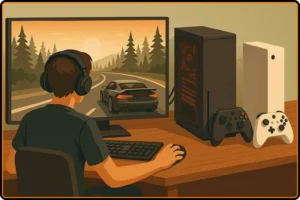
Sitting down in front of a PC has its own kind of anticipation, the kind that settles in your chest before your hands even reach the keyboard. Not the casual, half-asleep “let’s play something” feeling, but that moment when you sit, lean in to the screen, touch the keyboard with your fingers, and already know that something different is waiting for you. Something that’s yours. (Do you feel that moment when, even before clicking, you know you’re about to lose hours, questioning where your social life went?) And even before you click on the game icon, you can feel that the whole thing has its own ritual. It’s not just playing. It’s a relationship. Trust. Sometimes, a little madness. PC gaming has always felt like a kind of quiet magic to me. People who have never sat a few centimeters from a monitor in a dark room, where the only light comes from RGB fans and a flickering HUD, might struggle to understand what exactly pulls you in. Because, let’s be honest, a PC demands more than a console. It demands patience, time, knowing at least the basics about temperatures, drivers, settings, resolutions…and sometimes it even demands your soul when graphics card prices jump as if they were pure gold. I swear, I almost considered auctioning my kidneys online just to afford a decent GPU. Isn’t it wild how digital power can test your moral boundaries? But in return? It gives you a feeling that’s hard to describe without exaggerating a little but at least it’s honest: you’re closer to the action than on any other platform.
The PC Experience: More Than Just Hardware
When you play on a PC, you’re actually playing on something you’ve partly built yourself. It doesn’t have to be a super-expensive build with an RTX 4090 and liquid cooling that looks like a spaceship. Even an average setup works, as long as it’s one you chose yourself you decided which graphics card, what FPS to aim for, how much noise bothers you, whether the case is minimalist or glows like a Christmas tree. It’s intimate. You don’t buy a PC and throw it under the TV like a console. You build it. You nurture it. It might sound silly, but every PC gamer knows that feeling when you power up a new build for the first time and listen to it hum. Will everything boot? Will the BIOS show life? Will Windows install without making you question the meaning of existence? And when all that is done and you open your first game…that’s when the real story begins.
Immersion Through Proximity
People often underestimate just how much being physically close to the screen changes the way you experience a game. On a console, you’re usually slouched back two or three meters from the TV. That’s fine if you just want to relax, but it’s hardly conducive to feeling like you’re in the game. On a PC, proximity isn’t optional it’s essential. I emphasize: you’re here. Right here. No buffer zone. No distance between you and the action. The screen fills your vision in a way a living room setup simply can’t replicate. Sometimes, if you really lean in, you can see individual pixels but somehow, that adds to the magic rather than taking away. Sound works differently too. When most of us use headphones, every footstep, every distant bird call, every rustle of leaves becomes intimate, almost tactile. It doesn’t just come from “somewhere in the room”; it’s all around you. And your hands aren’t resting idly they’re poised over keys or gripping a mouse with a readiness you can feel in your arms. There’s a tension, an alertness that you can’t manufacture from three meters back on a couch. Every click, every swing of a sword, every precise aim is amplified by proximity, giving each interaction a weight and immediacy consoles can’t quite match. Being close also exposes details a TV often swallows. Micro-reflections on armor, the subtle grain of a wooden floor, tiny particles of dust suspended in light all of it becomes noticeable. Even sound cues that would normally disappear into the ambient noise of a living room suddenly become crucial. The wind in a forest doesn’t just blow it whispers. Rain hitting a rooftop doesn’t just patter it drums with purpose. Every layer of the game world becomes richer, denser, more alive. And it’s not just about noticing more it’s about feeling more. You aren’t simply observing; you’re inhabiting. Up close, textures, lighting, and minute details aren’t decoration. They are part of the experience. Shadows aren’t just shadows they have depth. Reflections aren’t just reflections they respond to the world around them. Even environmental effects like fog, dust, or sunlight scattering through leaves hit differently. You’re no longer an outsider looking in; you are part of the ecosystem. The immersion isn’t a side effect it’s the entire point. This proximity changes how you play, too. Reaction times feel sharper because you see more clearly; decisions feel weightier because the world is tangible. There’s no safe buffer, no invisible wall between you and the virtual space. Every mistake, every victory, every tense encounter lands harder. You don’t just play the game—you breathe it, react to it, and for a few hours, it feels as alive as the real world outside your window.
Freedom to Shape Every Frame
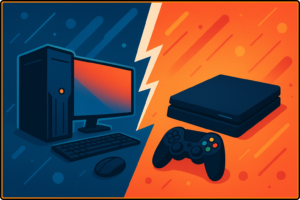
What separates PC from consoles most of all is the feeling that you adjust everything yourself. Consoles give a “preset” experience: performance mode, resolution mode, sometimes a balance between the two. On PC, it’s like being handed the entire control room of a nuclear power plant. It’s not just that you can change everything it’s that you do it because you want the absolute best experience. Want 1440p instead of 4K because you need more FPS? Sure. Want ultra textures but medium shadows? Of course. Want DLSS on quality so the game looks like a painting but still flies above 120 FPS? Go ahead. PC lets you balance the game according to your own idea of “perfect.” And that is an incredibly personal experience.The difference is felt, especially in fast-paced games. High refresh monitors 144 Hz, 165 Hz, 240 Hz, even 360 Hz change how you react, move, and shoot. Not because you’re “better,” but because everything feels faster, more natural, more intuitive. And there’s no “performance mode” on consoles that can beat a properly tuned PC.
Precision and Control Like Nothing Else
One of PC’s greatest strengths, and honestly one of the reasons I keep coming back, is control. Not just graphical control, not just FPS, but actual control over the very feel of playing. High-DPI mice, mechanical keys that click and provide tactile feedback, adjustable cursor weight—these all change the way you experience a game. In an FPS, the difference between a standard controller and a finely tuned mouse with a great sensor is incredible. Every action, every jump, every headshot feels like an extension of your own hands, not something you’re doing through a universal remote. RTS or strategy games? Every click becomes a precise decision, and control over the map is instant and fluid. No compromises. That precision gives you the feeling that every defeat is yours, and every victory is yours. No chance. Just you and your skill. And then there are the so-called “meh” moments. For example, a game that looks perfect on paper, but the AI is so clumsy that sometimes you hit every enemy simply because they failed virtually. On PC, you feel those little things more than on a console. But that’s part of the beauty: you can adjust difficulty, AI modes, and even modify saves through a trainer or mod. No limits, only options.

Visuals That Breathe Life
Graphics on PC aren’t just bigger they breathe. There’s a subtle vitality in modern PC visuals that consoles rarely replicate. When you play a game like Cyberpunk, Elden Ring, or Call of Duty at high FPS with ray tracing enabled, every element reacts dynamically to the world around it. Light falls naturally, shadows shift with intention, reflections respond to movement and environmental changes, and textures behave exactly as they should, with a richness that makes you pause mid-step just to admire it. On a console, the experience is often “close enough,” but PC gaming transforms the visuals into something almost alive, something you step into rather than merely observe. I remember the first time I booted Cyberpunk on max settings. The city sprawled before me, alive with neon glow slicing through fog, reflections rippling across rain-soaked streets, and streetlights glinting off wet pavement with cinematic clarity. I stood there, just watching, letting the world exist around me, because it wasn’t just a game it was a moment, a small performance happening in real time. Every puddle, every flickering sign, even the subtle shimmer on a passing car’s paint demanded attention. It was mesmerizing not because it was perfect, but because it felt real. The lighting, the textures, the movement they weren’t static; they were responsive. Beyond light and shadow, PC graphics offer a tactile connection to the environment. Leaves sway differently depending on wind patterns, water ripples convincingly when disturbed, and even atmospheric effects like fog, smoke, and rain interact naturally with light and surfaces. In Elden Ring, sunlight piercing through mist over the mountains creates a depth and atmosphere that feels palpable; the way shadows stretch across a valley or reflect in a puddle makes the world feel like it has weight. On consoles, these details exist, but they’re often flattened or compressed, losing that visceral effect that makes a world feel alive. Texture fidelity on PC also plays a huge role in immersion. Stone, metal, fabric, and wood all have a tangible quality that consoles can only hint at. You can notice the grain in wooden planks, the scratches on armor, or the subtle imperfections on skin that make characters feel real. Every minor detail adds layers to the world small things that aren’t just visual flourishes, but elements that subtly inform how you react and move within the game. In a survival scenario or tense RPG moment, these details aren’t just decoration they heighten awareness, tension, and engagement. Even dynamic effects like particle systems or volumetric lighting feel alive on PC. Dust swirling in a sunbeam, embers rising from a fire, or fog rolling through a forest aren’t static animations—they’re responsive, evolving, and entirely immersive. In Cyberpunk, the reflections on glass and neon refracted through haze make me forget I’m staring at a screen. In Elden Ring, the interplay of rain, mud, and armor shine gives the impression that the environment exists independently of my actions, yet reacts to them in ways I can feel. Ultimately, PC visuals don’t just let you see the world they let you inhabit it. Every light source, shadow, reflection, and texture collaborates to make the space feel lived-in, reactive, and real. The difference isn’t simply technical superiority; it’s emotional. You don’t just play these worlds you feel them, and that subtle, constant engagement is why immersion on PC has a kind of heartbeat consoles struggle to match.
Customizability and Mods
If you love games but also love making them your own, PC is paradise. Mods aren’t just “changing skins.” They transform the experience. Skyrim can become a photorealistic fantasy, Far Cry can get new campaigns and weapons, and Minecraft turns into an architectural simulator. Every game becomes a playground for creativity. Console gaming? You get a DLC, maybe an update, and that’s it. On PC, every mod, every script, every tweak becomes yours. Want to change color grading, saturation, shaders, weather effects? You can. Want to add your own campaigns, weapons, NPCs? You can. This isn’t just playing it’s expressing yourself. Your ideas, your style, your choices. And then there are the old classics. Sure, you can replay expensive titles on new consoles, but do they let you turn old Half-Life 2 into a photorealistic version? No. PC lets you do that. Every old hit becomes a new experience, and it feels fresh again.
Audio and Atmosphere
Never underestimate the power of sound. On PC, headphones aren’t just an accessory—they’re a portal into the game world. Sound isn’t just music or effects; it’s the very texture of the environment, shaping how you perceive every moment. The rustle of leaves in a dense forest, the distant footfalls of an unseen enemy, the echo of explosions through a canyon, the subtle drip of water in a cave all of it becomes a living, breathing component of the experience. On consoles, sound is often compressed, flattened, or limited by speaker quality, losing nuance and spatial depth. On PC, every frequency, every whisper, every micro-detail tells a story and demands attention. What makes this truly special is how audio interacts with proximity. Sitting close to the screen, with headphones that separate channels cleanly, transforms ambient noises into directional cues. In a stealth RPG or survival game, I can tell whether a patrol is approaching from the left or right, or whether a creaking floorboard above signals danger. These aren’t just gameplay advantages they’re immersion enhancers. The world reacts, and you feel it in a way that’s hard to replicate with a controller in your lap two meters away. PC soundscapes also excel with subtle environmental layering. Rain hitting cobblestones in an open-world RPG resonates differently depending on nearby surfaces; footsteps crunch differently on dirt, gravel, or metal; distant thunder rolls in a realistic, unpredictable way. Music and dialogue don’t just exist on top of the environment they interweave with it, giving weight and emotion to every scene. A city street in Cyberpunk feels bustling and alive not just visually, but aurally: chatter, cars, sirens, neon hums all overlapping, all dynamic. Even simple games feel “alive” on PC because audio reacts and adapts to player action. Your presence changes what you hear, making exploration and decision-making feel consequential. In horror or suspense RPGs, that subtle creak or whisper can make the difference between calm curiosity and heart-in-throat tension. On consoles, the same effect is often dulled; you hear it, but you don’t feel it as an extension of the game world. I’ll admit it this is one of the reasons PC gaming feels deeper. Maybe it’s technical superiority, maybe the placebo effect of leaning in, but when I sit with a high-end sound card, quality headphones, and a rich audio engine, I feel every heartbeat, every gust of wind, every tremor in the world around me. Sound isn’t just a layer it’s a lifeline connecting me to the game, and on PC, that connection is intimate, intricate, and incredibly hard to leave behind.
Longevity and Upgrades
PC isn’t static. Consoles are almost always fixed until the next generation, their hardware locked and unchangeable, leaving you waiting years for meaningful improvements. A PC, on the other hand, grows with you. A new graphics card, a faster CPU, extra RAM, or even a better SSD doesn’t just make your rig run smoother it transforms how you experience every game you own. The upgrades aren’t just technical; they’re emotional. Each new component feels like a milestone, a reward, a chance to rediscover familiar worlds with fresh eyes. And it’s not just about performance. A PC library is alive. Old classics get new life through mods, graphical overhauls, and gameplay tweaks. I’ve taken games from 2010, patched them with texture packs, added lighting mods, or even entirely new quests, and they looked and felt better than any version I could play on a brand-new console. That sense of continuity is rare, almost magical: you don’t lose your history when hardware advances; instead, your old favorites evolve alongside your machine. The flexibility is liberating. Want to replay Skyrim with hyper-realistic textures, a fully revamped weather system, and smarter AI? Done. Want to revisit a turn-based strategy game from a decade ago with custom maps, UI improvements, and multiplayer tweaks? Easy. On a console, you’re bound to whatever the developers shipped, but a PC lets you rewrite the experience, layer by layer, for as long as you want. Beyond performance and mods, there’s the satisfaction of growth. Every upgrade is a choice, a personal statement. It’s yours. You didn’t just buy a system; you nurtured it. That bond adds an emotional layer to gaming. When I load an old RPG or action title on my updated rig, I feel the evolution the game is the same, but I am different, and the machine bridges that gap. Investing in a PC isn’t just money it’s experience, relationship, and lasting satisfaction. It’s about watching worlds mature with you, revisiting them in ways that consoles, with their rigid cycles, simply can’t replicate. Every upgrade, every mod, every tweak is a dialogue with the game, with the past, and with yourself. That’s longevity you can touch, see, and feel.
RPG Adventures and Personal Preference
I have to admit, when I play, RPGs are my go-to choice. There are FPS games that are technically impressive, sure, but nothing replaces the feeling of your character growing, of your decisions truly carrying weight, and of every quest leaving an impact. On PC, that feeling is even stronger. Every RPG I’ve played whether it’s The Witcher 3, Divinity: Original Sin 2, Baldur’s Gate 3, or the RPG segments of Cyberpunk has given me a level of control and personalization that consoles simply can’t replicate. On paper, The Witcher 3 is fantastic even on console, but when you run it on PC with mods for better textures, enhanced lighting effects, and gameplay tweaks, you feel like every step Geralt takes is your own choice. The same goes for Divinity: Original Sin 2, where every decision, every skill point, every dialogue shapes the experience. On PC, I have complete freedom to adjust difficulty, AI behavior, the camera, even the interface. On console, you’re limited to what the developers imagined for the “average player.” And honestly, I’m not average. I want more. I want layers. I want control. RPGs on PC aren’t just games; they’re worlds that respond to you in ways consoles rarely allow. On paper, it looks great, but when you sit down and play, you realize every detail matters. From character customization and inventory management to subtle graphical tweaks that change the atmosphere it’s all part of the experience. And let’s not forget mods. Older RPGs can gain entirely new storylines, fresh quests, or extra layers of interaction with NPCs. On consoles? That’s nearly impossible.
Modding: Breathing New Life into RPGs
Take this scenario: Elder Scrolls IV: Oblivion. Originally, it was a solid game for its time, but the textures were dull, AI sometimes clunky, and combat simple. I launched it on PC, added a few graphics mods, a couple of AI and quest mods, and the experience became completely different. Every step in the castle, every conversation with an NPC, every dungeon crawl took on a new dimension. This isn’t a trick. It’s an experience consoles just can’t replicate. Or consider Divinity: Original Sin 2. Every skill point, crafting recipe, and moral decision carries weight when playing on PC. I can adjust the number and strength of enemies, custom maps, even multiplayer scenarios I want to experiment with. This isn’t just flexibility; it’s creative freedom. PC gaming allows me to see the game not just as a finished product, but as a living world I can step into and shape.
Immersion, Atmosphere, and Roleplay
You know that moment when you start a game, sit at your monitor, put on your headphones, and feel like the world exists independently of you? PC RPGs take that sensation and magnify it in ways consoles rarely achieve. Every shadow in the Witcher world, every gust of wind across Skyrim’s mountains, every carefully written line of dialogue in Baldur’s Gate—they all become threads in your personal story. You’re not observing; you’re embedded, fully present, and the world reacts to your choices in real time. It’s a sensation that feels organic, almost fragile, like stepping into a living diorama where every movement and decision has consequence. Even the smallest details contribute. Minor NPC animations a blink, a subtle shift in stance, the slight pause before dialogue carry meaning. Footsteps echo differently on stone than wood. The clang of a sword ringing through a castle hall resonates in a way that makes you feel its weight. Environmental sounds, when heard through quality headphones, transform. A distant waterfall doesn’t just signal location; it establishes atmosphere. The whistling of wind through treetops isn’t background filler it shapes your sense of presence. On a console, many of these nuances are flattened or lost entirely, leaving you “watching the game” rather than living inside it. PC RPGs also enhance roleplay in ways that go beyond visuals and sound. I can tweak camera angles, adjust field of view, or even modify HUD elements to suit my playstyle, creating an experience that feels uniquely mine. Dialogue choices carry a deeper emotional weight when the game world feels alive around you. Combat decisions, stealth maneuvers, or even simple exploration feel like deliberate, personal acts rather than predefined sequences. Every action, no matter how small, contributes to a sense of ownership and responsibility over your journey. And then there’s the cumulative effect of all these elements combined: lighting, sound, movement, detail, and choice. Together, they create a feedback loop that draws you in further with every hour played. You’re not just controlling a character you’re inhabiting a living ecosystem, reacting, adapting, and feeling consequences in ways consoles struggle to replicate. That’s why, when I play RPGs on PC, I often lose track of time entirely. It’s immersion without compromise, a total surrender to a world that respects and responds to me.
Performance and Technical Flexibility
We can’t ignore the technical advantages. On PC, the ability to adjust frame rates, resolution, graphics settings, and even physical simulations is a huge plus, especially for RPGs. High FPS on a 144Hz monitor or ultrawide setup changes how I react to in-game situations. Practically every hit, every sprint, every battle feels more alive, more precise. And it’s not just about FPS or 4K. It’s about mixing everything: ray tracing, ambient occlusion, volumetric fog, HDR, high-res textures. RPGs that rely on atmosphere and visual storytelling gain an entirely new dimension. When I see light filtering through the forests in Witcher or sunlight glinting off Skyrim’s mountains, I feel like I’m really there. And this isn’t just an impression it’s a real sense of presence.
The Long Game: Library and Upgrades
Another thing I love: the library. On PC, every game I’ve ever bought or downloaded remains accessible. An old classic from 2007 can look better than when I first played it, thanks to mods and graphic updates. Consoles, even with backward compatibility, don’t offer this freedom. And when you love RPGs, where every quest matters, every world is layered, this is crucial. My collection of Baldur’s Gate, Divinity, and Witcher games grows and transforms every year. Every upgrade or mod is an opportunity to replay a game and experience it in a completely new way. There’s no other medium that offers such continuity and depth.
Conclusion
PC gaming isn’t perfect. Sometimes drivers break, sometimes updates mess up settings, sometimes a game won’t run immediately. There are moments of frustration, sure like chasing a stubborn mod conflict, waiting for a patch to fix a bug that shouldn’t exist, or realizing your high-end rig still struggles with a badly optimized title. But in the grand scheme, these annoyances are tiny, almost affectionate reminders that you’re part of something bigger: a world that you can shape, influence, and truly inhabit. What you get in return is extraordinary. Control over every aspect of your experience from framerate to graphics, from keybinds to AI difficulty is unmatched. Immersion becomes tangible. A high-resolution world, combined with precise input and rich audio, makes every quest, every battle, every story beat feel immediate. You don’t just play you live, you adapt, you react. In RPGs, that feeling is amplified: your choices matter, your character evolves in ways that feel genuinely personal, and every exploration uncovers something new that consoles simply can’t deliver with the same depth. I remember the first time I launched Elden Ring in 4K with DLSS and HDR. On paper? Just graphics and FPS. But the moment I stepped into that world, it was like someone had peeled back the barrier between imagination and reality. Every shadow, every rustle of leaves, every distant howl felt alive. The world didn’t just exist it acknowledged my presence. I wasn’t merely a player; I was a part of it. And that’s the magic of PC gaming: it rewards patience, curiosity, and care. It lets you explore without restriction, tweak without fear, and experience stories with a depth that consoles often simplify. PC gaming is closer, deeper, and more personal. It’s not perfect, but its imperfections are part of its charm they remind you that this is your journey, shaped by your choices and creativity. The freedom to upgrade, mod, and personalize ensures your experience is never static. Once you’ve felt that level of immersion, that sense of agency, and the thrill of playing an RPG where every decision has weight, going back to a console feels like stepping through a fogged window: you can see the world, but you’re no longer inside it. In the end, PC gaming is more than a platform it’s a craft, a hobby, and for those of us who love RPGs, a portal into endless worlds where the story isn’t just written it’s lived. And honestly? Once you’ve tasted it, there’s no turning back. And let’s be honest, trying to play Skyrim on a console after that feels like trying to eat soup with a fork. Painful, messy, and slightly humiliating.