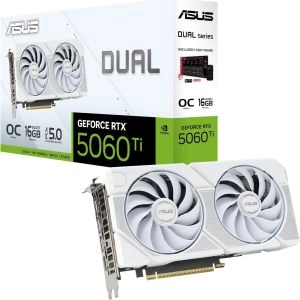
REVIEW | ASUS DUAL GEFORCE RTX 5060 Ti 16GB | WHITE COOL, QUIET & ALMOST TOO SAFE
A product that lives somewhere between brilliance and mediocrity carries its own strange charm, the kind that makes you hope quietly that it might just exceed its reputation. You know, that middle space where expectations aren’t sky-high, but you still secretly hope the thing will surprise you. The ASUS Dual RTX 5060 Ti 16GB White feels exactly like that kind of component. A card that doesn’t scream for attention but still walks into the room dressed in clean white, pretending it didn’t spend the whole morning in front of the mirror. And somehow, that combination of understatement and confidence makes it strangely likeable right from the start. Before I even dive deep, I’ll be straightforward in the tone I always take: this is not a card that’s pretending to revolutionize gaming. It’s not here to make the 4090 nervous or make tech channels redefine benchmarks. But it is a GPU that tries to offer a smooth, visually pleasant experience for people who want to game comfortably, create content occasionally, and have a system that doesn’t melt steel beams just by existing. On paper, the 5060 Ti hits a sweet balance between efficiency and performance; in practice…well, that’s what this text is about. And yes, I’ll say it right away: based on everything I’ve researched, compared, and pieced together the 90/100 score feels justified. So let’s take this step by step, in a way that’s not trying to impress you with buzzwords but trying to actually explain what this card feels like, what it aims to be, and what it manages to deliver.
Design, Build, and First Impressions
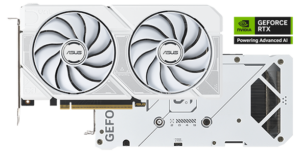
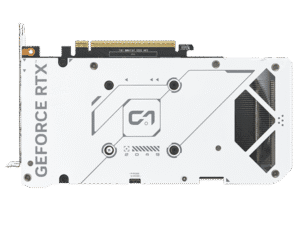
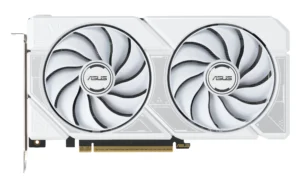
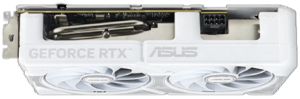
The first thing you notice, obviously, is the white finish. It’s clean, minimal, almost too polite for its own good. ASUS took its usual Dual-series design and essentially bleached it into something that blends effortlessly into white-oriented setups. The shroud has those slightly industrial, slightly futuristic grooves that don’t pretend the card is from another planet just that it was assembled by someone who cares about aesthetics a bit more than usual. The Dual series is known for being on the smaller side relative to the big triple-fan monsters out there. And yes, that holds true here: the card isn’t overly long, doesn’t sag like a depressed bridge, and doesn’t demand a power supply that costs as much as your motherboard. For mid-tower cases or compact builds that still want air without sacrificing airflow, this is one of the few cards that strike a balance. The two Axial-tech fans do what they’re supposed to. They’re not oversized “let me lift your house off the ground” fans, but they push enough air and stay reasonably quiet unless you’re doing something that makes your whole system sweat. What I like about the design is that ASUS didn’t try to fake premium through fake chrome or exaggerated lines. It’s just…clean. And that, for me, always works. The backplate is metal (not cheap plastic pretending to be metal), sturdy enough to prevent flexing, and visually matches the white aesthetic. Not too busy, not too plain that sweet spot again. If you’re the type of person who stares through a side panel window while waiting for a game to load, this is the kind of GPU that at least doesn’t make you regret your purchase every time you look at it.
Performance in Modern Gaming
This is where the 5060 Ti shows what it intends to be: a 1080p and 1440p performer with some small ambitions towards lighter 4K workloads. It’s not the kind of card that pretends DLSS will magically transform it into a flagship, but it does benefit from the upscaling tech in the areas where it matters mainly stabilizing frame rates and keeping things consistent. At 1080p, the card handles almost everything that’s considered “modern mainstream” without much trouble. Competitive titles run extremely well, even at higher settings, and the headroom provided by 16 GB of VRAM helps in avoiding those micro-hiccups that you get when games start streaming large textures. The extra memory doesn’t just look good on a spec sheet; in certain games, it genuinely keeps things smoother during long sessions. 1440p is a more interesting conversation. The 5060 Ti can manage it, yes, but not always effortlessly. You’ll often be tweaking settings, lowering shadows, turning off three useless ray-traced reflections you won’t see anyway…that kind of thing. But once you settle on a configuration that fits your taste, the gameplay is pretty comfortable. Single-player titles absolutely benefit from the card’s VRAM and bandwidth; competitive shooters prefer lower resolutions or lowered settings. Nothing surprising there. Ray tracing performance is…well, let’s just say it exists. Not in a tragic way, but in a “use it only when it makes sense” way. The card doesn’t melt or stutter, but it definitely reminds you that ray tracing is still a playground for higher-end GPUs. Thankfully, DLSS helps enough to keep things under control in the titles that support it. If I had to summarize the real-world feeling of using this GPU for gaming, I’d describe it like this: It feels like a card that respects your time. It doesn’t try to show off, doesn’t pretend to be something else, but it gives you stable, predictable output in situations where you just want to sit down and enjoy a game without babysitting your settings every five minutes.
Thermals and Noise
Now, this is where the card’s more modest design could’ve turned against it but surprisingly, it doesn’t. The dual-fan design holds up well under load, and temperatures stay in that comfortable mid-70s range even during extended sessions. The fans ramp up slowly, don’t suddenly spike, and overall the cooling feels balanced. The card is not silent. Don’t expect a miracle there. But it is controlled the kind of noise level where you notice it if your room is completely quiet, but it blends into background noise when you’re gaming, listening to music, or doing anything else. For people who care about acoustics: no weird coil whine screams, no sudden turbulence noises. Slight electrical buzz at very high FPS? Sure, but that’s almost universal for modern mid-range GPUs. Thermally, ASUS did what it always does with Dual models: made a cooler that doesn’t pretend to outperform physics but uses what it has efficiently. And honestly, that’s enough.
Productivity, Workloads, and Everyday Use
This is the part that often gets ignored when people talk about mid-range GPUs, but trust me, it matters. Many people buying cards like the 5060 Ti aren’t just gamers; they’re students, creators, freelancers, or professionals who rely on their GPU for acceleration in software like DaVinci Resolve, Blender, Photoshop, Premiere Pro, etc. The 16 GB of VRAM helps significantly here. It’s not a gimmick it genuinely improves stability in GPU-heavy workloads that require large buffers. Video editing, high-resolution renders, large AI-assisted operations (image scaling, project previews, filtering)…all of these run smoother than what you’d get on a lower-memory card. Rendering performance is above average for its class. It’s not touching the high-end tier, but it lands in a comfortable position where it feels capable without begging for mercy. Everyday usage browsing, multitasking, office apps, Windows animations is obviously effortless. This category isn’t worth dwelling on, but I’ll just say this: the card feels like a component that plays nice with everything.
Power Efficiency and System Requirements
This is one thing NVIDIA genuinely nailed with this generation. The 5060 Ti isn’t power-hungry, doesn’t spike randomly, doesn’t demand a 1000W PSU for absolutely no reason. A decent mid-range power supply handles it easily. Its efficiency-to-performance ratio is one of the card’s biggest strengths. You get solid frame rates without your system sounding like it’s trying to take off into orbit. Temperatures stay reasonable largely because the card doesn’t consume high amounts of energy in the first place. It’s the kind of GPU that slips into almost any existing setup without forcing you to upgrade half your components. And honestly…that’s refreshing.
The White Edition: Aesthetics and Practicality
Let me dedicate a moment to the white version specifically. White components can be a gamble. Some look elegant, some look cheap, and some turn yellow after six months like a smoker’s fingernails. ASUS usually makes good white components, and this one continues that tradition. The coating feels durable and doesn’t look like it will discolour easily. In builds where the theme is white-black, snow-white, icy-blue, or RGB-heavy, this GPU blends in beautifully, almost like it was sculpted to complement any light or pastel tone you might be aiming for. It doesn’t just sit in the case it elevates the whole interior, turning what could be a simple setup into something that looks more considered, more polished. The shroud’s curves and fan accents catch the light in a way that makes the GPU feel substantial yet refined, and subtle reflections on the edges give it a quiet elegance that contrasts nicely with the often aggressive aesthetics of high-end components. The only downside of white components? Dust. Every small particle stands out like it’s waving a tiny flag. But if you’re the kind of person who builds white PCs, you’re probably already brushing your case more often than your hair, so it balances out. In short, this isn’t just a functional piece of hardware it’s a visual centerpiece that makes the entire build feel more premium and cohesive without screaming for attention.
Strengths and Weaknesses in the Bigger Picture
The 5060 Ti lands in an interesting position in the GPU market. It’s neither a “budget savior” nor a “performance king.” It’s that quiet middle child trying to do everything reasonably well gaming, content creation, thermals, power efficiency, aesthetics and somehow managing to deliver stability across the board. But it’s not without flaws. The pricing can sometimes feel inconsistent depending on region and availability. Some expectations tied to “Ti” branding are not fully met in heavier workloads. And ray tracing is clearly limited no sugarcoating that. Still, in overall day-to-day usage, the card feels competent, steady, and reliable. It’s not a card that excites you with insane peaks; it’s a card that reassures you with consistency.